


Green Scent Bottle
A green scent bottle brings rich colour and tactile weight to a dressing table, combining functional perfume storage with decorative metalwork.
Green Scent Bottle
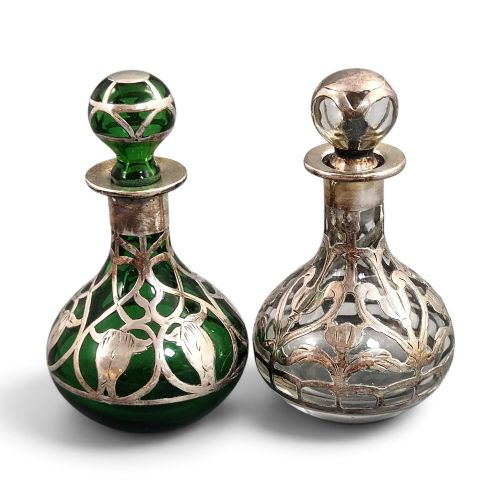
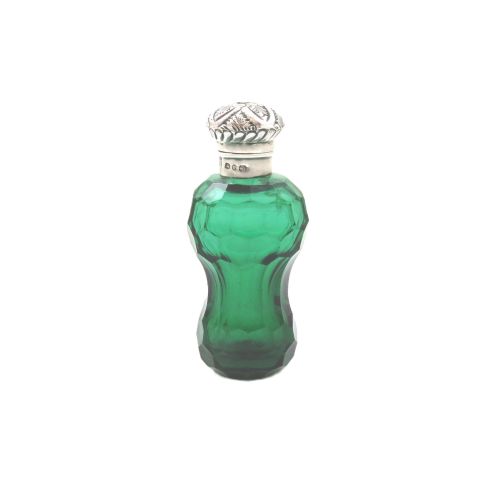
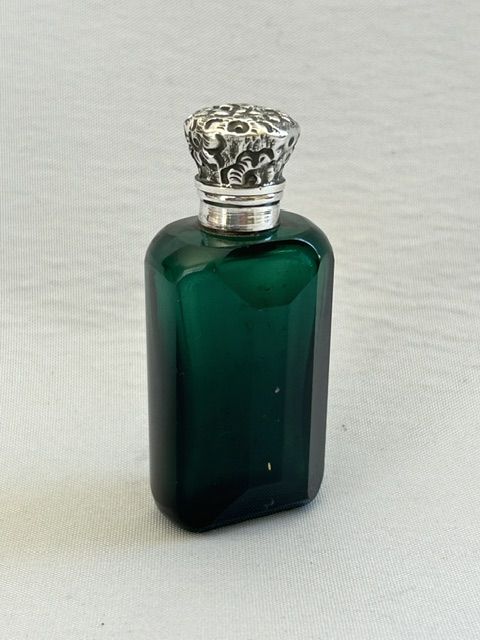
A green scent bottle is a compact vessel designed to hold perfume, dressing oils or smelling salts, frequently fitted with a hinged cap or screw lid. These items appear primarily in Victorian, Edwardian and Art Deco forms, ranging from modest pocket versions to substantial dressing table fittings.
The materials span deep Bristol green glass, vaseline glass and layered overlay glass, often paired with sterling silver mounts or intricate enamel work. Collectors encounter both English and continental European pieces, including characteristic Bohemian overlay designs and French glassworks.
Manufacturing Methods
Glassmakers utilised mould-blowing, free-blowing and cased overlay techniques to achieve rich green hues, sometimes cutting back outer layers of glass to reveal contrasting clear or white strata beneath. The resulting bodies were frequently polished by hand to sharpen the facets and soften the pontil scars.
Silversmiths and metalworkers then shaped sterling silver, silver gilt or bronze mounts, securing them to the glass necks with specialised adhesives or threaded collars. Many lids received hand-engraved monograms, repoussé decoration or guilloché enamel applied across engine-turned bases.
The archive includes delicate Chinese Peking glass alongside heavy Bohemian overlay specimens from the Victorian era.
Factors of Quality
Quality rests heavily on the depth and clarity of the green glass, alongside the precision of any external overlay cutting. Sharp, clean facets on a Bohemian or Bristol glass body demonstrate superior execution compared to soft or blurred moulding.
The integrity of the metal mounts and stoppers dictates value, particularly where inner glass stoppers survive intact alongside the outer silver cap. Maker marks from established silversmiths or renowned glass houses elevate the standing of a piece within the broader archive.
Gorham·Jacob Petit·Macintyre·Henry Perkins·Karl Palda·René Lalique·Hermanova·Mappin And Webb·Sampson Mordan·Henry Matthews·Greenberg And Co·The Mousley Brothers·J Grinsell And Sons·Richard Comyns·Charles May·Saunders And Shepherd·William Hutton And Sons·Moser
The Green Scent Bottle Glossary
- Bristol Green
- A deep, saturated tone of alkaline green glass produced in English factories during the nineteenth century. It provides the backdrop for many silver-mounted Victorian perfume bottles.
- Overlay Glass
- A method where a layer of coloured glass is fused over a clear or contrasting inner body before being partially cut away. This technique creates high-contrast geometric or floral patterns.
- Guilloché Enamel
- A decorative technique where translucent enamel is layered over machine-turned metalwork. It produces repeating geometric patterns visible beneath the coloured glaze.
- Vaseline Glass
- A yellowish-green glass containing uranium dioxide that glows under ultraviolet light. It appears in various Victorian and Edwardian scent containers.
- Double-Ended
- A symmetrical bottle featuring hinged caps at both extremities, designed to hold two different liquids or salts simultaneously. They were popular pocket accessories during the Victorian era.
Green Scent Bottle: Frequently Asked Questions
What are double-ended scent bottles?
Double-ended bottles feature a compartment at each end, allowing a user to carry two distinct scents or smelling salts in a single pocket item. They were widely produced during the Victorian period with hinged silver caps on both sides.
These pieces required careful balance so that neither cap leaked its contents while stored horizontally. They remain distinct collectible items due to their complex internal glass structure.
What is vaseline glass?
Vaseline glass is a distinct type of pressed or blown glass containing small amounts of uranium dioxide, giving it a characteristic yellow-green tint. In daylight, it has a translucent greasy lustre that inspired its common name.
These items react under ultraviolet light by emitting a bright green fluorescence. Victorian manufacturers utilised this material extensively for decorative vanity sets and scent flasks.
How are stopper replacements handled?
Original inner glass stoppers are remarkably scarce because they were easily misplaced or broken during daily use over the decades. Finding a bottle that retains its matching internal stopper significantly affects its historical completeness.
Many surviving pieces function purely with their outer silver screw cap or hinged lid acting as the primary seal. Collectors often prioritize matching stoppers when assessing the overall integrity of an antique flask.