


Green Gemstone Studs
Green gemstone studs bring a focused flash of colour to the earlobe, ranging from the deep forest tones of emerald to pale oriental jadeite.
Green Gemstone Studs
When you search for green gemstone studs, you encounter a selection of earrings featuring stones such as emerald, jade, jadeite, chalcedony, peridot, opal doublet, bloodstone and andalusite. These pieces span periods from the 1930s and 1950s through to contemporary and later than 1960 designs, offering a variety of expressions in both simple mountings and clustered settings.
The version you are most likely to meet on this page is a mid-century piece from the 1950s, frequently cast in 9ct or 14ct gold and set with emeralds or jade. Styles range from straightforward studs to drop earrings and cluster arrangements incorporating diamonds. Whether you prefer the translucent quality of jadeite or the intense saturation of an emerald, these earrings present numerous ways to wear green stones.
Materials and construction
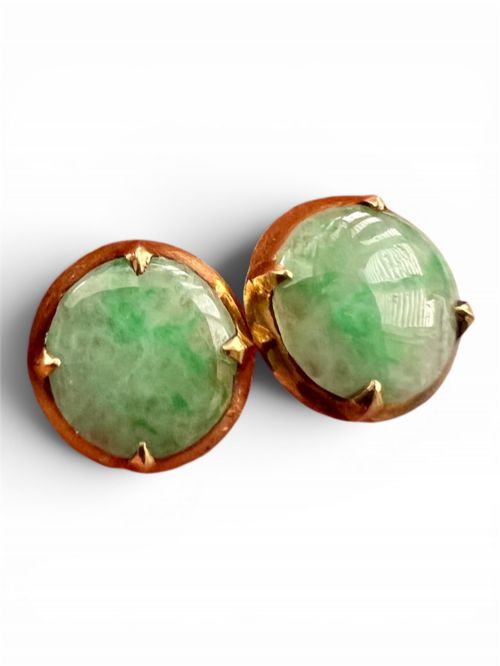
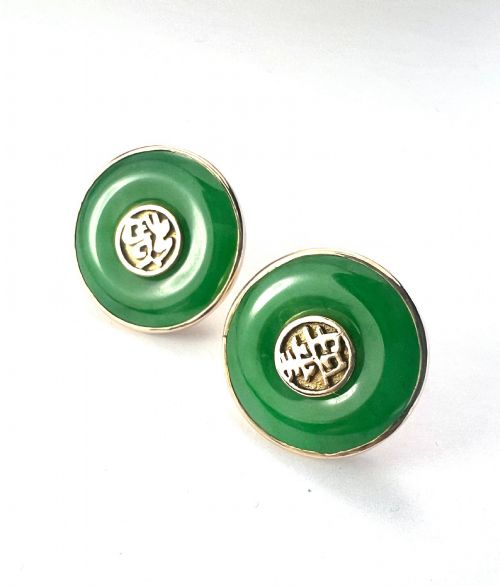
Gold forms the primary metal foundation for these earrings, appearing in 9ct yellow gold, 14ct gold, 14ct white gold, and 18ct gold. Stones are secured in settings that highlight the natural character of each mineral, whether through claw mounts holding faceted gems or polished bezels enclosing smooth jade toruses and cabochons.
Many designs incorporate secondary stones to frame the central green gemstone, most notably diamonds arranged in clusters or halos around emeralds and opals. The craftsmanship adapts to the specific physical properties of each material, ensuring that softer stones like jadeite or chalcedony receive appropriate support from the metalwork.
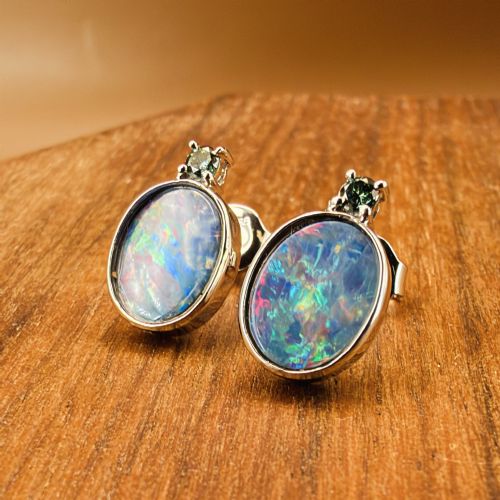
Some mid-century makers decided that a simple gold setting simply wasn't enough, adding teal diamonds to an opal doublet just for fun.
Factors of quality
The distinction between tiers of quality rests largely on the depth of colour and clarity inherent in the primary green gemstone. An emerald with vibrant saturation and good crystal structure commands greater regard than a heavily included or muted stone, just as a richly coloured jadeite exhibits superior visual presence.
Workmanship in the gold mount and the precision of the diamond halo setting also dictate the standard of a pair. Heavier gauge gold and secure, balanced claw work elevate a pair of earrings above lighter, mass-produced settings from the same period.
The Green Gemstone Studs Glossary
- Emerald
- A green variety of beryl coloured by traces of chromium and vanadium. It appears frequently in cluster settings alongside diamonds.
- Jadeite
- One of the two distinct mineral species recognised as jade, prized for its translucence and vitreous lustre. It is typically cut as cabochons or carved toruses in vintage pieces.
- Cluster
- An arrangement of smaller gemstones surrounding a larger central stone. This layout maximises the overall brilliance and presence on the ear.
- Opal doublet
- A composite stone made of a thin slice of opal glued to a darker backing material to enhance its play of colour. They appear paired with teal diamonds in mid-century designs.
- Cabochon
- A gem polished to a smooth, convex surface rather than faceted. This cut is common for opaque or translucent green stones like jade and chalcedony.
Green Gemstone Studs: Frequently Asked Questions
How do I clean vintage green gemstone studs?
Most gold and gemstone earrings tolerate gentle cleaning in warm, soapy water with a soft brush. Care must be taken with organic or softer materials like jadeite, pearls, and opals, which can be sensitive to harsh chemicals or ultrasonic cleaners.
Ensuring the settings remain secure after washing preserves the longevity of the piece. Avoid soaking glued composite stones like opal doublets in water for extended periods.
Are these earrings suitable for daily wear?
Gold and harder gemstones like diamond and emerald handle regular wear well when set securely. Lighter gold alloys and durable stud designs make them practical choices for everyday adornment.
Consider the specific stone type when planning frequent use, as softer minerals require more mindful handling during insertion and removal.
What periods do these green earrings represent?
The pieces span several decades, featuring items from the 1930s, 1940s, 1950s, and later than 1960. Mid-century aesthetics and earlier revival styles dominate the selection.
Each era brings distinct metal choices and setting techniques, from Art Deco influences to the bolder cluster forms of the 1950s.
How can I tell a jadeite stud from chalcedony?
Jadeite possesses a characteristic fibrous micro-structure and a cool, dense feel that distinguishes it from other green stones. Green chalcedony often presents as a uniform translucent quartz with a slightly different lustre.
Examining the stone under magnification helps reveal the internal grain unique to jadeite.