
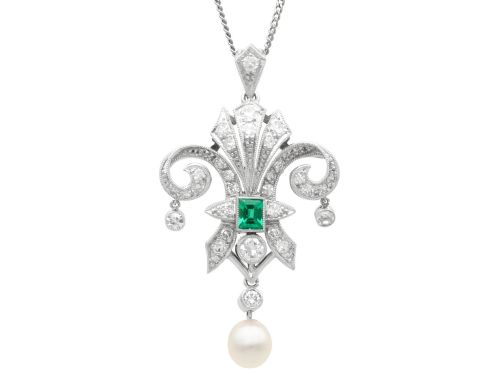
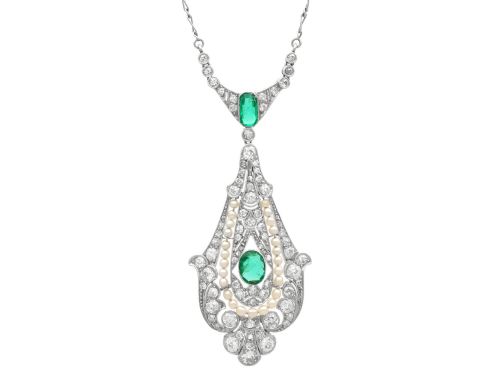


Green Emerald Necklace
A green emerald necklace brings centuries of rich verdant colour to the neckline, spanning Georgian paste to mid-century modern diamond settings.
Green Emerald Necklace
When you search for a green emerald necklace, you encounter everything from Georgian rose gold rivière sets to Art Deco platinum and diamond pieces. The selection includes pendant necklaces, drop neckchains, and convertible brooch pendants spanning the Victorian and Edwardian eras.
The version you are most likely to meet on this page combines emerald stones with diamonds in yellow gold, platinum, or silver settings. These pieces range from delicate single-strand seed pearl combinations to substantial multi-carat centre stones.
Pieces originating from French workshops and Austro-Hungarian makers sit alongside British Victorian and mid-century designs. Each period brings distinct mounting techniques and stone cuts to the form.
How they were made
Metal selection evolved from early silver and rose gold settings to 15ct and 18ct yellow gold, eventually reaching platinum and white gold in twentieth-century examples. Goldsmiths mounted stones using closed-back foils in early periods before transitioning to open-backed collet settings that allowed light to pass through.
Gemstones were paired with supporting diamonds, pearls, or green paste to enhance the visual impact of the central green emerald. Hand-forged links and articulated drops allowed rigid metalwork to drape smoothly against the skin.
Listings feature emerald pieces mounted in sterling silver, yellow gold, white gold, and platinum across the Victorian, Edwardian, and Art Deco eras.
What varies in quality
The clarity and saturation of the emerald dictate the visual presence of the piece, alongside the brilliance of any accompanying diamonds. Natural gemstone certification, such as distinctions for Zambian or Columbian origins, separates standard stones from exceptional specimens.
The integrity of the original metalwork, including the survival of period clasps, pin stems on convertible brooches, and undisturbed claw settings, influences the standing of the piece. Matching stone cuts and uniform wear across the links demonstrate careful original assembly.
The Green Emerald Necklace Glossary
- Rivière
- A necklace composed of a continuous sequence of gemstones of graduated or uniform size, typically individually bezel-set. This style sits closely around the base of the neck.
- Collet
- A band of metal that holds a gemstone in place by being pushed over the edge of the girdle. This secure setting style is characteristic of antique manufacturing.
- Brooch pendant
- A versatile piece of jewellery fitted with both a folding bail for suspension on a chain and a pin mechanism for wear as a brooch. This dual function was particularly popular during the Victorian era.
- Drop neckchain
- A necklace featuring a suspended central element or pendant that hangs below the main collar line. These pieces often showcase a principal emerald accented by smaller diamonds.
Green Emerald Necklace: Frequently Asked Questions
How do I date an antique emerald necklace?
Dating relies on examining the metal alloys, such as rose gold or platinum, and the specific stone-cutting techniques used in the mounting. Setting styles like closed-back foils point toward Georgian origins, while geometric platinum work indicates the Art Deco period.
Examining the clasp construction and chain links provides further clues. Hand-beaten components and integrated box clasps help narrow down the decade of manufacture.
What is green paste in antique jewellery?
Green paste is a heavy, high-refractive glass shaped and polished by hand to imitate genuine emeralds. In the eighteenth and nineteenth centuries, artisans valued paste for its intense coloration and ability to be moulded into complex designs.
These glass stones were frequently foil-backed to catch and reflect light from within the setting. They represent a distinct lapidary tradition rather than a modern imitation.
Can I wear an antique emerald necklace daily?
Emeralds have a moderate hardness and natural inclusions that require mindful wear, particularly with antique claw settings. Gentle handling prevents impact damage to fragile stones and delicate gold or silver links.
Storing the piece flat in a lined box protects the softer stones and pearls from scratching against other items. Regular inspection of the settings helps secure the gems over time.