

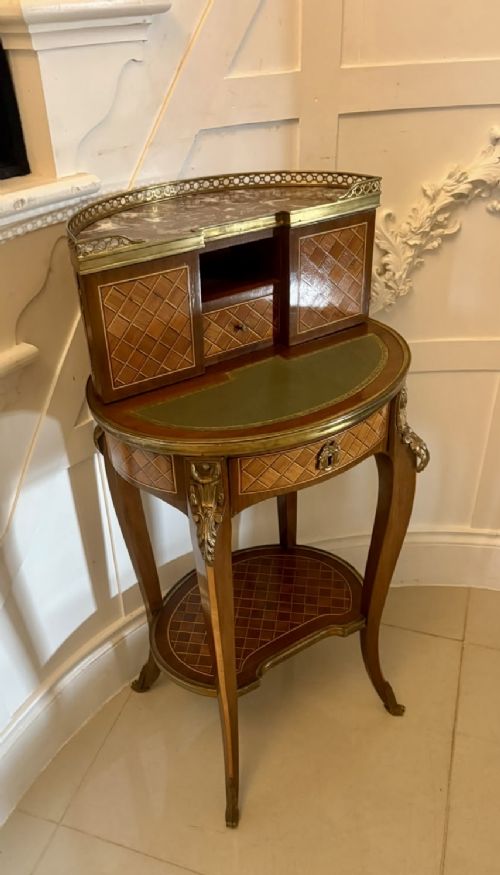


Green Secretary
A green antique secretary brings together rich timber and fitted writing compartments, offering a working surface that conceals your papers with understated elegance.
Green Secretary
When you search for green antique secretary, you encounter a selection of historic writing furniture, including secretaire bookcases, bureau cabinets, and compact writing desks. These pieces originate from various periods such as the Georgian, Victorian, and Edwardian eras, reflecting changing domestic habits and writing needs over centuries.
Mahogany and oak serve as the primary foundational timbers for these desks, whilst satinwood, kingwood, and walnut appear in more decorative or continental examples. You will frequently find fitted writing compartments featuring pigeonholes, small drawers, and tooled leather inserts designed for correspondence.
The assortment spans from substantial library bookcases with secretaire drawers to smaller lady's writing tables and bonheur du jour desks. Each form provides a dedicated space for penmanship and storage, combining practical function with period craftsmanship.
Materials and Construction
Cabinet makers utilised dense hardwoods like mahogany and oak for structural integrity, often incorporating finer timbers such as satinwood and kingwood for decorative veneer work. Parquetry and crossbanding techniques create geometric patterns across writing surfaces and drawer fronts.
Brass handles, escutcheons, and occasional ormolu mounts provide functional hardware and decorative contrast against the dark wood tones. Writing surfaces frequently feature inset panels of tooled leather, offering a durable texture for writing.
Green Secretary Retail Price Guide 2026
Typical asking prices for green secretary among the pieces listed under this phrase on Sellingantiques today, from the lower quarter to the upper quarter. They describe what is for sale here now, not the wider market.
Listings feature pieces spanning the Georgian, Victorian, and Edwardian eras, constructed from mahogany, oak, satinwood, and kingwood.
Factors of Quality
The fineness of the interior cabinetry sets superior examples apart, particularly in the complexity of internal pigeonholes, secret compartments, and small drawers found behind a drop-front desk. Secondary timbers and the precision of drawer dovetailing reveal the care taken by the cabinet maker.
The choice of decorative veneers, such as figured mahogany or intricate kingwood parquetry, dictates the visual impact of the piece. Ormolu mounts and well-cast brass hardware further distinguish high-grade examples from standard utilitarian desks.
Gamichon A Paris·Druce & Co.
The Green Secretary Glossary
- Secretaire
- A piece of furniture containing a built-in writing drawer or fold-down writing surface. This flap conceals an interior arrangement of small drawers and pigeonholes.
- Bonheur du jour
- A light lady's writing desk originating in France, typically featuring a small cabinet or shelving superstructure above the main writing surface.
- Davenport
- A compact form of small writing desk featuring a sloping, hinged writing surface and a bank of drawers to one side.
- Parquetry
- A geometric mosaic of wood pieces used for decorative floors and furniture veneers. It relies on contrasting colours and grain patterns of timbers like kingwood and satinwood.
- Ormolu
- Gilded bronze used for decorative mounts on furniture, particularly prominent on French desks from the nineteenth century.
Green Secretary: Frequently Asked Questions
What is a green antique secretary?
A green antique secretary refers to historical writing furniture, often finished with green leather writing inserts or painted surfaces, encompassing styles from Georgian bookcases to Victorian bureaus.
These pieces combine functional storage with traditional craftsmanship, offering a dedicated writing space within a historic cabinet.
How were these desks used historically?
Owners used these pieces for private correspondence, storing stationery, and managing household accounts.
The drop-down fronts and internal drawers kept sensitive documents secure and organised out of sight.
How do I care for wooden writing furniture?
Keep wooden desks away from direct sunlight and sudden temperature changes to prevent the timber and veneers from drying out.
Apply quality beeswax periodically and clean leather inserts gently with a dry or barely damp cloth.
How do I distinguish between Georgian and Victorian pieces?
Georgian furniture typically displays restrained classical proportions and fine mahogany craftsmanship, often associated with Chippendale influences.
Victorian pieces frequently incorporate heavier carvings, varied revival styles, and a broader range of domestic timbers.