

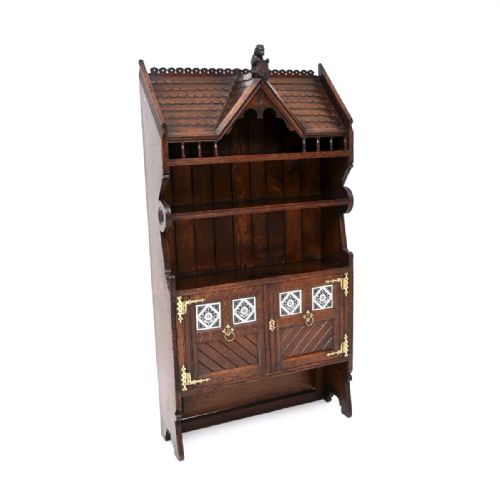


Gothic Revival Wall Display
Gothic revival wall display pieces bring architectural timberwork and pointed arches indoors, offering serious collectors a chance to mount substantial Victorian character on any wall.
Gothic Revival Wall Display
A gothic revival wall display brings together architectural forms, pointed arches, and period timberwork designed to be mounted directly onto domestic walls. Buyers searching for gothic revival wall display examples will encounter everything from simple hanging corner cupboards to elaborate ebonised wall bookcases and display shelves.
Most pieces seen here date from the nineteenth century and Victorian period, utilising oak, mahogany, ebonised timber, and satin birch. Forms range from ecclesiastical antiques and hymn boards to open plate racks and breakfront bookcases.
The aesthetic frequently intersects with the Aesthetic Movement and Chippendale revival styles, offering dark woods and intricate fretwork alongside structural tracery. These items transform bare vertical surfaces into functional display spaces with distinct historical weight.
Materials and construction
Cabinet makers relied heavily on solid oak, walnut, and mahogany, frequently applying ebonising to timber to achieve the sombre, dramatic tone favoured by Victorian designers. Brass hardware and wrought iron fittings provided robust structural support and decorative contrast on doors and shelf brackets.
Joinery techniques matched the architectural ambitions of the period, employing pegged mortise and tenon joints for structural wall shelves and intricate fretwork for lighter display tiers. Satin birch and rosewood appeared in specific pieces to offer contrasting grain patterns within otherwise dark Gothic schemes.
Gothic Revival Wall Display Retail Price Guide 2026
Typical asking prices for gothic revival wall display among the pieces listed under this phrase on Sellingantiques today, from the lower quarter to the upper quarter. They describe what is for sale here now, not the wider market.
Assessing quality and execution
Quality rests upon the ambition of the architectural detailing, separating standard production wall cabinets from pieces that successfully translate stone cathedral motifs into domestic timber. Crisp carving on tracery, well-executed ebonising, and the integration of original brass or iron hardware elevate a piece significantly.
The handling of secondary timbers and the stability of hanging mechanisms dictate long-term durability. Superior examples maintain structural integrity across complex multi-tier fretwork and breakfront configurations without relying on later reinforcement.
John Moyr Smith·George Edmund Street
The Gothic Revival Wall Display Glossary
- Ebonised timber
- Wood treated with a dark stain or finish to imitate ebony. This dark surface treatment was particularly popular during the Victorian period for achieving high-contrast Gothic and Aesthetic interiors.
- Tracery
- Architectural stone window ornamentation translated into woodwork. It defines the openwork patterns found on cabinet doors and display brackets within this tradition.
- Breakfront
- A cabinet design where the central section projects forward from the flanking wings. This format adds architectural depth to larger wall-mounted bookcases.
- Fretwork
- Ornamental design created by cutting patterns through thin boards of wood. It appears on lighter Victorian wall shelves to provide decorative lightness.
Gothic Revival Wall Display: Frequently Asked Questions
How do I hang a heavy gothic wall cabinet?
These cabinets require secure fixing directly into wall studs or masonry using appropriate heavy-duty brackets. Given the weight of Victorian oak and walnut, professional installation is strongly recommended to protect both the timber and the wall.
Ensure the weight is distributed evenly across the primary mounting points rather than relying on decorative trim. Checking the historical hanging loops or internal battens before installation ensures the piece remains safe.
Were these pieces originally meant for kitchens?
Some hanging corner cupboards and plate racks served practical storage roles in domestic kitchens and pantries. Others functioned as reception hall cabinets or parlour display spaces for ceramics and books.
Examining the depth and interior configuration usually reveals the intended room. Enclosed cabinets with glass or solid doors protected valuable tableware, while open tiers held books or decorative objects.
Can I mix ebonised wood with lighter oaks?
Victorian interiors frequently combined dark ebonised furniture with warmer oak and mahogany tones. The eclectic nature of the period encourages mixed timber displays.
Balancing the visual weight of dark ebonised cabinets with lighter satin birch shelves creates a layered historical atmosphere. The shared nineteenth-century origin provides a natural visual harmony across different finishes.