



Gothic Revival Pine Table
These gothic revival pine table pieces bring earnest architectural character into a room through honest timber and ecclesiastical lines.
Gothic Revival Pine Table
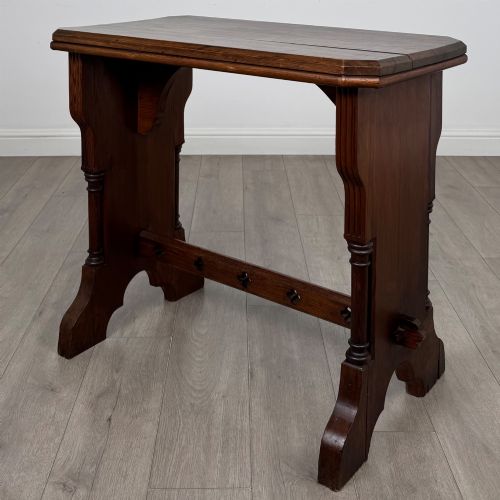
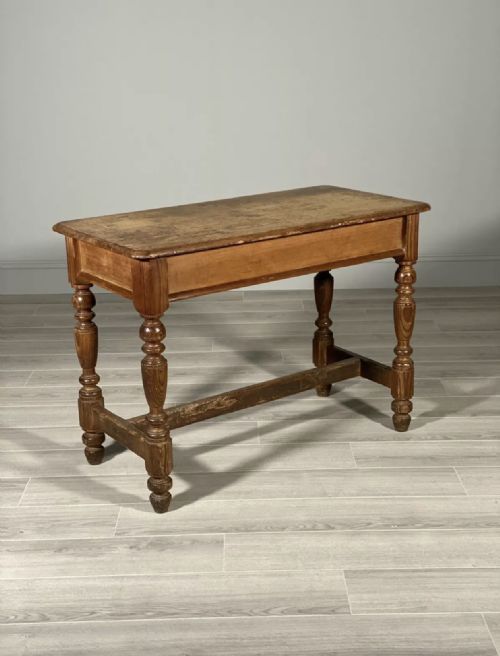
A gothic revival pine table unites the heavy structural forms of medieval architecture with the domestic utility of the Victorian era. When you search for a gothic revival pine table, you encounter domestic items like side tables, writing desks, and hall tables alongside ecclesiastical furniture.
The pieces on this page emerge primarily from the nineteenth century, spanning decades such as eighteen fifty, eighteen sixty, eighteen seventy, eighteen eighty, and nineteen ten. Victorian makers adapted architectural motifs from stone buildings into domestic timber furniture, resulting in functional pieces with pointed arches and heavy legs.
Pitch pine and Oregon pine dominate the forms recorded here, displaying the dense grain and honey tones favoured by nineteenth-century cabinet makers. You will find items ranging from narrow freestanding tables to larger altar and library tables that echo church architecture.
Construction and materials
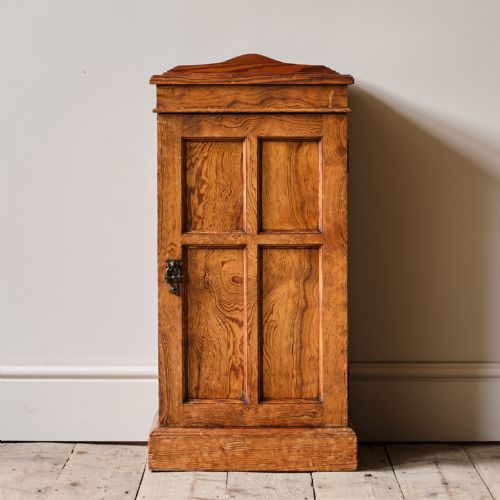
Makers utilised resilient softwoods like pitch pine and Oregon pine, selecting timber with strong resinous grain patterns that aged to a rich warm hue. These softwoods were planed, joined, and shaped to withstand robust daily use in domestic and ecclesiastical settings.
Iron fittings and ceramic elements occasionally appear to reinforce joints or provide functional surfaces on washstands and writing furniture. Carpenters relied on traditional mortise and tenon joinery to construct frames capable of supporting heavy loads without losing structural integrity.
Gothic Revival Pine Table Retail Price Guide 2026
Typical asking prices for gothic revival pine table among the pieces listed under this phrase on Sellingantiques today, from the lower quarter to the upper quarter. They describe what is for sale here now, not the wider market.
Object types span practical household forms including side tables, writing desks, washstands, and ecclesiastical altar tables.
Judging quality in nineteenth-century pine furniture
Quality rests upon the crispness of the architectural carving and the selection of the pine timber itself. Dense pitch pine with a striking grain commands greater respect than plain knotty deal, especially when combined with faithful adherence to gothic proportions.
Construction methods also separate utilitarian workshop pieces from finer examples designed in the manner of notable architects. Well-balanced proportions, sturdy underframes, and well-executed details such as chamfered edges or pierced quatrefoils elevate a piece above standard utility furniture.
AW Pugin
The Gothic Revival Pine Table Glossary
- Pitch Pine
- A durable resinous softwood native to North America and widely imported into Britain during the nineteenth century. Its heavy grain makes it particularly distinctive when polished.
- Gothic Revival
- An architectural and decorative movement drawing inspiration from medieval forms such as pointed arches and quatrefoils. It found expression in both great public buildings and domestic furniture.
- Altar Table
- A substantial table modelled on church furnishings, often featuring heavy timber construction and ecclesiastical detailing. These pieces served devotional purposes before entering domestic use.
- Pot Cupboard
- A small bedside cabinet designed to house a chamber pot, often enclosed by a single panelled door. In pine, these items frequently share the architectural vocabulary of larger gothic furniture.
- Quatrefoil
- A decorative ornamental shape composed of four partially overlapping circles arranged in a symmetrical cloverleaf pattern. It appears frequently in nineteenth-century gothic tracery and woodwork.
Gothic Revival Pine Table: Frequently Asked Questions
What rooms suit a gothic revival pine table?
These tables find a natural home in hallways, studies, and living spaces where their architectural lines add structural weight and historic character. Their honest timber construction pairs well with both traditional and contemporary interiors.
Peculiar forms like narrow hall tables or side tables fit neatly into restricted spaces while providing useful surface area. Larger writing desks and library tables serve as striking focal points in a home office or library.
How do I date a nineteenth-century pine table?
Dating relies upon examining construction marks, timber characteristics, and the specific styling of the gothic ornamentation. Pieces from the middle of the nineteenth century often display hand-planed surfaces and simpler joinery before industrial methods expanded later in the Victorian period.
Makers working around eighteen eighty often incorporated more pronounced ecclesiastical details and denser pitch pine boards. Reference to specific decades or the broader Victorian era helps establish the likely period of manufacture.
Were these tables used in churches?
Some pieces originate directly from ecclesiastical settings, including altar tables and church side tables constructed for vestries or parish halls. These items often display more overt architectural motifs connected to religious buildings.
Other forms were produced purely for domestic interiors while borrowing the vocabulary of church architecture. The distinction lies primarily in the scale and specific function of the piece rather than its material.
How should I care for pitch pine furniture?
Pitch pine responds best to simple maintenance using a soft cloth and occasional application of traditional beeswax to nourish the timber. Avoid placing these tables in direct sunlight or close to heat sources to prevent the resinous wood from drying out.
Allowing the natural patina to develop preserves the character accumulated over more than a century of use. Gentle cleaning maintains the deep grain patterns characteristic of nineteenth-century softwoods.