
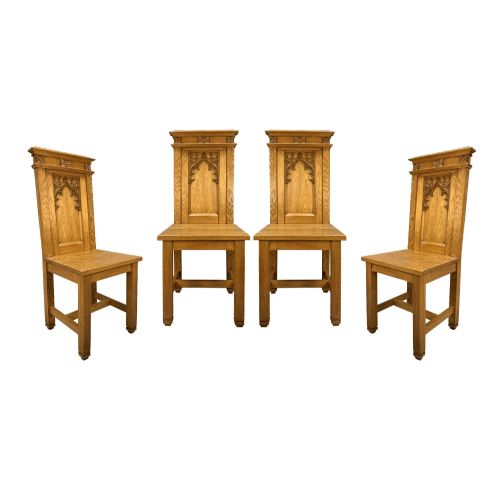
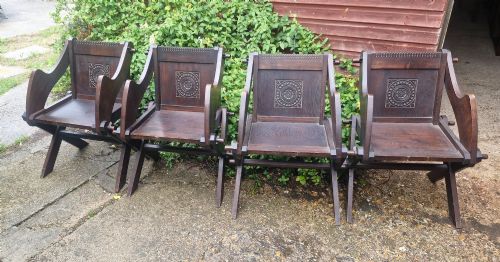
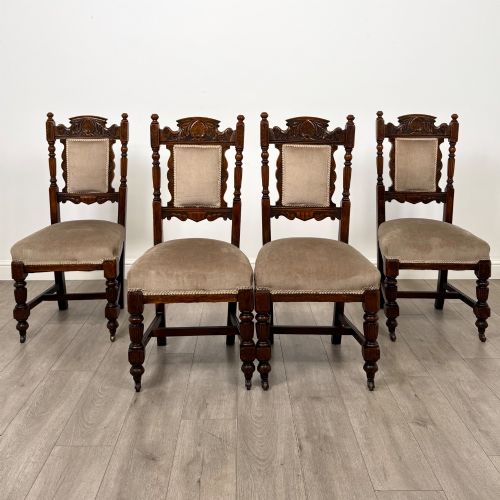


Gothic Hall Chairs Set
These gothic hall chairs set pieces are sturdy timber seating defined by pointed arches and tracery, offering instant architectural presence in a corridor or dining room.
Gothic Hall Chairs Set
A gothic hall chairs set comprises matching timber seating built within the Gothic Revival and Victorian traditions, frequently featuring high backs and pointed architectural motifs. These groups appear most often in sets of three, four, or six pieces, constructed primarily for formal hallways or grand dining spaces.
The evidence shows these sets span the nineteenth century, including specific dates such as eighteen hundred, eighteen seventy, and eighteen eighty, alongside general Victorian periods. Woods vary from standard oak and carved oak to mahogany and pitch pine, occasionally paired with leather or upholstery fabric.
Formations range from strict hall chairs and side chairs to armchairs, Glastonbury armchairs, and parlour side chairs. Several examples incorporate heraldic details, heavy carved ornamentation, or French and Spanish regional influences.
Materials and construction
Makers relied heavily on solid oak and carved oak, alongside mahogany and pitch pine, building rigid frames designed to endure heavy daily use in domestic entryways. Timber selection governed the weight and grain of each piece, with dark finishes frequently chosen to emphasise the solemnity of the style.
Carving serves as the primary decorative technique, shaping trefoils, lancets, and heraldic emblems directly into the wood of the backrests and crestings. Secondary materials such as brass studs occasionally secure leather or upholstery fabric seats to the wooden frames.
Listings demonstrate that oak dominates the material record for these seating sets, followed by mahogany and pitch pine.
Judging quality
Quality rests upon the depth and crispness of the timber carving, distinguishing flat mechanical work from hand-chiselled tracery that retains sharp architectural edges. The architectural proportions of the high backrest relative to the seat determine whether a piece holds true historical balance.
The choice and thickness of the primary timber dictate the structural integrity of the frame over centuries of use. Dense oak and figured mahogany demonstrate superior material selection compared to softer pitch pine or utilitarian secondary woods.
George Morant·Pugin
The Gothic Hall Chairs Set Glossary
- Gothic Revival
- An architectural and decorative movement reviving medieval forms, pointed arches, and ecclesiastical motifs during the nineteenth century.
- Glastonbury armchair
- A specific nineteenth-century chair design featuring X-framed legs and a sloping paneled back, often constructed in oak.
- Pitch pine
- A resinous softwood utilised for Victorian seating frames, known for distinct grain patterns and durability.
- Heraldic
- Relating to coats of arms and familial crests, frequently carved into the crest rails of hall chairs.
- Tracery
- Architectural stone-like openwork patterns adapted by cabinetmakers to decorate wooden chair backs.
Gothic Hall Chairs Set: Frequently Asked Questions
Where were these chairs used?
These chairs originally stood in grand entrance halls, corridors, and formal dining rooms where guests gathered before entering main reception spaces.
Their upright backs and rigid wooden seats encouraged proper posture rather than relaxed lounging.
How do I date a set?
Dating relies on identifying timber species, carving styles, and structural joinery typical of the nineteenth century.
Nineteenth-century examples frequently exhibit deep hand-carved Gothic tracery and heavier proportions than later reproductions.
Can I mix mismatched sets?
Mixing different sets requires matching timber tones and architectural height to maintain visual balance in a room.
Most buyers prefer keeping matching counts together to preserve the formal symmetry intended by the maker.
How should I maintain the wood?
Maintain finished surfaces by applying appropriate furniture wax sparingly to nourish dry timber without building up residue.
Keep pieces away from direct heat sources and strong sunlight to prevent the timber and leather from splitting.