
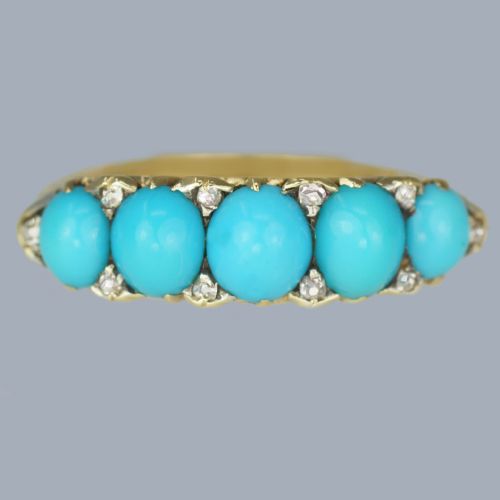


Gold Turquoise Dress Ring
A gold turquoise dress ring brings together vibrant blue cabochons and warm precious metal in designs spanning the Victorian era to the mid-century.
Gold Turquoise Dress Ring
A gold turquoise dress ring represents a category of antique and vintage finger ornaments designed primarily for aesthetic wear rather than betrothal. The examples found here span from late Victorian creations through Edwardian, Art Deco, and mid-century modernist periods.
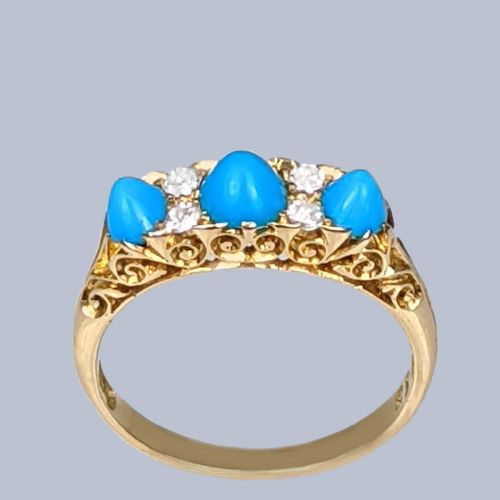
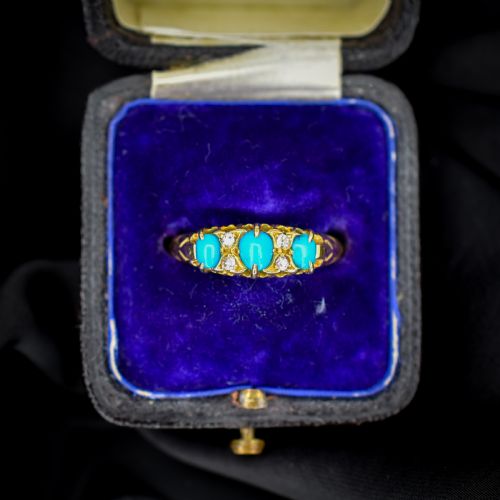
The version a buyer meets most frequently on this page is the Victorian ring, often fashioned in eighteen carat or fifteen carat yellow gold. These pieces frequently incorporate clusters, trilogies, or boat shapes featuring turquoise set alongside diamonds or pearls.
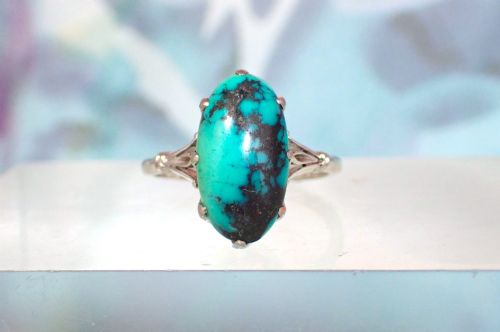
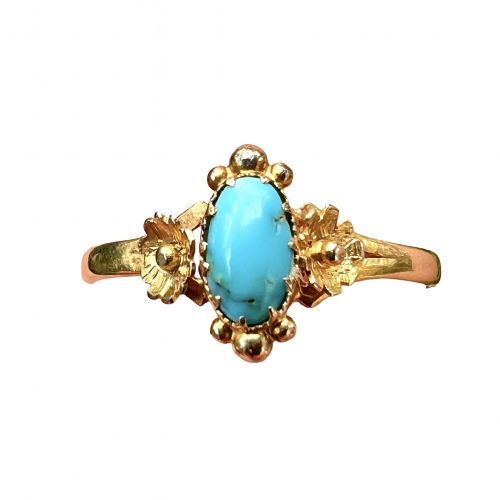
Beyond the standard Victorian cluster, the selection encompasses specific stylistic variations including Arts and Crafts flower motifs, navette designs, buckle bands, and geometric Art Deco white gold iterations.
Materials and construction
Gold forms the structural backbone of these jewels, utilising varying purities including nine carat, twelve carat, fifteen carat, and eighteen carat yellow and white gold. Goldsmiths shaped these metals into substantial bands, delicate scroll boat settings, and intricate cluster mounts.
Turquoise stones, typically shaped as smooth cabochons, take centre stage or alternate with old cut diamonds, rose cut diamonds, and split pearls. Master craftsmen secured these gems using traditional claw, flush, and bezel settings suited to the softer nature of turquoise.
The listings combine Victorian, Edwardian, Art Deco, and mid-century modernist styles utilising turquoise, diamonds, pearls, and gold.
Assessing quality and craftsmanship
The distinction between ordinary examples and exceptional pieces rests upon the saturation and matrix of the turquoise, alongside the overall harmony of the design. Stones exhibiting a uniform robin's egg blue without dark veining command greater appreciation from collectors.
Metalwork finesse further separates the tiers, visible in hand-engraved scrollwork, secure claw settings, and the integration of supporting old cut diamonds. Pieces bearing clear hallmarks denoting specific makers or assay offices like Chester or Birmingham add documentary weight to the physical execution.
The Gold Turquoise Dress Ring Glossary
- Cabochon
- A gemstone shaped and polished with a smooth, convex domed surface rather than faceted. This cut is traditional for turquoise to highlight its natural colour and texture.
- Navette
- A boat-shaped or marquise setting that tapers to points at both ends. This elongated silhouette is characteristic of late Victorian cluster designs.
- Old cut diamond
- A precursor to the modern brilliant cut diamond featuring a smaller table, higher crown, and open culet. These stones are hand-cut and typical of nineteenth-century jewellery.
- Trilogy ring
- A ring featuring three primary gemstones set in a row. In antique pieces, these often combine turquoise with flanking diamonds.
- Split pearl
- A natural or cultured pearl that has been halved to facilitate flush setting against a gold backing. They frequently accompany turquoise in Victorian and Edwardian cluster configurations.
Gold Turquoise Dress Ring: Frequently Asked Questions
How do I clean an antique turquoise ring?
Turquoise is a porous and relatively soft gemstone that absorbs moisture and oils easily. Cleaning requires only a soft, dry cloth to remove surface dust.
Submerging the ring in water or exposing it to chemical ultrasonic cleaners damages the stone and alters its blue colour permanently.
Can I wear a turquoise dress ring daily?
Daily wear is possible if approached with care due to the gemstone's moderate hardness rating. Removing the ring during manual tasks prevents scratching and impact damage.
Prongs and settings in older rings also benefit from periodic inspection by a jeweller to ensure stones remain secure.
How can I tell a Victorian ring from a mid-century one?
Victorian rings typically employ higher carat yellow gold, intricate floral or navette motifs, and hand-cut diamonds like rose or old cut stones. Gemstones are frequently foil-backed or set in closed-back mounts in earlier pieces.
Mid-century modernist pieces favour cleaner geometric lines, sometimes utilising white gold or distinct abstract arrangements that depart from nineteenth-century symmetry.
What does a hallmark tell me about the ring?
Hallmarks stamped inside the band reveal the gold purity, such as nine, fifteen, or eighteen carat. They also frequently identify the specific assay office and year of manufacture.
These tiny stamped markers serve as a reliable guide for authenticating the period of origin against the style of the setting.