


Gold Sapphire Daisy Ring
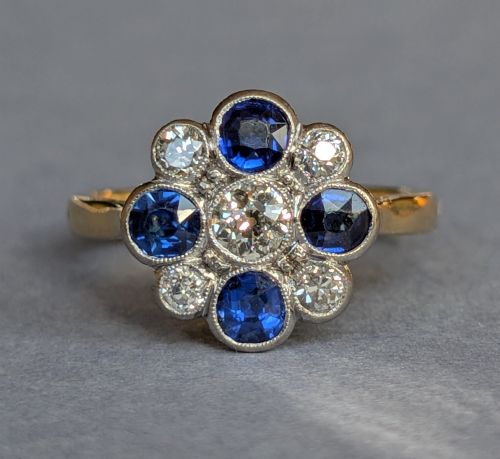
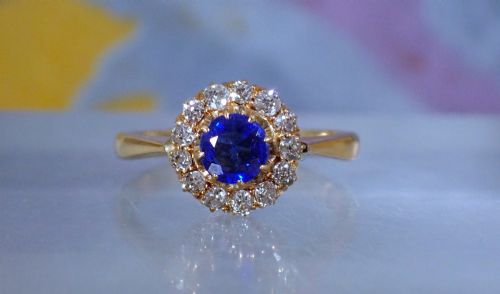
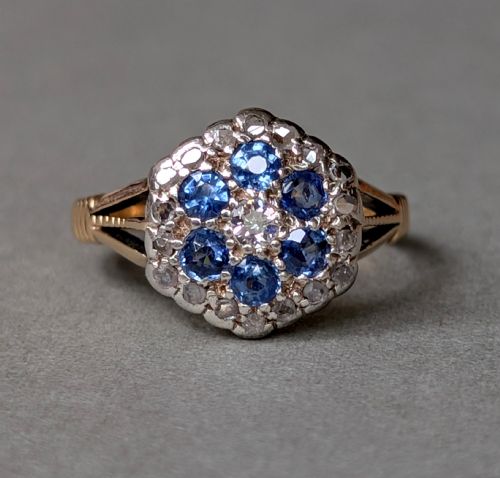
A gold sapphire daisy ring brings together a central sapphire and surrounding diamonds in a floral cluster that sits neatly on the hand.
Gold Sapphire Daisy Ring
When you search for a gold sapphire daisy ring, you find a cluster ring form where a central sapphire is encircled by diamonds, mimicking the petals of a flower. These pieces span from the late nineteenth century through the Edwardian and Art Deco periods, extending into mid-century vintage examples.
The version you are most likely to meet on this page combines an eighteen-carat gold band with a central blue sapphire and diamond accents, often featuring platinum settings for the stones. The scale varies from delicate Edwardian flower clusters to bolder geometric Art Deco designs.
Makers utilised yellow gold for the shanks while frequently mounting the stones in platinum or white gold to enhance the brilliance of the diamonds. The cluster arrangement remains the defining characteristic across all periods represented in the archive and current listings.
How they were made
Goldsmiths worked primarily in eighteen-carat gold, shaping shanks by hand or casting them to support the central stone cluster. Yellow gold provides the warm tone for the body of the ring while platinum appears frequently in the upper cluster to hold the sapphire and diamonds securely.
Stone setting required precision, with claw or bezel settings holding the central sapphire and surrounding diamond melee. Jewellers balanced the deep blue of the sapphire against the bright facets of the diamond border to create the distinct floral silhouette.
Several rings include cabochon sapphires, offering a smooth, rounded dome instead of traditional facets.
What varies in quality
The depth of colour in the central sapphire and the matching consistency of the surrounding diamonds dictate the visual impact of the cluster. Stones with better saturation and fewer inclusions elevate the piece above standard examples.
Precision in the arrangement of the diamond border around the central sapphire shows the skill of the original workshop. Finer rings maintain tight spacing between the stones with minimal visible metal in the cluster top.
The Gold Sapphire Daisy Ring Glossary
- Daisy cluster
- A ring arrangement featuring a central gemstone surrounded by a circle of smaller stones, resembling a flower. This style gained immense popularity during the Edwardian and Art Deco eras.
- Platinum
- A dense, silvery-white precious metal used in jewellery fabrication. It provides high durability and was frequently utilised for setting diamonds securely in early twentieth-century rings.
- Eighteen-carat gold
- An alloy containing seventy-five percent pure gold mixed with other metals for strength and colour variation. It forms the primary structural material for the bands in these listings.
- Target ring
- A specific type of cluster ring featuring concentric circles of contrasting gemstones around a centre stone. This form shares similarities with the daisy configuration.
Gold Sapphire Daisy Ring: Frequently Asked Questions
What periods do these rings come from?
The pieces span several distinct eras, including Victorian, Edwardian, and Art Deco periods. Mid-century and vintage examples also appear regularly.
Each era brings subtle shifts in design, moving from delicate floral motifs to more geometric cluster arrangements.
How do I care for my ring?
Clean the ring gently using warm soapy water and a soft brush to remove everyday oils from beneath the stones. Avoid harsh chemical dips that might affect the sapphire or gold.
Store the piece separately in a fabric-lined box to prevent the diamonds from scratching softer metals or other jewellery.
Are these rings suitable for daily wear?
Eighteen-carat gold and platinum provide a durable foundation for regular use, though older settings benefit from periodic checks by a jeweller. Sapphires possess high hardness, making them resilient for everyday engagement wear.
Care should still be taken during heavy manual tasks to protect the claw settings surrounding the cluster.
How do I identify an Edwardian daisy ring?
Edwardian examples typically feature delicate yellow gold bands paired with platinum-topped settings that lighten the appearance of the diamond border. The overall aesthetic emphasises lightness and intricate floral grace.
Art Deco versions, by contrast, lean towards stronger geometric lines while maintaining the central cluster formation.