

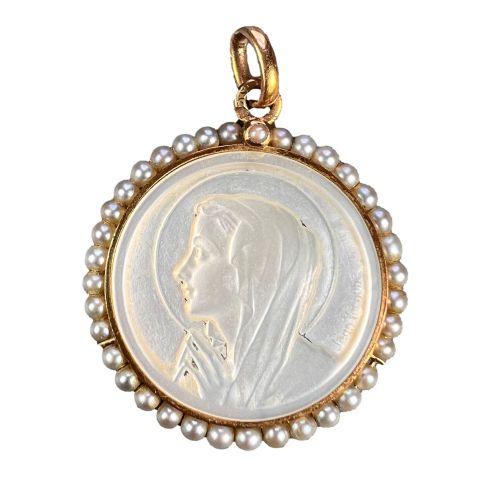
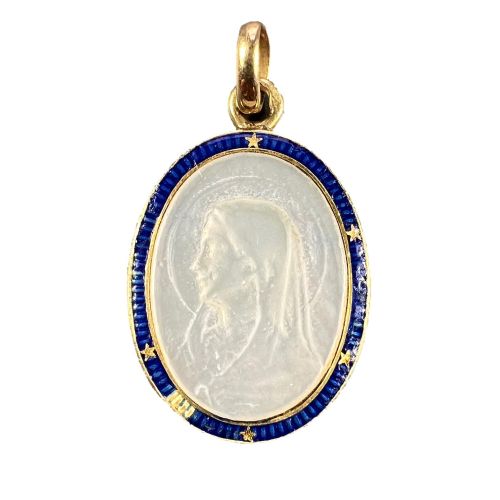
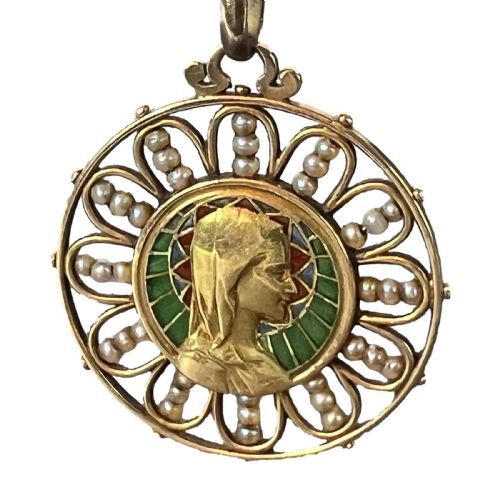
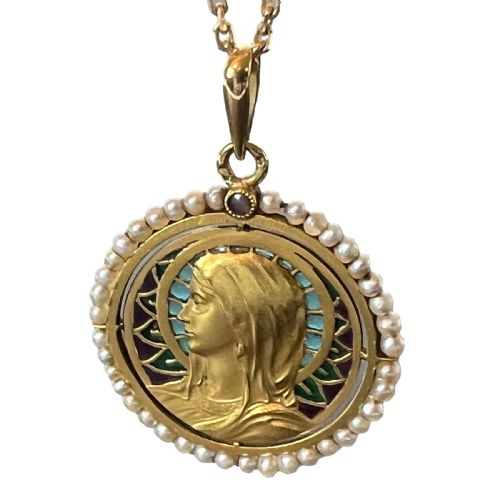


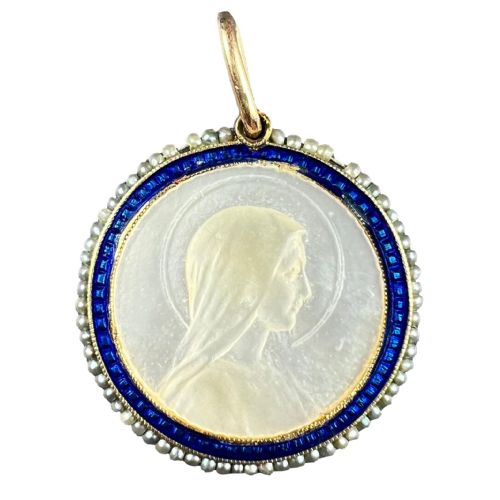
Gold Pearl Mary Charm
These gold pearl mary charm pieces are devotional pendants carrying centuries of quiet French craftsmanship, offering a tangible connection to traditional religious art.
Gold Pearl Mary Charm
A gold pearl mary charm takes the form of a small pendant or medal, typically depicting the Virgin Mary. These devotional pieces emerge primarily from French traditions spanning the early twentieth century, including the Victorian era, Art Nouveau, and the Belle Epoque.
The objects combine sacred imagery with wearable jewellery, functioning as charms or pendants. Most examples integrate mother of pearl backgrounds with precious metal frames and delicate seed pearls.
Collectors encounter diverse stylistic interpretations on this page, ranging from traditional religious medals to elaborate French Art Nouveau designs. The pieces bridge personal devotion and decorative ornament.
Materials and construction
Maker workshops shape these pendants predominantly from 18K gold, utilising both yellow and white gold variations for the metalwork. Mother of pearl provides an iridescent disc base that catches the light behind the central figural relief.
Enamel work frequently enhances the composition, sometimes utilising the translucent plique-a-jour technique to let light pass through the coloured glass areas. Seed pearls are then set delicately around the borders or integrated into the decorative scheme.
Jewelters also incorporate occasional diamonds into the design alongside the pearls and enamel. Each component requires precise miniature assembly to mount the mother of pearl and secure the precious metal bezel.
Gold Pearl Mary Charm Retail Price Guide 2026
Typical asking prices for gold pearl mary charm among the pieces listed under this phrase on Sellingantiques today, from the lower quarter to the upper quarter. They describe what is for sale here now, not the wider market.
Some makers tucked tiny seed pearls so tightly around the Virgin Mary that they look like a microscopic gathering of bubbles.
Assessing quality in the pieces
The refinement of the central depiction of the Virgin Mary distinguishes standard work from exceptional examples. Skilled modellers achieve subtle facial expressions and detailed drapery on the mother of pearl or metal relief.
The complexity of the surrounding metalwork and enamel dictates the upper tier of the range. Intricate plique-a-jour enamel and well-matched seed pearls demand advanced technical competence from the workshop.
The integrity of the mother of pearl ground and the precision of the 18K gold casting anchor the physical durability of the object. Signed pieces by recorded makers carry distinct documentary interest.
Sellier·Becker
The Gold Pearl Mary Charm Glossary
- Plique-a-jour
- An enamelling technique where enamel is applied in cells without a backing, resembling miniature stained glass. This method allows light to shine directly through the translucent coloured material.
- Seed Pearl
- A very small, naturally occurring or cultured pearl, often half-drilled and threaded or set closely together. Jewellers utilise them to create delicate borders on antique pendants.
- Mother of Pearl
- The iridescent inner layer of certain mollusc shells, carved into thin plaques. It serves as the lustrous background material for devotional medal reliefs.
- Belle Epoque
- A period of French design spanning the late nineteenth and early twentieth centuries. This style prioritises lightness, grace, and intricate platinum or gold work.
- Devotional Medal
- A small religious pendant worn for personal piety or commemoration. These items often feature sacred figures like the Virgin Mary.
Gold Pearl Mary Charm: Frequently Asked Questions
How were these pendants worn?
Makers designed these objects primarily as charms or pendant medals to be suspended from necklaces. Their compact size suited close personal wear against the body.
They served both as expressions of religious faith and as fashionable accessories within period dress.
What materials make up the pieces?
The primary structure relies on 18K yellow or white gold framing an iridescent mother of pearl plaque. Seed pearls and enamel provide decorative borders and colour highlights.
Certain examples incorporate small diamonds to accent the central sacred imagery.
How do I identify Art Nouveau examples?
Art Nouveau pieces display characteristic organic motifs, flowing lines, and naturalistic curves that break from rigid symmetry. Enamelling techniques such as plique-a-jour often feature prominently in these designs.
The overall aesthetic prioritises fluid integration of metal and gemstone elements.
From which period do most pieces date?
The listed items originate predominantly from the early twentieth century, spanning the 1900s to the 1930s. This timeframe includes late Victorian, Belle Epoque, and Art Nouveau stylistic phases.
French workshops produced the majority of these devotional jewels during these decades.