





Gold Framed Equine Art
Gold framed equine art brings together nineteenth-century sporting life and traditional oil painting inside heavy gilded mouldings.
Gold Framed Equine Art
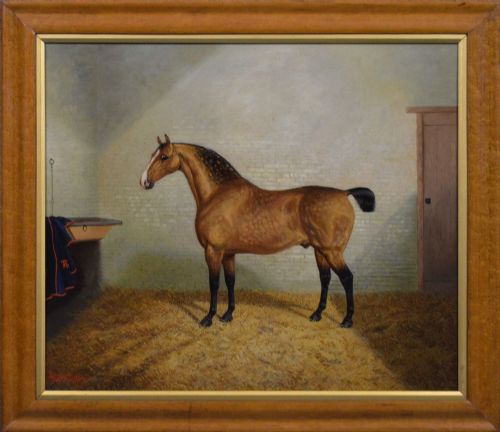
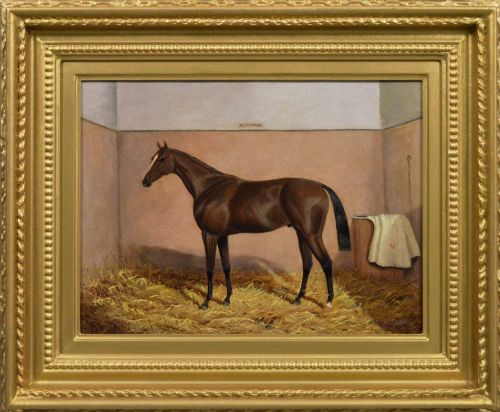
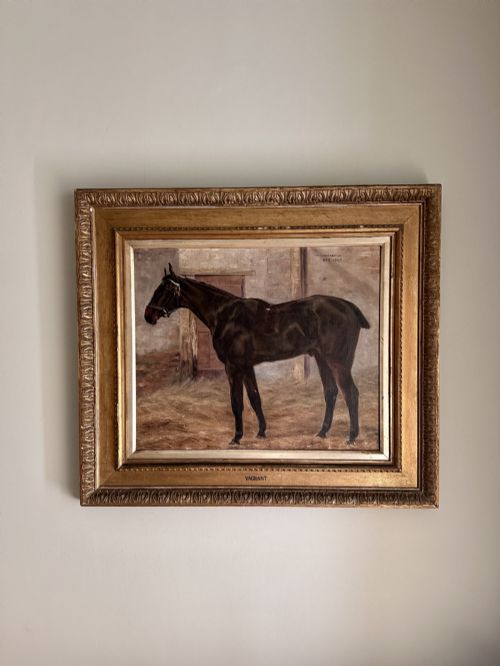
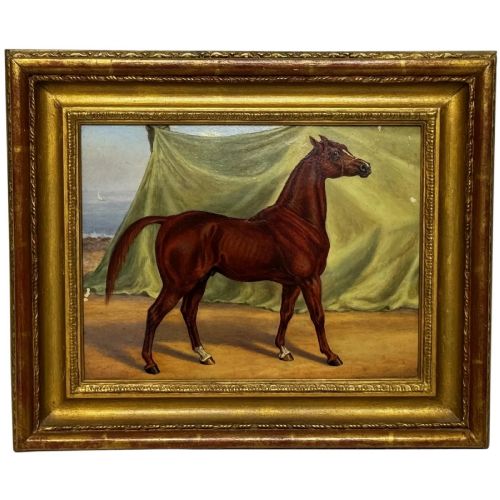
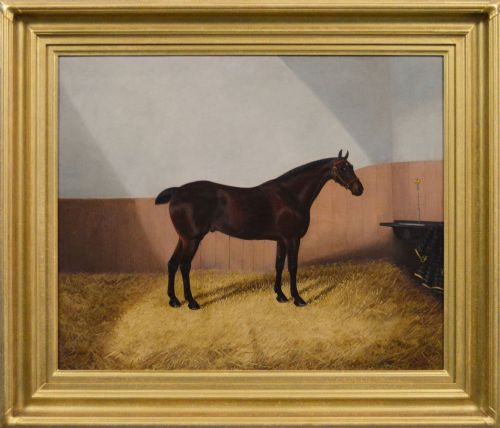
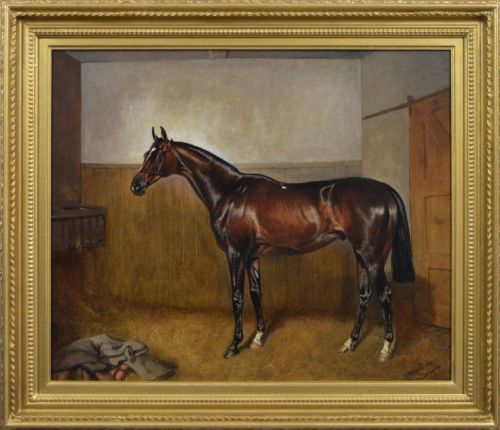
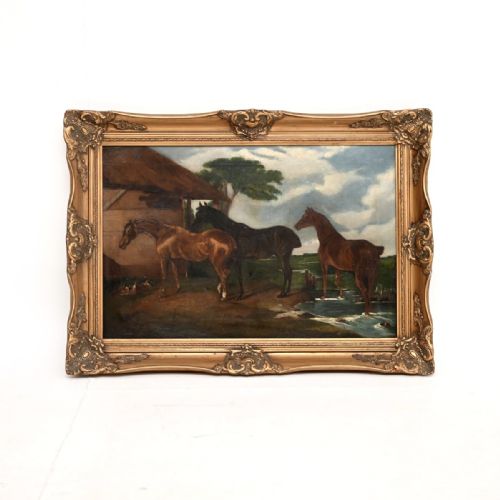
Gold framed equine art consists primarily of nineteenth-century oil paintings on canvas depicting horses in stables, landscapes, and racing portraits. These works range from intimate studies of individual hunters and racehorses to wider scenes of rural village life and agricultural labour.
The selections available lean heavily toward Victorian sporting art and traditional realism, capturing thoroughbreds, working shires, and ponies. Buyers encounter both named subjects with detailed provenance and atmospheric landscape compositions featuring horses in coastal or river settings.
How they were made
These works are executed in oil paint upon prepared canvas, though occasional watercolours on paper also appear. The handling of the pigment builds up rich textures for coats and mannes, ranging from smooth glazes on racehorses to thick impasto on working shires.
The supporting frames utilise wood structures covered in gesso and finished with gold leaf or giltwood. Mouldings often incorporate decorative plasterwork that catches the light around the perimeter of the canvas.
Portraits include famous nineteenth-century racehorses alongside working shires in traditional country landscapes.
What varies in quality
Quality rests upon the anatomical precision of the horse and the handling of light within the composition. Master painters capture muscle tension, bone structure, and intelligent expression with an authority that lesser hands miss entirely.
The framing also dictates value, as period giltwood mouldings applied with genuine gold leaf carry greater presence than later replacements. The integrity of the underlying canvas and the subtlety of the background landscape further separate standard decorative items from fine collector pieces.
Albert Clark·Fred Fitzpatrick·John Alfred Wheeler·John Ferneley Senior·Eugene Joseph Verboeckhoven·Alfred Moginie Bryant·Abraham Cooper RA·George Goodwin Kilburne·Edward Lloyd·James Barenger·George Cole·William Shayer Snr
The Gold Framed Equine Art Glossary
- Giltwood
- Wood carved and covered with a thin layer of gold leaf or metallic powder. This finish provides the characteristic metallic gleam surrounding traditional oil paintings.
- Gesso
- A paint mixture consisting of a neutral binder mixed with chalk, gypsum, or pigment. It forms the smooth white base applied to wooden frames before gilding.
- Impasto
- Paint applied thickly to a canvas so that the brush or palette knife marks remain visible. This technique adds tactile dimension to the coats of horses and foreground foliage.
- Provenance
- The documented history of ownership of a work of art. Clear records link specific paintings to estates, galleries, and notable historical figures.
- Sporting art
- A genre dedicated to the depiction of equestrian sports, hunting, racing, and animals in the field. It flourished in Britain throughout the nineteenth century.
Gold Framed Equine Art: Frequently Asked Questions
What periods do these paintings come from?
The works span the nineteenth and early twentieth centuries, with a strong concentration of Victorian pieces. Dates range from Georgian examples up to mid-century rural scenes.
Most items reflect the stylistic conventions of British and Irish sporting art from eighteen-hundred to nineteen-hundred.
How should I hang and care for them?
Keep these oil paintings away from direct sunlight and sudden temperature shifts to protect the canvas and gold leaf. Hang them securely using appropriate fixings suited to the weight of the gilded wooden frames.
Dust the frames gently with a soft dry brush and avoid using liquid cleaners on the gilded surfaces.
How can I tell a racehorse portrait from a working horse scene?
Racehorse portraits usually name specific thoroughbreds like Persimmon or Flying Fox alongside jockeys or trainers. They focus on the sleek conformation of the animal in stable or track settings.
Working horse scenes depict shires, ponies, and farm horses engaged in ploughing, hauling hay, or travelling along rural roads.
What materials make up the frames?
The frames are constructed from wood coated in gesso to create a smooth surface for gilding. Layers of gold leaf or gilt finish are applied over the moulded decoration.
Heavier frames feature intricate plaster ornamentation typical of Victorian and Georgian framing traditions.