


Gold Cross Necklace
A gold cross necklace carries centuries of devotion and design, shifting from Georgian coral and seed pearls to mid-century diamond-encrusted styles.
Gold Cross Necklace
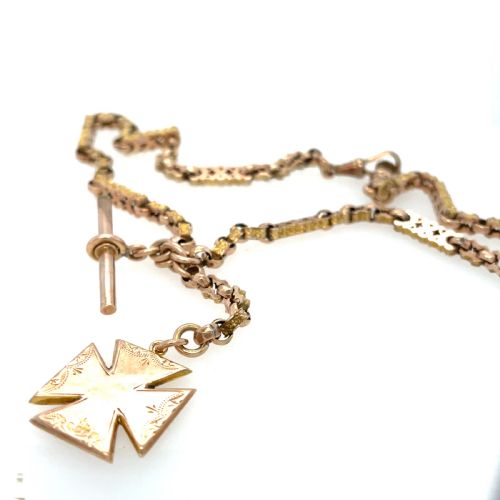
A gold cross necklace brings together centuries of devotional metalwork and personal ornamentation, spanning from Georgian and Victorian periods through Edwardian craftsmanship to mid-century modernist designs. Buyers seeking a gold cross necklace will encounter pendant forms, lockets, and charms suspended from chains, Albert chains, or incorporated into riviere suites.
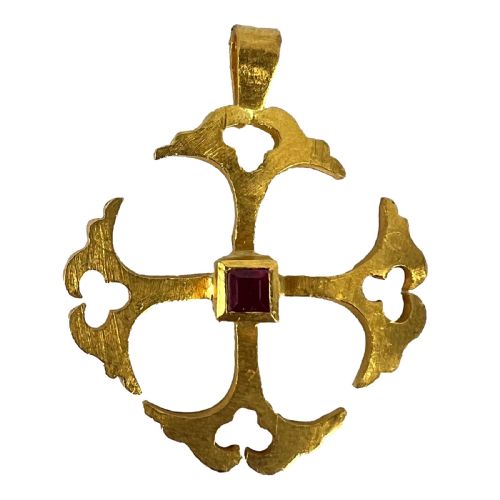
The pieces listed here draw upon diverse materials, pairing yellow, rose, and white gold with diamonds, pearls, turquoise, coral, sapphires, rubies, and various coloured gems. This selection reflects both traditional religious symbols and decorative interpretations, such as sunburst medals and Maltese-style crosses.
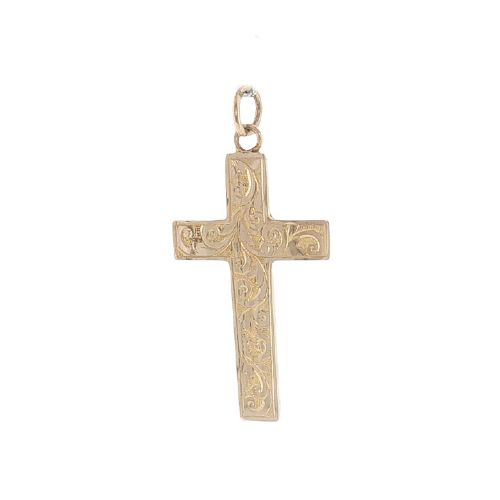
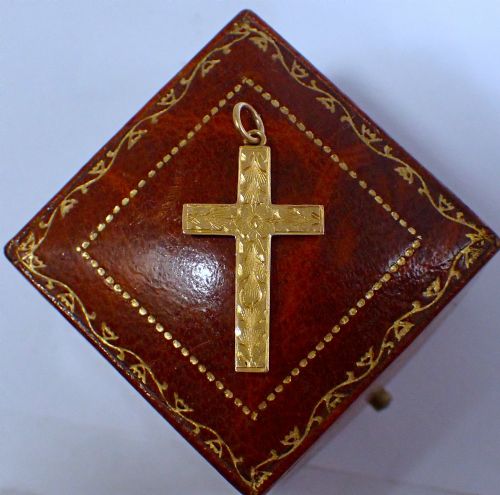
The most common examples on this page are Edwardian and Victorian 9ct gold engraved pendants, alongside 18ct white gold and diamond pieces from the 1950s. These items range from simple hand-engraved metalwork to complex multi-gem clusters set with garnet, topaz, and amethyst.
Materials and technique
Craftsmen utilised various purities of gold, predominantly 9ct, 15ct, and 18ct yellow, rose, and white gold, sometimes incorporating higher purities like 24K. These metals were cast, beaten, or drawn into wire to form the structural framework of the pendant.
Gemstones including diamonds, seed pearls, turquoise, coral, rubies, and sapphires were integrated using traditional claw, bezel, or flush settings. Surface decoration relied heavily on hand engraving, enamel work, and repousse techniques to create texture and pattern across the gold.
Some Victorian crosses double as lockets, secretly harbouring tiny locks of hair or miniature painted portraits inside.
Distinctions in quality
The calibre of a gold cross necklace depends upon the precision of the hand engraving and the structural integrity of the metalwork. Finer pieces demonstrate crisp, deep cutting in the gold and secure, flush stone settings that hold gems firmly without excess solder.
Material selection also dictates the tier of the piece, with higher carat golds and well-matched, lively gemstones marking superior examples. The complexity of the design, such as multi-tiered diamond encrustation or intricate enamel detailing, separates standard production from exceptional work.
The Gold Cross Necklace Glossary
- Albert chain
- A chain originally designed to attach to a pocket watch, frequently adapted to hold pendants and crosses.
- Seed pearl
- A very small, natural, or cultured pearl often used in Victorian and Edwardian cluster settings.
- Rivière necklace
- A necklace composed of a continuous sequence of gemstones of identical or graduated size.
- Repoussé
- A metalworking technique where the metal is hammered from the reverse side to form a raised design in relief.
Gold Cross Necklace: Frequently Asked Questions
What periods do these crosses span?
The pieces span from the Georgian era through the Victorian and Edwardian periods up to the mid-century 1950s and 1960s.
Earliest examples feature coral, seed pearls, and rose gold paste settings, while later twentieth-century items incorporate white gold and brilliant-cut diamonds.
How do I wear a pendant cross?
Pendant crosses are typically suspended from gold chains or Albert chains and worn around the neck as a focal piece of jewellery.
Some buyers pair smaller antique engraved crosses with delicate chains, while larger diamond-set pieces serve as standalone statement necklaces.
Are these crosses made of solid gold?
The listings comprise pieces fashioned from solid gold, spanning 9ct, 15ct, 18ct, and 24K variations in yellow, rose, and white gold.
Each piece reflects the specific purity standards of its period of origin, marked by Birmingham hallmarks where applicable.
What gemstones appear on these crosses?
Common gemstones include diamonds, seed pearls, turquoise, coral, sapphires, rubies, garnets, topazes, and amethysts.
Stones are frequently arranged in clusters around a central cross or used as single accent points within the engraved metal design.