
Gold 7 Stone Ring
When searching for a gold 7 stone ring, buyers encounter multi-stone settings spanning Victorian, Edwardian, Art Deco, and mid-century periods.
Gold 7 Stone Ring
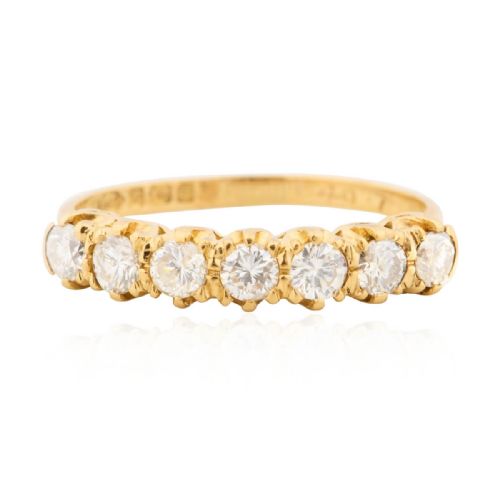
A gold 7 stone ring brings together seven individual gems set linearly or in a cluster formation across the finger. These designs frequently appear in Victorian, Edwardian, and later vintage iterations.
The materials paired with the central stones typically involve 18ct yellow gold, 18ct white gold, or platinum. Many examples combine diamonds with rubies, opals, or sapphires.
Makers ranged from standard regional assay offices like Chester and Birmingham to specific firms such as Kutchinsky. The forms span boat rings, daisy clusters, and half eternity bands.
How they were made
Goldsmiths utilised 18ct gold and platinum to construct durable settings for multiple stones. Stones were secured using claw settings, gypsy flush settings, or close cluster arrangements.
Cut styles on these pieces predominantly include old cut, old mine cut, and old cushion cut diamonds alongside mixed-cut coloured gems. Silver was occasionally used on the face of earlier pieces to whiten the metal underneath stones.
Listings demonstrate these rings spanning from the late nineteenth century through the 1960s, executed in yellow gold, white gold, and platinum.
What varies in quality
The standard of a multi-stone ring rests upon the matching and graduation of the seven gems. Uniformity in colour and cut among the stones elevates the overall harmony of the piece.
Setting execution and the weight of the underlying gold shank dictate the longevity and structural integrity of the ring. Heavier gauge metalwork and secure, even claw work distinguish superior examples.
Kutchinsky
The Gold 7 Stone Ring Glossary
- Boat ring
- A curved, navette-shaped setting that tapers toward the ends, popular during the Edwardian period. This configuration often holds a central stone flanked by smaller gems.
- Old cut diamond
- A hand-faceted diamond cut before modern machinery, characterised by a high crown and small table. These stones possess a distinctive softer glow under candlelight.
- Half eternity ring
- A band featuring a row of gemstones set across the top half of the hoop. They frequently utilise channel or claw settings for the stones.
- Gypsy ring
- A style where stones are flush-set directly into the thick gold band. This mounting style protected the girdle of the gem during daily wear.
- Trilogy ring
- A ring holding three principal stones representing past, present, and future. They frequently appear alongside wider multi-stone arrangements.
Gold 7 Stone Ring: Frequently Asked Questions
What is a gold 7 stone ring?
A gold 7 stone ring is a jewellery piece featuring seven distinct gems mounted in a single row or cluster on an 18ct gold or platinum band. These configurations often take the form of half eternity bands or daisy clusters.
They emerged across multiple eras, showing up in late Victorian, Edwardian, and mid-century designs. The layout allows for alternating coloured stones and diamonds or a graduated line of sparkling gems.
How do I wear a multi-stone ring?
These rings function well as standalone dress pieces or stacked alongside plain wedding bands. Due to the stones spanning across the finger, daily wear requires basic care during manual tasks.
Matching the metal colour of the band to other jewellery helps create a cohesive look. Low-profile gypsy settings offer robust options for everyday use compared to elevated claw mounts.
How can I date an antique ring?
Dating relies heavily on hallmarking stamps, assay office marks, and the specific cut of the gemstones. Old cut diamonds and boat-shaped mountings typically point toward late Victorian or Edwardian periods.
Maker's marks and numerical date letters stamped inside the band provide precise years of origin. Stylistic cues like platinum usage often indicate pieces made after the turn of the twentieth century.
What stones are used in these rings?
Diamonds form the primary stone choice, frequently paired with rubies, sapphires, opals, or emeralds. Past epochs also utilised paste glass, turquoises, and citrines.
Coloured gemstones are often arranged alongside or between diamond accents to create contrast. Natural opals and Burmese rubies appear frequently in the older classifications.