




Glass Skeleton Clock
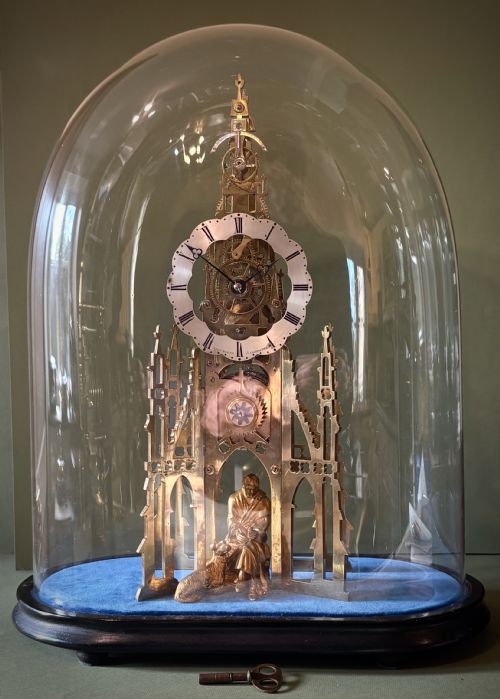
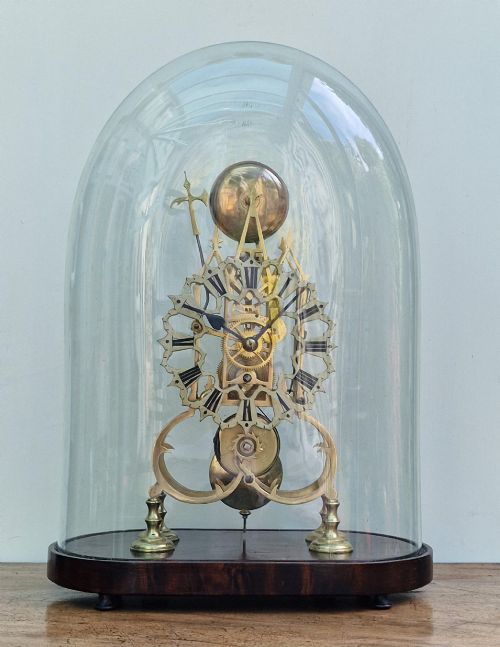
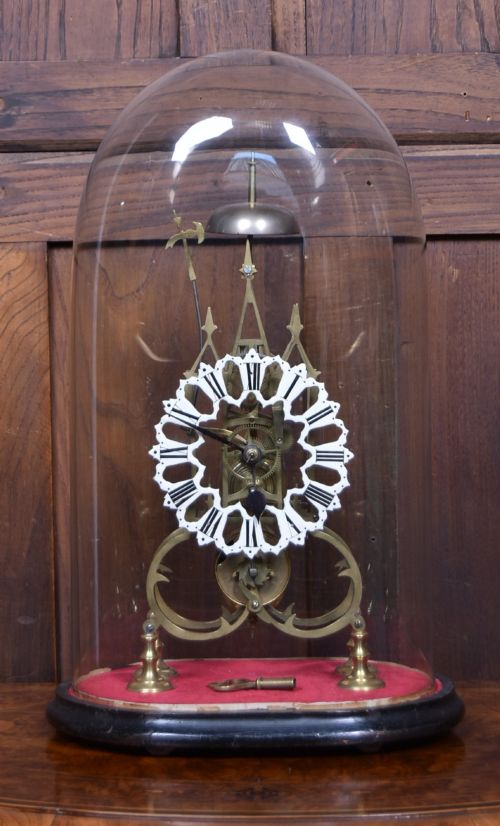
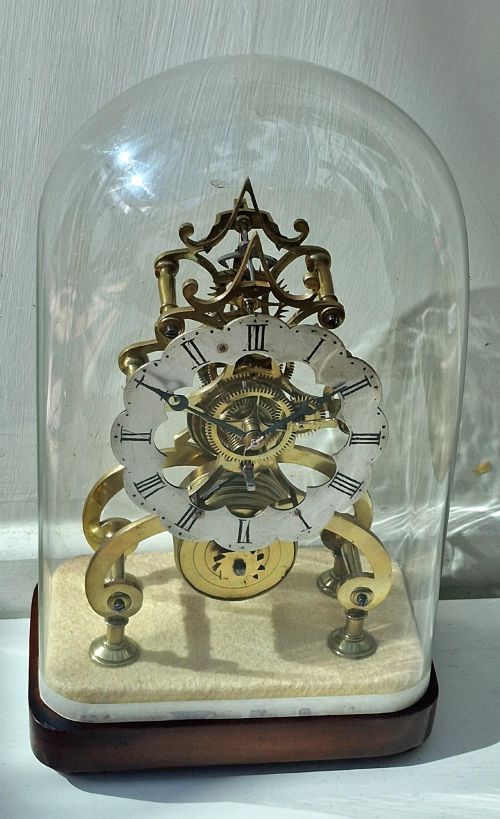
These glass skeleton clocks lay bare their intricate brass and steel workings beneath protective glass domes, offering a mesmerising display of mechanical precision.
Glass Skeleton Clock
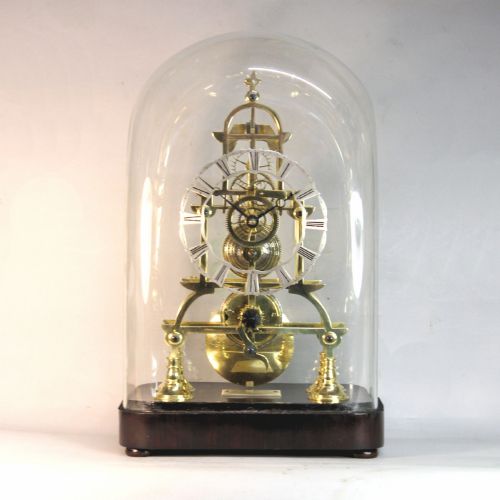
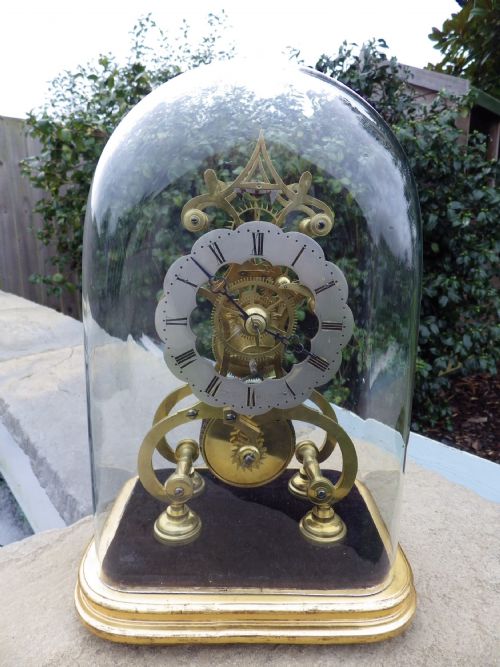
A glass skeleton clock strips away traditional wooden or metal cases to expose the intricate gear trains, escapements, and dial work of the movement. When you search for a glass skeleton clock, you encounter timepieces designed to be viewed from every angle, typically protected by a blown or polished glass dome that rests upon a wooden or marble plinth.
The versions most commonly met on this page span the Victorian era up to the mid-twentieth century, encompassing both English fusee-driven movements and French mantel designs. Makers often mounted these delicate brass frameworks upon brass feet or stepped wooden bases to elevate the brass plates and wheel work.
Alongside traditional weight-driven or spring-driven fusee mechanisms, the listings include later electric and torsion variations housed within glass enclosures. These pieces function as mantel clocks, library clocks, and table clocks, bridging the gap between mechanical engineering and domestic ornamentation.
Materials and construction
Brass forms the structural backbone of nearly every glass skeleton clock, utilised for the plates, wheels, and dial rings that hold the gear train in alignment. Steel components, including pinions, arbors, and escapement parts, work alongside brass to transfer power steadily through the movement.
Bases are frequently fashioned from mahogany, ebonised wood, or polished marble, providing a stable foundation to support the heavy glass domes that protect the delicate brass frameworks from dust. Enamel is often applied to small chapter rings or dials, bearing painted Roman or Arabic numerals.
Later twentieth-century examples incorporate modern finishes such as rhodium plating over brass components, alongside specialised electric mechanisms driven by battery currents rather than traditional mainsprings or fusee chains.
Glass Skeleton Clock Retail Price Guide 2026
Typical asking prices for glass skeleton clock among the pieces listed under this phrase on Sellingantiques today, from the lower quarter to the upper quarter. They describe what is for sale here now, not the wider market.
Some electric models hum quietly inside their glass domes, secretly powered by air pressure changes while pretending to be ancient.
What separates the finest examples
Quality in a glass skeleton clock rests upon the complexity and finish of the wheel work and the precision of the escapement. Fine English examples feature six-spoke wheel work and sophisticated escapements like the coup perdu detent, executed by skilled makers who hand-filed each brass tooth.
The proportion and clarity of the protective glass dome also distinguish superior pieces. Original blown domes with natural surface undulations command greater appreciation than modern replacements, sitting neatly upon matching wooden or ebonised bases without distortion.
Richard Winter of Chieveley·Maurice and Marcel Moulin Favre-Bulle·Thwaites of London·Jaeger-LeCoultre·William Evans of Handsworth·Allen Colyer
The Glass Skeleton Clock Glossary
- Fusee
- A conical pulley used in mechanical clocks to maintain an even pull on the gear train as the mainspring unwinds. This mechanism ensures more accurate timekeeping throughout the duration of the wind.
- Dome
- A blown or cast glass cover placed over a clock to keep out dust and atmospheric moisture. These protective covers often sit on fitted wooden, mahogany, or ebonised bases.
- Escapement
- The mechanism inside a clock that controls the release of power from the gear train to the pendulum or balance wheel. It gives the clock its characteristic ticking sound.
- Garniture
- A set of matching ornamental objects for a mantelpiece, consisting of a central clock flanked by matching decorative pieces. They often share materials such as brass, marble, and glass.
- Torsion clock
- A clock regulated by a torsion pendulum that rotates back and forth rather than swinging. These mechanisms often run for long periods between windings.
Glass Skeleton Clock: Frequently Asked Questions
What is a glass skeleton clock?
A glass skeleton clock is a timepiece engineered with open brass plates and exposed gear trains, allowing light to pass directly through the movement. These intricate mechanisms are traditionally displayed on a wooden or marble base beneath a clear glass dome.
This design allows admirers to observe the interaction of the wheels, escapement, and mainspring during operation. The style originated centuries ago to showcase the skill of the horologist.
How do you wind a fusee skeleton clock?
Winding a fusee skeleton clock involves inserting a small key into the dial or movement aperture to tension the mainspring via the conical pulley. Care must be taken not to overwind the chain, which transfers power steadily to the gear train.
Because the movement is completely exposed without a solid case, winding requires steady hands to avoid disturbing the delicate wheel work or pendulum suspension spring.
Are glass domes original to these clocks?
Many surviving glass skeleton clocks retain their original blown or cast glass domes, which feature slight thickness variations and tiny air bubbles characteristic of older manufacturing methods. These domes rest directly on the matching plinth to protect the brass movement from dust.
When a dome is replaced later, the glass often appears flatter, clearer, and heavier than period glass. Examining the fit against the wooden or marble base helps determine its authenticity.
How do electric skeleton clocks differ from mechanical ones?
Electric skeleton clocks, such as those produced by Bulle or Jaeger-LeCoultre, replace traditional mainsprings and weight drives with electromagnetic or perpetual motion systems. These units utilise battery power or barometric pressure fluctuations to maintain the oscillation of the balance wheel.
Despite the modern power source, they maintain the open, exposed aesthetic of traditional mechanical skeleton clocks by mounting their functional coils and circuits within glass enclosures.