





Glass Prism Holders
Glass prism holders are decorative lighting accessories designed to suspend hanging crystal drops, bringing brilliant prismatic sparkle to 19th century and early 20th century interiors.
Glass Prism Holders
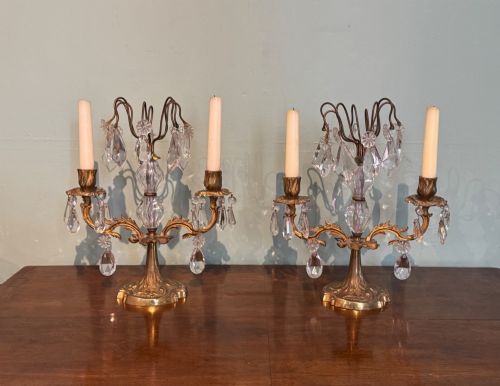
Glass prism holders encompass table lustres, mantle lustres, and candelabra designed to catch and refract light through suspended crystal pendants. When searching for glass prism holders, collectors generally encounter pairs of Victorian and Regency pieces intended for formal mantelpieces and side tables.
The primary forms include single lustres, multi-branched candelabra, and candlestick hybrids fitted with brass or ormolu mounts. These objects bridge the gap between functional illumination and decorative display, serving as striking focal points in a traditional room.
How they were made
Maker workshops shaped these pieces using heavy lead crystal and coloured flash glass, often overlaying contrasting hues before cutting through the top layer to reveal the clear glass beneath. Metal elements such as brass, gilt bronze, and ormolu provided sturdy structural bases and sconces to support the weight of the glass.
The prisms themselves, frequently referred to as spear or leaf drops, were hand-cut and faceted to maximise light refraction. Enamel and gold leaf details were then applied to the glass bodies, fixed with low-fired pigments to add ornamental depth.
Glass Prism Holders Retail Price Guide 2026
Typical asking prices for glass prism holders among the pieces listed under this phrase on Sellingantiques today, from the lower quarter to the upper quarter. They describe what is for sale here now, not the wider market.
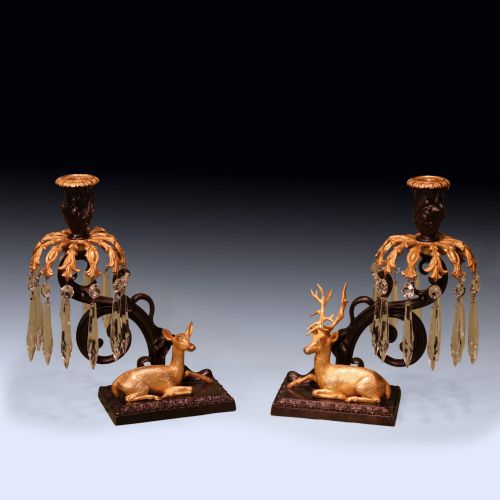
Several Victorian examples feature matching stags and does standing steadfastly beneath the candle branches.
What varies in quality
Quality rests heavily on the depth and precision of the hand-cut facets on both the body and the hanging pendants, alongside the clarity of the glass itself. Clear, resonant crystal with sharp facet edges sits at the higher end, while softer mouldings represent simpler production.
The proportion and weight of the metal mounts, whether gilt brass or bronze, define the structural integrity of the piece. Heavier, finely chased ormolu details elevate the overall refinement compared to lighter, plain brass fittings.
The Glass Prism Holders Glossary
- Lustre
- A decorative tabletop vase or candlestick fitted with a ring of hanging crystal prisms. These pieces were designed primarily to enhance candlelight through optical refraction.
- Flash glass
- A two-layer glass formed by dipping a core of clear or coloured glass into molten glass of a different colour. Subsequent cutting removes parts of the outer layer to expose the contrasting base colour underneath.
- Ormolu
- Finely ground high-carat gold mercury-gilded onto a bronze base. This technique creates a rich, durable golden surface on the metal mounts of candelabra and lustres.
- Prism
- A cut-glass pendant suspended from the rim of a lustre or candelabra. These elements disperse ambient light into spectral colours.
Glass Prism Holders: Frequently Asked Questions
How do I care for antique glass prism holders?
Maintenance requires gentle cleaning with lukewarm water and a mild detergent, washing the glass and crystal drops by hand. Metal mounts should be kept dry and dusted with a soft brush to protect gilt surfaces.
Prisms are best unhooked individually for cleaning to prevent accidental chipping against the main body of the piece.
Where were these glass prism holders displayed?
In period homes, these pieces occupied prominent positions on mantelpieces, sideboard tables, and pier tables. Their reflective glass and polished metal components were positioned to capture and multiply the flickering light of oil lamps and candles.
They served as grand decorative ornaments during evening gatherings in formal drawing rooms.
How can I tell a Victorian lustre from a Regency one?
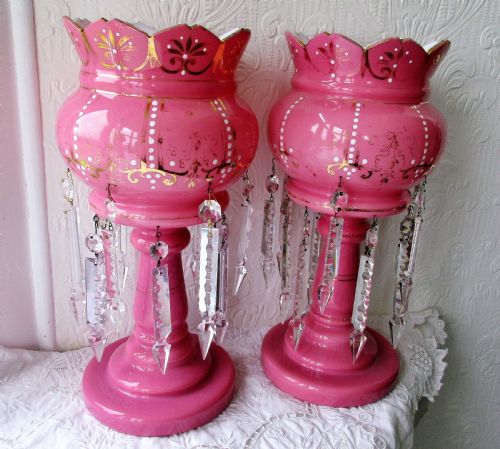
Regency examples often feature cleaner, classical lines with bronze and ormolu mounts, clear cut-glass, and restraint in ornament. Victorian pieces frequently introduce rich colours like ruby red, emerald green, and opaque pink, alongside enamelled and gilded floral motifs.
Proportions on Victorian items also tend toward heavier, more exuberant forms characteristic of later 19th-century revival styles.