

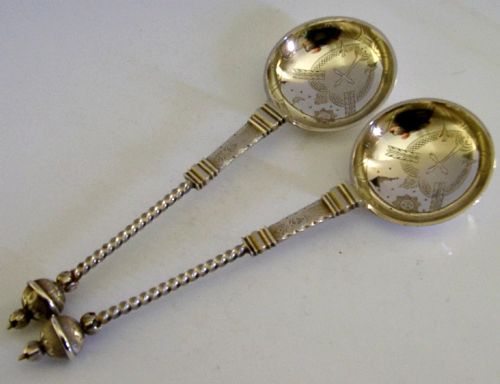


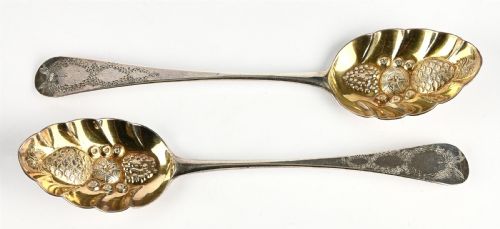


Gilt Berry Spoons
Gilt berry spoons are ornate serving pieces designed for fruit, combining polished bowls with silver gilt finishes and intricate engraving.
Gilt Berry Spoons
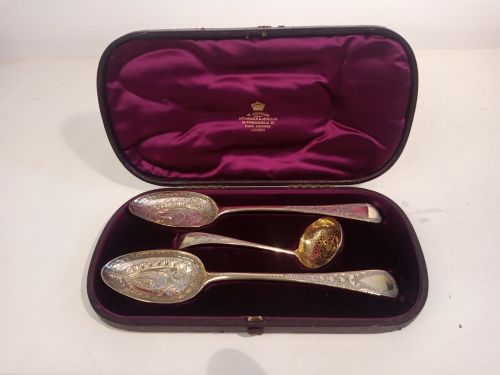
These gilt berry spoons span the Georgian, Victorian, and Edwardian eras, with many originating from the eighteenth and nineteenth centuries. Makers produced them primarily as serving spoons, sifter spoons, and fruit sets, often housing pairs in fitted boxes lined with velvet and silk.
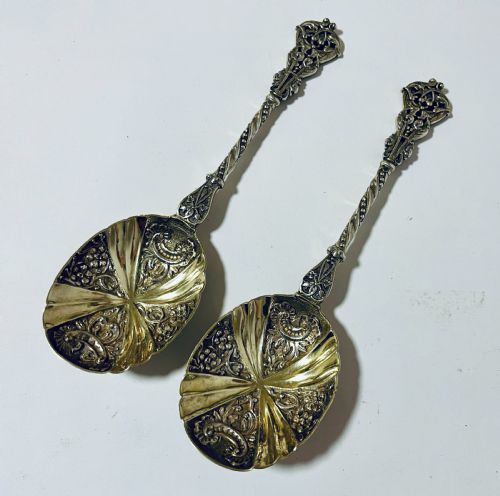
The assortment on this page includes sterling silver and silver-gilt examples alongside weighted Norwegian pieces and silver-plate fruit sets. Collectors encounter styles ranging from plain George III forms to elaborate Arts and Crafts and Art Nouveau designs.
How they were made
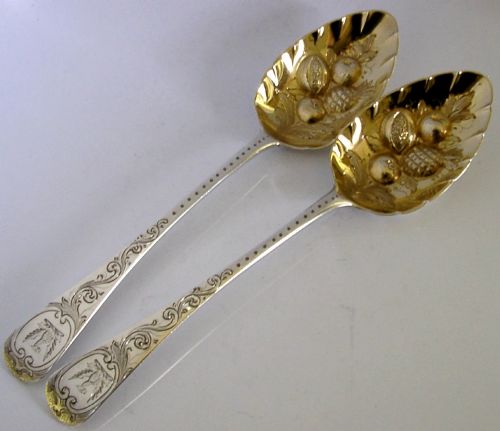
Silversmiths utilised sterling silver and silver-gilt, applying gold wash techniques to create the rich gilt surfaces inside the bowls and across the handles. Engraved handles and embossed fruit motifs on the bowls required skilled hand-chasing.
Many items incorporate crests and decorative chasing executed by prominent workshops. Fitted presentation cases utilise silk and velvet linings to protect the silver and gilt finishes during storage.
Gilt Berry Spoons Retail Price Guide 2026
Typical asking prices for gilt berry spoons among the pieces listed under this phrase on Sellingantiques today, from the lower quarter to the upper quarter. They describe what is for sale here now, not the wider market.
Many Georgian spoons started life as plain flatware before Victorian silversmiths chased them with exuberant fruit clusters.
What varies in quality
The weight of the silver and the crispness of the chased fruit decoration determine the distinction between standard and superior pieces. Heavier gauges and well-preserved gilding indicate higher grade manufacturing.
Completeness alters desirability, particularly when pieces retain their original silk and velvet lined boxes or form matching pairs by noted makers such as Peter and Anne Bateman or Marius Hammer.
Marius Hammer·Peter and Anne Bateman·William Chawner II
The Gilt Berry Spoons Glossary
- Silver-gilt
- Silver objects that have been coated with a thin layer of gold, often referred to as gilt. This technique enhances the interior of spoon bowls with a warm golden tone.
- Berry spoon
- A serving spoon featuring embossed fruit and leaf decoration chased into the bowl, typically produced during the Georgian and Victorian periods. Makers often adapted earlier plain spoons by adding this ornamentation later.
- Sifter spoon
- A serving spoon with a pierced or perforated bowl designed for dusting sugar over fruit or desserts. These appear in both Georgian and Arts and Crafts styles.
- Hallmark
- Official marks stamped onto precious metal items to guarantee purity, origin year, and maker identity. British pieces often display town marks and maker initials.
- George III
- The stylistic and historical period spanning the reign of King George III, noted for refined neoclassical silver forms before later Victorian elaboration.
Gilt Berry Spoons: Frequently Asked Questions
What were gilt berry spoons used for?
These spoons served soft fruits, berries, and desserts at formal dining tables during the Georgian and Victorian eras.
Hosts utilised them alongside sugar sifters to portion fruit cleanly from central serving dishes into individual plates.
How do I date a gilt berry spoon?
Hallmarks stamped onto the silver provide the exact year and assay office for British pieces made in London and other cities.
Stylistic shifts from plain Georgian lines to ornate Victorian and Art Nouveau engraving also help determine the period.
Are these spoons solid silver?
The selection includes sterling silver, hallmarked silver, and silver-plate items alongside Norwegian pieces marked with specific fineness numbers.
Silver-gilt versions feature a gold wash applied over the solid silver substrate to create the distinctive dual-tone finish.
How should I store boxed serving sets?
Fitted presentation boxes lined with silk and velvet protect the gilt surfaces and delicate engraving from friction and tarnish.
Keeping the spoons in their original cases away from direct light preserves the integrity of both the lining and the metal.