




Gilt Accent Walnut Table
These pieces unite rich timber and bright metal, giving a gilt accent walnut table its distinctive presence in a room.
Gilt Accent Walnut Table
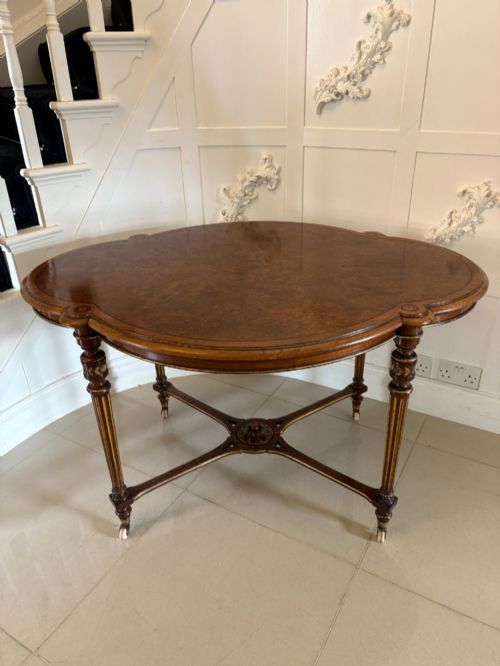
A gilt accent walnut table brings together dark wood and metallic detail across various forms such as centre tables, occasional tables, side tables, and etagere pieces. These items appear across the nineteenth century and into the early twentieth century, spanning Victorian, Louis XV Revival, French Rococo, and Empire influences.
Most examples rely on walnut or burr walnut for the primary structure, accented with gilt bronze, ormolu, brass, boxwood inlay, or parcel gilt highlights. Buyers encounter everything from small side pieces to large library tables and lamp tables, often showing French or Victorian design characteristics.
How they were made
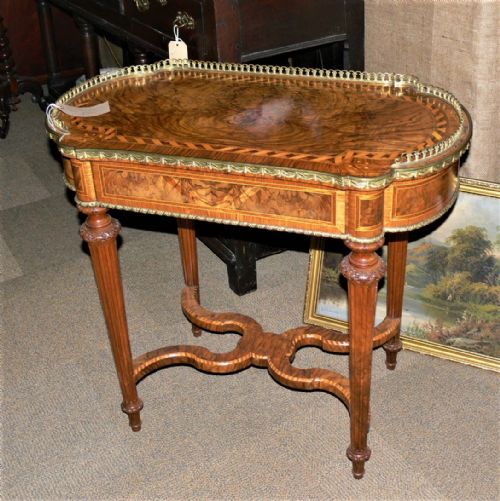
Cabinet makers utilised solid walnut and burr walnut veneers, frequently incorporating boxwood inlay and parquetry patterns across the top surfaces. Carved walnut elements provided structural form and decorative borders.
Metal mounts in ormolu, gilt bronze, and brass were cast and chased, then secured to the timber alongside ceramic castors on select items. Parcel gilding was applied to highlight specific carved areas of the walnut frames.
Some tables come fitted with original ceramic castors, allowing nineteenth-century tea trays to glide across the carpet with surprising Victorian smoothness.
What varies in quality
The refinement of the timber selection dictates the visual impact, with figured burr walnut and precise parquetry sitting above plain walnut surfaces. Finer pieces demonstrate tighter grain matching and more intricate boxwood inlay.
Metalwork execution separates standard production from superior examples, with crisply chased ormolu and gilt bronze mounts showing greater depth than simpler brass fittings. The precision of the joinery and the subtlety of the parcel gilding complete the distinction.
The Gilt Accent Walnut Table Glossary
- Burr walnut
- A figured wood grain obtained from walnut tree growths, valued for its complex swirling patterns. It appears frequently on tabletops.
- Ormolu
- Gilt bronze mounted onto furniture or used as decorative mounts, finished with a gold wash. It provides bright metallic contrast to the dark timber.
- Parquetry
- Geometric wood mosaics applied to furniture surfaces to create patterned panels. It forms decorative borders and tabletops.
- Gueridon
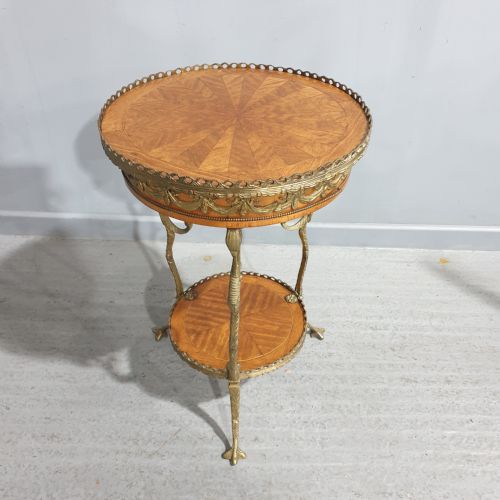
- A small French occasional table or stand, often round and supported by a central column or cabriole legs. These pieces frequently display revival styling.
Gilt Accent Walnut Table: Frequently Asked Questions
What rooms suit a gilt accent walnut table?
These tables fit easily into sitting rooms, libraries, and hallways as functional surfaces for lamps, books, or decorative objects. Their compact occasional forms allow them to sit beside seating or function as central display pieces.
The combination of dark walnut and bright metal accents helps these tables bridge traditional and more eclectic modern interior schemes without dominating the space.
How do I care for burr walnut and gilt mounts?
Dust the timber regularly with a soft, dry cloth and avoid applying modern aerosol polishes that can build up a residue over the walnut veneer. Keep the tables away from direct heat sources and strong sunlight to protect the finish.
Clean gilt bronze or ormolu mounts gently with a dry microfibre cloth, taking care not to use abrasive metal cleaners that might strip the gold finish.
How do I identify French revival styles on these tables?
French revival pieces often display characteristic Louis XV or Louis XVI curves, cabriole legs, and elaborate ormolu mounts. Look for shaped tops, parquetry work, and asymmetrical rococo detailing.
Victorian interpretations may blend these continental influences with heavier proportions or distinct British cabinet-making methods.
What is the difference between a centre table and an occasional table?
A centre table is traditionally designed to stand freely in the middle of a room, often finished on all sides with decorative timber and mounts. An occasional table is generally smaller and lighter, intended to be moved about a room as needed.
Both forms utilise walnut construction and gilt highlights, but their scale and intended placement within a historic room plan differ.