

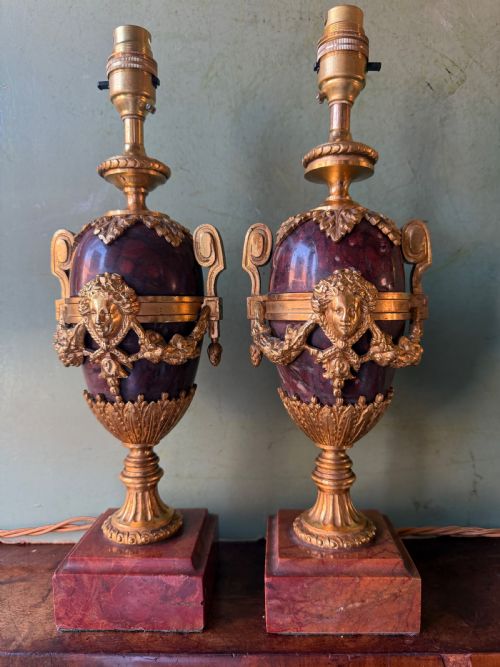


Gilded Bronze Mounted Lamps
These gilded bronze mounted lamps combine cast metalwork with marble, porcelain, or glass, bringing nineteenth-century French styling and warm illumination into a room.
Gilded Bronze Mounted Lamps
When you search for gilded bronze mounted lamps, you encounter nineteenth-century lighting fixtures that integrate cast metal mounts with bodies of marble, porcelain, or glass. The selection centres heavily on French Neoclassical, Louis XVI style, and Empire designs adapted as table lamps, torcheres, and ceiling lanterns.
The most common forms on this page include pairs of marble and ormolu table lamps alongside porcelain and glass vase conversions. These pieces originate primarily from the nineteenth century, spanning periods from the 1860s through to the 1930s.
Buyers also find occasional side tables with integrated lamps and hanging ceiling lanterns carrying gilt bronze frames and cut glass. Each piece reflects European domestic lighting history, merging decorative utility with sculptural metalwork.
Materials and construction methods
The construction relies on cast bronze or brass, frequently finished with a golden ormolu surface alongside structural elements of rouge marble and white marble. Workshops also mounted imported Japanese Satsuma pottery and Chinese export style porcelain into metal frames.
Craftsmen joined heavy stone bases to cast mounts using threaded rods and screws, incorporating fabric shades or glass shades for illumination. Surface decoration includes chased detailing on the metalwork alongside cut glass panels in ceiling fixtures.
Listings feature nineteenth-century French styles including Louis XVI, Empire, and Rococo Revival alongside Japanese Satsuma pottery.
Factors of quality and execution
Quality rests primarily in the crispness of the bronze chasing and the density of the marble or porcelain bodies. Finer examples display deeply carved foliage and sharply defined figures rather than soft, repetitive casting.
The weight and thickness of the ormolu mounts alongside the quality of the stone cutting separate standard production from superior workshop output. Original components and unified patination across the metal and stone components elevate the standing of a piece.
Coutan
The Gilded Bronze Mounted Lamps Glossary
- Ormolu
- Gilded bronze produced by applying a mercury and gold amalgam to cast bronze and firing it to leave a rich gold surface. This technique creates a durable finish seen on nineteenth-century French mounts.
- Rouge marble
- A deep red ornamental limestone with white and grey veining used extensively for bases and columns. It provides a heavy, colourful foundation for metalwork.
- Torchere
- A tall stand or floor lamp designed to hold a light source aloft. Nineteenth-century examples often take the form of classical figures holding torches.
- Satsuma
- A type of Japanese earthenware featuring cream-coloured crackle glaze decorated with enamel and gilt. These vessels were frequently exported to Europe and converted into lamp bases.
- Chinoiserie
- A European artistic style reflecting Chinese motifs and decorative techniques. It appears on porcelain bodies mounted in gilt bronze during the nineteenth century.
Gilded Bronze Mounted Lamps: Frequently Asked Questions
How do I date these lamps?
Dating relies on stylistic markers such as Louis XVI revival motifs, casting methods, and the type of marble or porcelain used in the body. Nineteenth-century pieces typically exhibit hand-chased metalwork and period wiring adaptations.
Examining the construction joints and the wear on the gilt surface provides further clues to the age and origin of the piece.
Are these lamps wired for modern use?
Most antique lamps are adapted for contemporary electrical standards, often with wiring that can be updated by a qualified electrician. Buyers should check the existing cord and plug configuration upon arrival.
The internal fittings are generally housed securely within the original metal or ceramic bodies without altering the exterior appearance.
How do I clean gilt bronze?
Gilt bronze and ormolu require gentle dusting with a soft, dry brush to avoid scratching the delicate gold surface. Moisture and chemical cleaners can strip the historical finish.
Maintaining these metals involves keeping them away from direct heat sources and abrasive cloths.
Can I find matching pairs?
Several listings feature matched pairs of table lamps, particularly those utilising rouge marble and ormolu mounts. These sets were often created together for sideboards or mantelpieces.
Single lamps also appear frequently, especially larger torcheres and converted vases.