
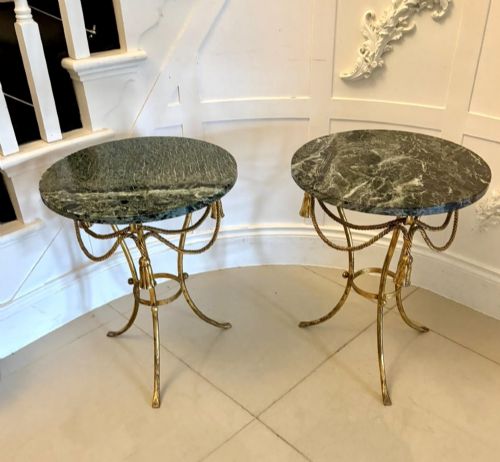



Gilded Brass Marble Table
A gilded brass marble table brings together heavy stone and cast metal in decorative furnishings spanning the nineteenth and early twentieth centuries.
Gilded Brass Marble Table
When you search for a gilded brass marble table, you encounter a selection of occasional tables, coffee tables, and lamp tables framed in brass, gilt metal, or ormolu and topped with marble, onyx, or rouge stone.
The pieces appearing on this page stretch from the Victorian era into the early twentieth century, drawing heavily on French Neoclassical, Louis XV, and Louis XVI revival styles.
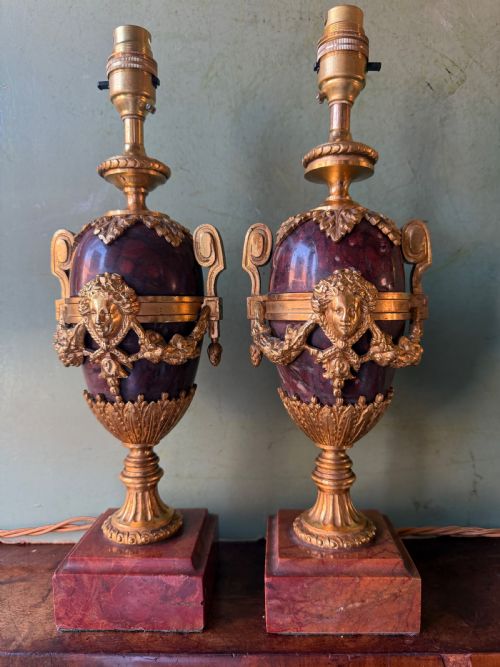
Alongside small support tables, the listings encompass related forms that share the same material palette, including marble and ormolu mantel clocks, candelabras, and columnar lamp bases.
Materials and construction
The foundational structure relies on cast brass, ormolu, and gilt metal, shaped into mounts, legs, and galleries that often reflect French stylistic influences.
Heavy slabs of white, green, or rouge marble provide the smooth upper surfaces, sometimes paired with secondary timbers such as mahogany and walnut in the supporting frames.
Gilding techniques impart a rich metallic finish to the bronze and brass elements, working alongside inset enamel dials and glass components on the timepieces.
Object types span mantel clocks, table lamps, side tables, coffee tables, occasional tables, plant stands, and candelabras.
Distinctions in quality
Quality rests heavily on the crispness of the metal casting and the depth of the gilding, where finer examples display sharp relief and deliberate chasing rather than soft outlines.
The choice and thickness of the marble top dictate the physical weight and presence of the piece, with richly coloured varieties like rouge or verde stone marking out superior execution.
Integration between the stone and the metal frame reveals the maker's hand, particularly where galleried edges and mounts fit precisely without excess adhesive or awkward gaps.
Japy Freres·Philippes Paris
The Gilded Brass Marble Table Glossary
- Ormolu
- Gilt bronze produced by applying a finely ground high-carat goldmercury amalgam to a bronze object. This skilled French technique gives decorative mounts their characteristic golden lustre.
- Galleried
- A raised ornamental border surrounding the edge of a table or shelf. It frequently takes the form of pierced brass or cast metal work designed to keep items from sliding off.
- Garniture
- A set of decorative objects designed to be displayed together, typically comprising a central clock flanked by matching candelabras or vases.
- Portico clock
- A mantel clock architectural in form, featuring a dial suspended within a frame supported by columns. They frequently incorporate marble and gilt bronze elements.
- Verde marble
- A dark green ornamental stone often variegated with white veins. It is commonly utilised for lamp bases and table tops.
Gilded Brass Marble Table: Frequently Asked Questions
What periods do these pieces date from?
The pieces span the nineteenth and early twentieth centuries, capturing the Victorian era and revivals of earlier French aesthetics.
Dates cluster around the middle and late Victorian decades, stretching into the nineteen-twenties and thirties.
How do I identify Louis XVI style?
Louis XVI style relies on classical restraint, featuring straight lines, symmetrical mounts, and architectural motifs drawn from antiquity.
Ormolu details on these pieces often incorporate ribbon twists, acanthus leaves, and fluted columns rather than the asymmetrical curves of the preceding Louis XV period.
Where were most of these items made?
France is the primary origin point for the majority of the clocks, lamps, and tables found in this selection.
French workshops set the standard for ormolu casting and marble work during the nineteenth century.
How should I care for marble tops?
Marble requires gentle cleaning with a damp cloth and mild soap to preserve the polished surface without scratching the stone.
Avoid acidic liquids and harsh household cleaners, which can etch and dull the natural finish over time.