






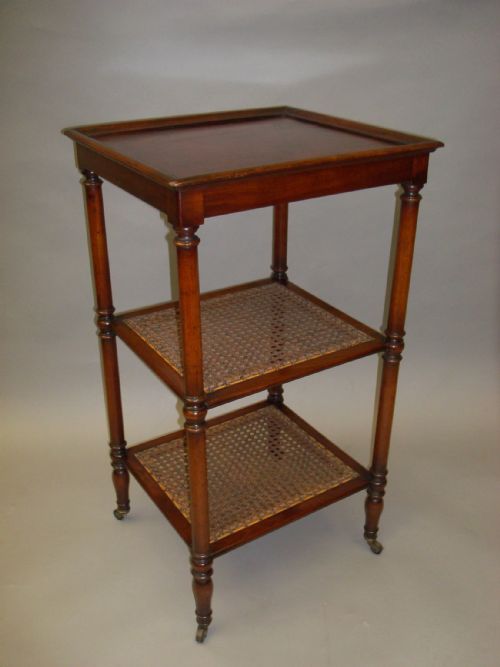

Georgian Whatnot Table
These open display stands and tiered serving pieces are practical pieces of furniture, and a georgian whatnot table brings layered shelving and period character to any room.
Georgian Whatnot Table
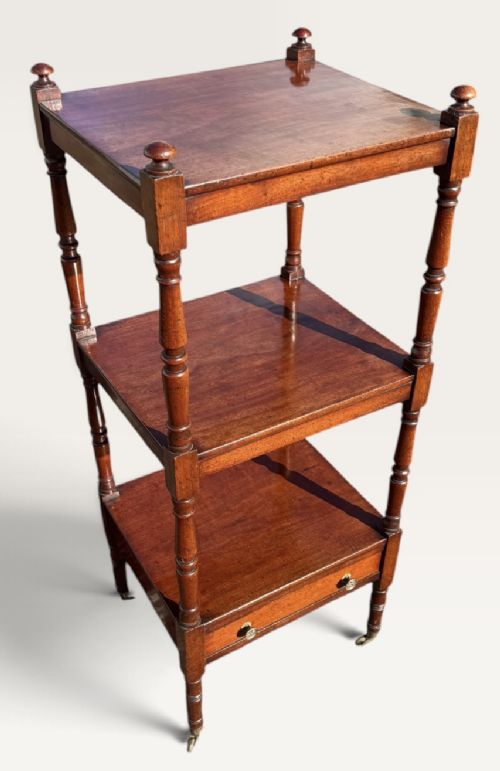
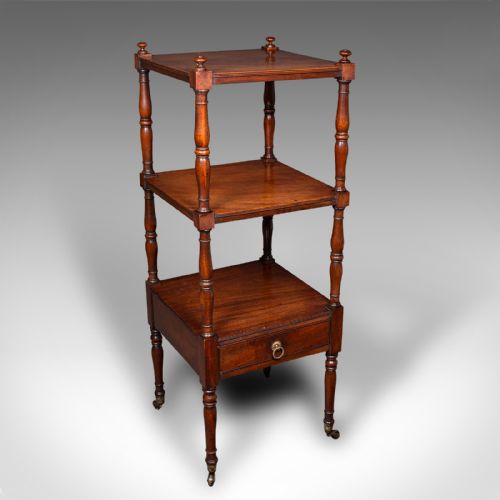
A georgian whatnot table functions as an open display stand or tiered etagere designed for holding books, decorative objects or dining items. These pieces typically take the form of stacked shelves supported by slender uprights, offering multiple levels of surface area without occupying a large footprint on the floor.
The versions most commonly found here belong to the Regency and George III periods, alongside later Victorian interpretations and Sheraton Revival pieces. Makers constructed these stands in varying heights, ranging from compact two-tier tables to taller three-tier structures, occasionally incorporating dumb waiter designs or bedside shelf configurations.
Materials and construction
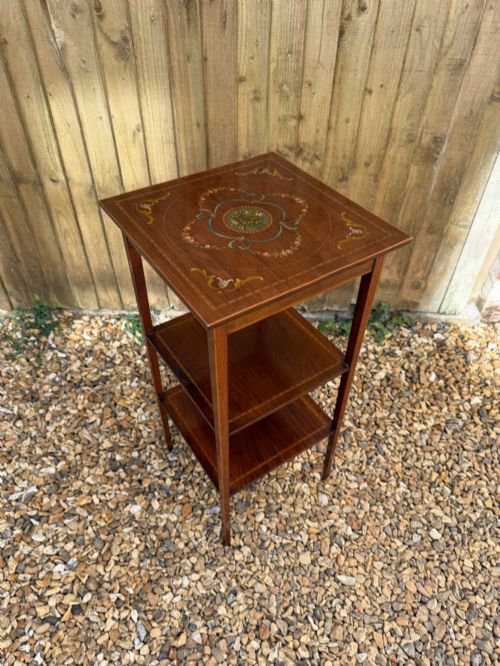
Cabinet makers built these tiered stands primarily using solid mahogany and rosewood, frequently selecting figured timber for the main display surfaces. Workshops also utilised oak, birdseye maple and painted finishes to achieve different aesthetic effects.
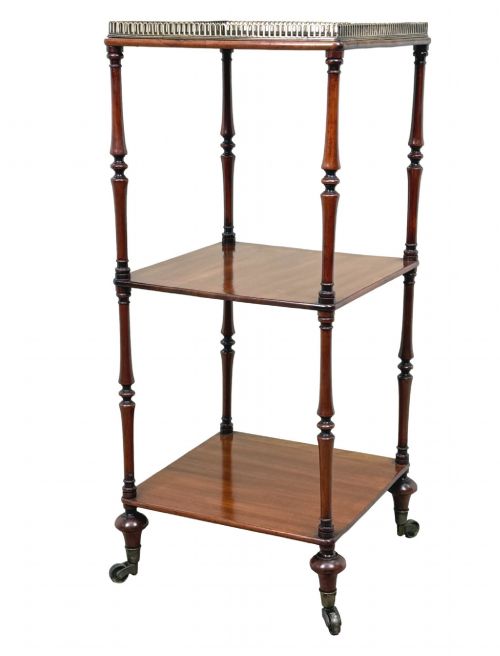
Detailing often included contrasting boxwood inlay and brass fittings such as castors or gallery rails. Structural support relied on slender corner posts or turned columns dividing each tier clearly.
Georgian Whatnot Table Retail Price Guide 2026
Typical asking prices for georgian whatnot table among the pieces listed under this phrase on Sellingantiques today, from the lower quarter to the upper quarter. They describe what is for sale here now, not the wider market.
Periods represented span from George III and Regency eras through late Victorian revivals.
Distinctions in craftsmanship
Superior examples demonstrate refined proportions and careful timber selection, where the grain pattern of the mahogany or maple is displayed to full advantage across every tier. Finer pieces often incorporate subtle decorative elements like string inlay or elegantly turned uprights rather than plain structural supports.
The overall rigidity of the stacked tiers and the crispness of the joinery distinguish higher grade pieces from simpler utility items. Quality makers paid close attention to the turning of the columns and the secure fitting of each shelf corner.
Gillows
The Georgian Whatnot Table Glossary
- Whatnot
- An open set of shelves used for displaying ornaments, books or tea wares. This form originated in the eighteenth century and remained popular through the Victorian era.
- Etagere
- A piece of furniture consisting of a series of open shelves for displaying small objects. The term is frequently used interchangeably with whatnot.
- Dumb waiter
- A tiered stand traditionally placed beside a dining table to hold dishes and cutlery. Certain examples combine this function with the open shelving of a whatnot.
- Boxwood inlay
- Narrow strips of pale wood inserted into contrasting darker timber to create linear decoration. This technique frequently frames the edges of shelves on finer pieces.
Georgian Whatnot Table: Frequently Asked Questions
What were whatnot tables used for?
These pieces served as versatile display and storage surfaces in principal rooms throughout the home. Families used them for holding books, porcelain, tea equipment and decorative ornaments.
Their open tiers allowed owners to keep frequently used items accessible while displaying collections. In dining contexts, similar tier configurations acted as serving stations for courses and utensils.
How do I identify a Regency whatnot?
Regency examples typically exhibit clean architectural lines, dark mahogany timbers, and sophisticated turning on the upright supports. Brass castors and subtle brass gallery rails often appear on these models.
Proportions on Regency pieces tend to be compact and balanced, reflecting the neoclassical tastes of the early nineteenth century. Makers during this period favoured restrained elegance over heavy ornamentation.
Can I use an antique whatnot as a bedside table?
Compact tiered stands and bedside shelf configurations suit modern bedroom layouts effectively. The multiple levels provide convenient separation for reading materials, lighting and personal items.
Selecting a piece with appropriate height and sturdy lower shelves ensures stability next to a standard bed frame.
What is the difference between a whatnot and an etagere?
Both terms describe multi-tiered open shelving units, though etagere sometimes implies a more decorative or French-influenced design. English makers generally preferred the term whatnot for utility stands.
In practice, historical makers and modern dealers use both labels interchangeably for pieces sharing this stacked shelf construction.