

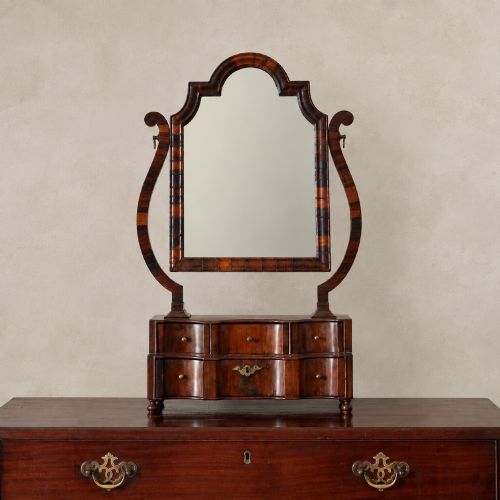


Georgian Walnut Table Glass
Georgian walnut table glass pieces are dressing and toilet mirrors designed for the vanity, offering rich timber figuring and adjustable plates that buyers prize.
Georgian Walnut Table Glass
When you search for Georgian walnut table glass, you are looking at small dressing mirrors and toilet mirrors designed to sit upon a chest of drawers or a dedicated dressing table. These items date primarily from the eighteenth century, spanning the Queen Anne, George II, and George III periods, alongside nineteenth-century examples and Dutch neo-classical variations.
The most common form you will meet on this page is the toilet mirror featuring an adjustable glass plate mounted between upright posts, sitting atop a small base fitted with one or more drawers. These pieces served a daily practical purpose in bedchambers for grooming and dressing, constructed in rich timbers including burr walnut and red walnut.
Makers utilised various decorative techniques to enhance these mirrors, including boxwood inlay, laburnum banding, and gold leaf highlights. Alongside standard rectangular dressing mirrors, the inventory includes specialised box mirrors and dressing table mirrors reflecting diverse regional styles from the seventeen-fifties through to eighteen-ten.
How they were made
Craftsmen built these mirrors using solid walnut and burr walnut veneers applied to secondary timbers, often accentuating the primary surfaces with contrasting boxwood inlay or laburnum stringing. The mirror frames and supporting bases rely on traditional joinery methods suited to domestic furniture of the eighteenth and nineteenth centuries.
Hardware played an essential functional role, with brass hinges and pivoting screws allowing the glass plate to tilt securely to the user's preferred angle. Interior compartments within the base drawers frequently incorporated small partitions for storing personal valuables and grooming accessories.
Georgian Walnut Table Glass Retail Price Guide 2026
Typical asking prices for georgian walnut table glass among the pieces listed under this phrase on Sellingantiques today, from the lower quarter to the upper quarter. They describe what is for sale here now, not the wider market.
Current listings feature materials including walnut, burr walnut, laburnum, boxwood inlay, brass, gold leaf, and mirror glass across the eighteenth and nineteenth centuries.
What varies in quality
The distinction between standard examples and superior pieces rests largely in the choice of timber figure, particularly the richness and depth of the burr walnut veneer used across the drawer fronts and frame. Finer execution shows in the crispness of the boxwood inlay and the careful selection of secondary woods like laburnum for banding.
Proportion and structural integrity dictate the overall calibre of a dressing mirror, with better-balanced upright posts and neatly dovetailed drawer construction marking out superior cabinet work. The retention of original mirror glass and authentic brass pivoting hardware substantially elevates the character of the piece.
The Georgian Walnut Table Glass Glossary
- Toilet mirror
- A small adjustable looking glass designed to stand on a dressing table or chest of drawers. These portable mirrors became essential bedroom furnishings during the eighteenth century.
- Burr walnut
- A prized timber veneer showing intricate, swirling grain patterns formed from tree growths. Cabinet makers selected it for its decorative impact on prominent surfaces.
- Laburnum
- A dense hardwood often utilised for contrasting cross-grain banded borders on fine tables and mirrors. Its dark heartwood creates a striking visual frame.
- Boxwood inlay
- Light-coloured decorative woodwork inserted into recesses within a darker primary timber. It provides sharp linear definition to drawer fronts and mirror frames.
Georgian Walnut Table Glass: Frequently Asked Questions
What is a walnut table glass?
A walnut table glass is a portable dressing or toilet mirror made from walnut timber, designed to sit on top of a chest of drawers.
These pieces feature an adjustable mirror plate mounted in a frame above a small compartmented base with drawers.
How were these mirrors used?
They were used in bedchambers for personal grooming, shaving, and applying wigs or makeup.
The small drawers in the base provided convenient storage for personal trinkets, pins, and cosmetics.
How do I date a Georgian mirror?
Dating relies on observing stylistic markers such as Queen Anne curves, George II proportions, or George III neoclassical details.
Construction methods, timber choices like burr walnut, and secondary woods also help establish the approximate period of manufacture.
Are the mirror plates original?
Many eighteenth-century mirrors have replacement glass plates because old mirror glass degrades or silvering deteriorates over time.
Examining the glass thickness and the backboards helps determine whether the looking glass retains its original plate.