

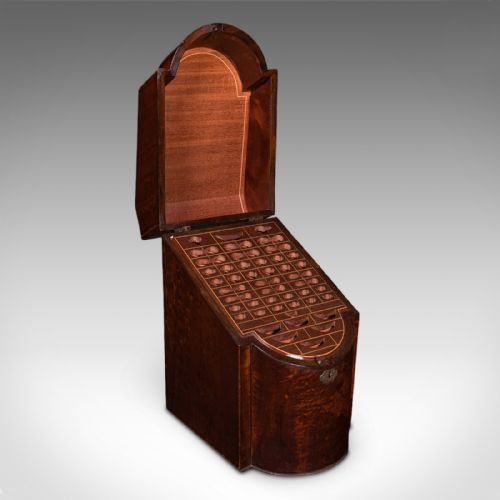


Georgian Stationery Knife
A georgian stationery knife or converted knife box is a desk accessory for letters and papers, prized for its figured timbers and fine proportions.
Georgian Stationery Knife
Buyers seeking a georgian stationery knife encounter desk pieces and slope-front boxes originating from the eighteenth century, George III period, and around eighteen hundred. These items frequently take the form of converted knife boxes or purpose-built letter holders designed to sit upon a desk.
The dominant forms present on this page include serpentine mahogany knife boxes, satinwood boxes mounted in silver, and inlaid storage boxes adapted for stationery. Mahogany and satinwood provide the primary wooden structures, often enhanced by decorative wood inlay.
Makers of the period constructed these storage boxes and cutlery chests with sloping lids and upright backs, shapes that lent themselves naturally to holding letters and papers. Examples range from small traditional boxes to larger stationery cabinets fitted with internal compartments.
Materials and construction
Cabinetmakers utilised solid mahogany and satinwood for the carcasses of these boxes, applying fine wood inlay to create contrasting borders and decorative motifs. Selected timbers display strong figuring, particularly on curved serpentine fronts.
Metal fittings such as brass handles, escutcheons, and hinges secure the lids and provide functional handling points. Silver mounts occasionally appear on satinwood pieces, adding a reflective contrast to the polished timber.
Georgian Stationery Knife Retail Price Guide 2026
Typical asking prices for georgian stationery knife among the pieces listed under this phrase on Sellingantiques today, from the lower quarter to the upper quarter. They describe what is for sale here now, not the wider market.
Judging quality and character
Superior examples display exceptional timber selection, where the grain of the mahogany or satinwood flows naturally across the curved serpentine shape of the box. Fine craftsmanship shows in the precision of the wood inlay and the crispness of the brass fittings.
The integrity of the conversion work distinguishes adapted knife boxes, as older adaptations retain the original proportions and internal character of the piece. The overall presence relies upon untouched surface patination rather than heavy modern restoration.
The Georgian Stationery Knife Glossary
- Serpentine
- A curved shape curving outward at the centre and inward at the sides, frequently seen on eighteenth-century box fronts.
- Satinwood
- A yellow-brown tropical timber with a lustrous sheen, utilised during the Sheraton period for high-status cabinet work.
- Inlay
- A decorative technique where pieces of contrasting wood are inserted into depressions within the primary surface.
- Escutcheon
- A protective brass plate surrounding a keyhole, designed to prevent wear on the surrounding timber.
Georgian Stationery Knife: Frequently Asked Questions
What is a georgian stationery knife?
A georgian stationery knife typically refers to desk accessories or converted eighteenth-century knife boxes used for organising letters and papers.
These pieces reflect the cabinet-making styles of the George III era, utilising figured mahogany and satinwood.
How were these boxes used?
Original knife boxes were built to store cutlery on dining tables before being adapted over time to hold letters and writing materials on desks.
Their sloping lids and internal dividers made them suitable repositories for correspondence in period libraries and studies.
Where should you place a stationery box?
These boxes sit securely on a partner desk, side table, or writing slope where their polished timbers remain visible.
They serve both a decorative function and a practical role in holding modern letters or cards.