



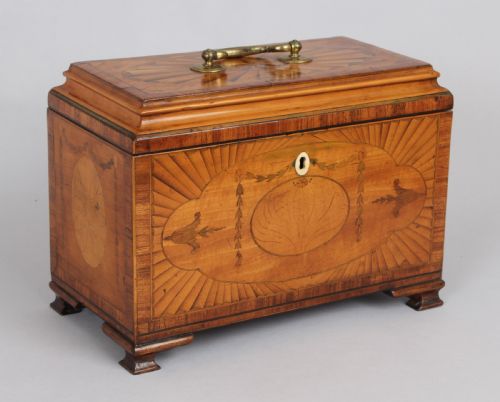

Georgian Satinwood Tea Caddy
A georgian satinwood tea caddy brings pale figured timber and neoclassical inlay to a room, holding dry leaf safely away from damp air.
Georgian Satinwood Tea Caddy
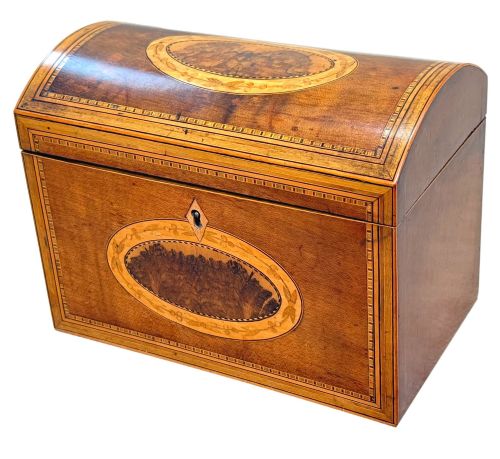
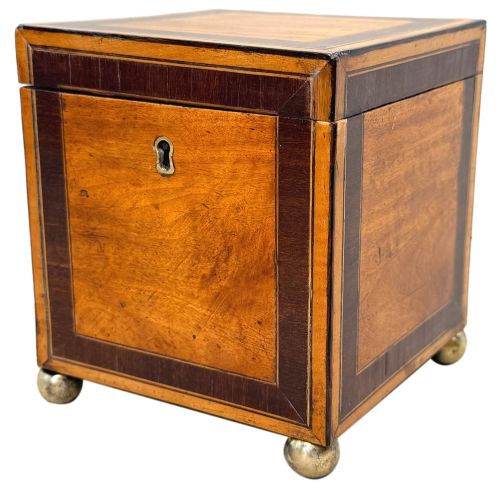
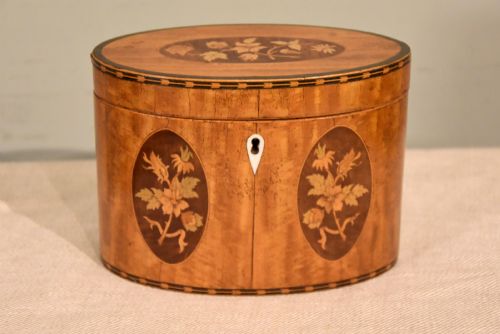
A georgian satinwood tea caddy is a small wooden chest made to store precious tea leaves under lock and key during the eighteenth and early nineteenth centuries. These boxes survive in square, oval, octagonal, and sarcophagus forms, often displaying contrasting veneers and delicate inlay.
The pieces on this page span the Georgian, Regency, and Victorian eras, drawing on George III styles and Neoclassical motifs. Alongside standard tea caddies, the selection includes related forms such as teapoys, needlework boxes, and jewellery caskets finished in the same timber.
What varies in quality
The standard of a georgian satinwood tea caddy rests on the choice of timber figure and the precision of its inlay work. Finer examples display balanced grain patterns and crisp, tightly fitted geometric or pictorial stringing.
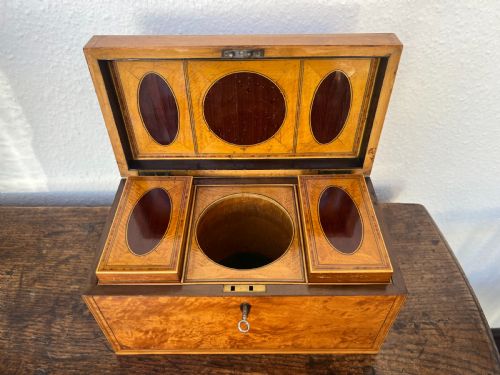
Proportion and surface finish dictate value. Pieces retaining their original interior fittings, such as mixing sticks and glass bowls, demonstrate greater integrity than those altered over time.
Georgian Satinwood Tea Caddy Retail Price Guide 2026
Typical asking prices for georgian satinwood tea caddy among the pieces listed under this phrase on Sellingantiques today, from the lower quarter to the upper quarter. They describe what is for sale here now, not the wider market.
Listings feature satinwood combined with brass, bone, harewood, ebony, boxwood, rosewood, and mahogany across Georgian and Regency periods.
The Georgian Satinwood Tea Caddy Glossary
- Satinwood
- A tropical timber prized for its lustrous, golden sheen and smooth grain. It forms the primary visible surface on these caddies.
- Harewood
- Sycamore timber stained a cool grey-green tone using iron salts. It appears frequently in neoclassical stringing and panels.
- Marquetry
- The art of forming decorative patterns using thin veneers of various woods. Craftsmen assemble these pictorial designs carefully before gluing.
- Teapoy
- A small stand or large caddy designed to hold tea canisters and a mixing bowl. They stand upon central pillars or bracket feet.
- Escutcheon
- A small protective plate surrounding a keyhole. These fittings utilise brass and prevent timber wear around the lock.
Georgian Satinwood Tea Caddy: Frequently Asked Questions
What is a georgian satinwood tea caddy?
A small wooden storage chest designed in the Georgian period to keep loose tea leaves secure and fresh.
These boxes utilise figured satinwood veneers and often feature delicate inlay work or internal glass bowls.
How were tea caddies used?
Servants or homeowners kept tea locked away because the dry leaf was an expensive commodity.
The host mixed black and green teas inside the caddy using a small bowl before brewing.
How do I date a satinwood caddy?
Look to the overall silhouette, such as oval or sarcophagus shapes, and the specific inlay motifs employed.
Neoclassical shell designs and stringing indicate late eighteenth century George III craftsmanship.
Can I use these for modern storage?
These boxes suit jewellery, trinkets, and small keepsakes rather than daily modern tea storage.
Keep them away from direct sunlight and radiators to protect the delicate veneer and timber.