
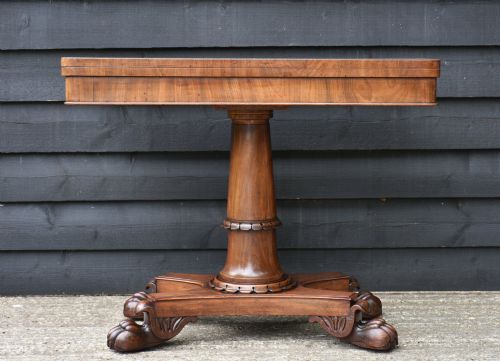
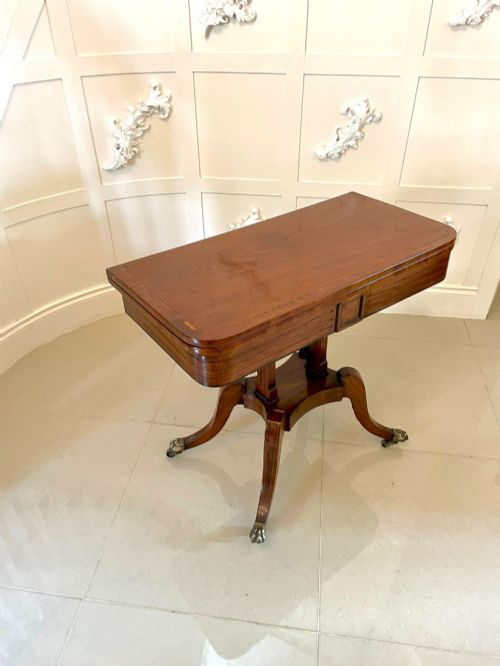
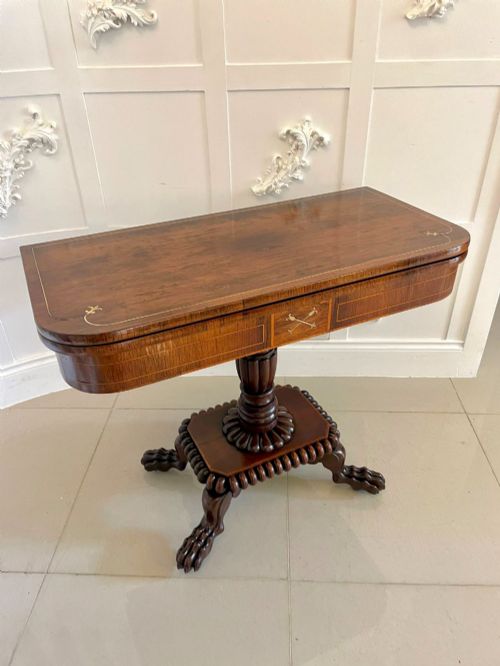
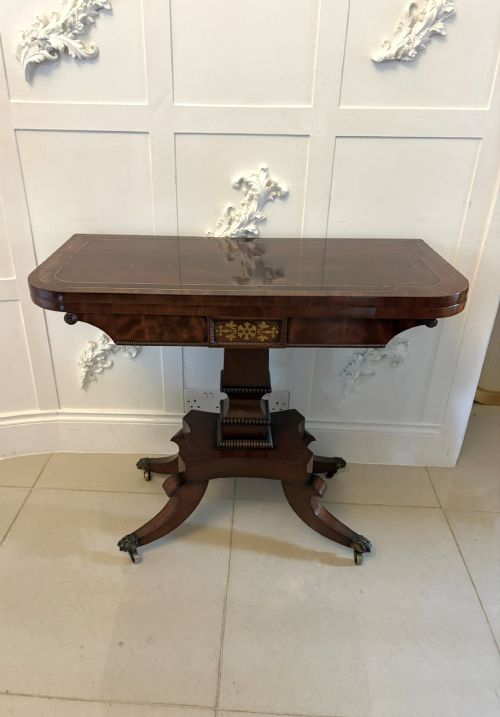
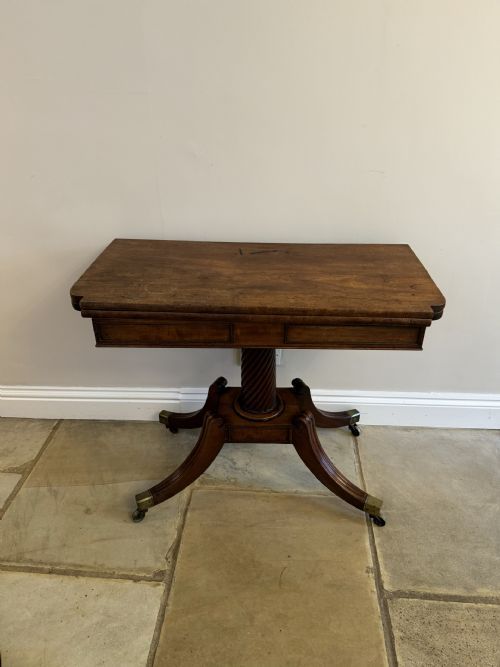
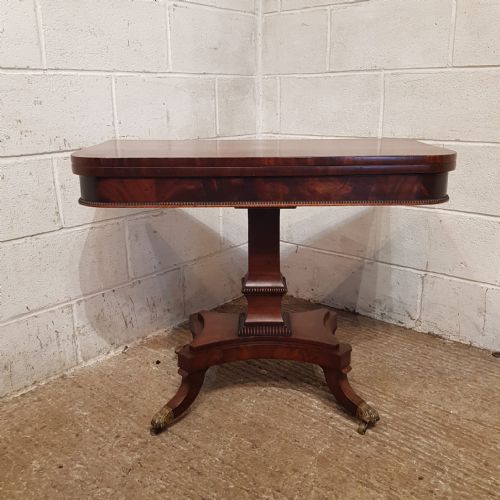
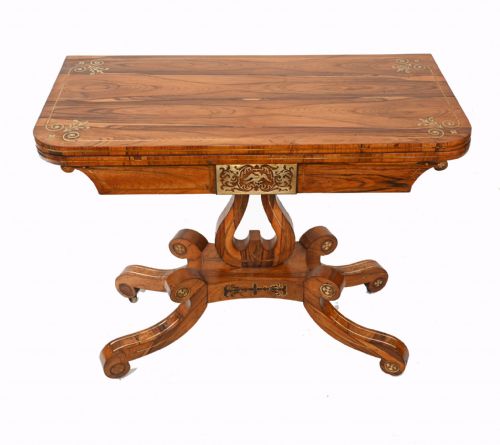
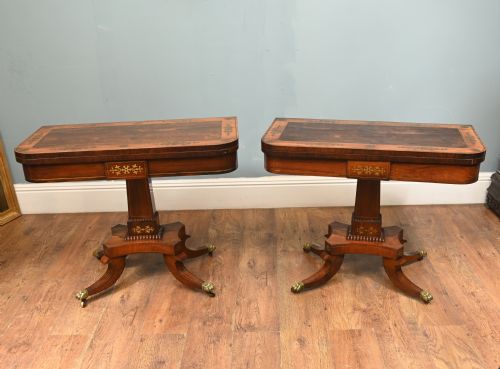


Georgian Pedestal Games Table
A georgian pedestal games table is a fold-over surface for cards and board play, offering clever mechanical ingenuity and rich timber grain.
Georgian Pedestal Games Table
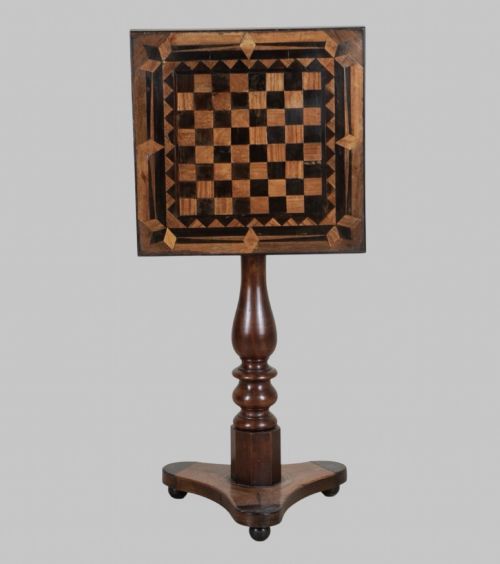
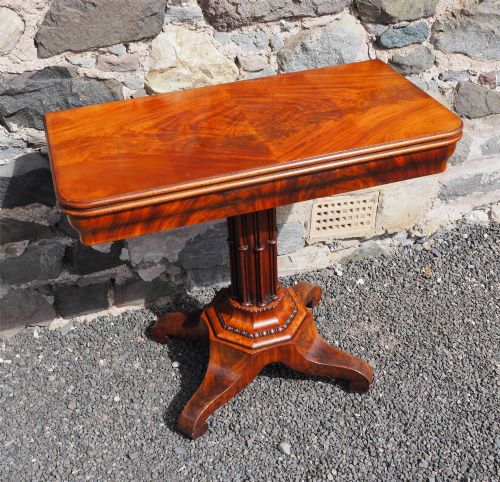
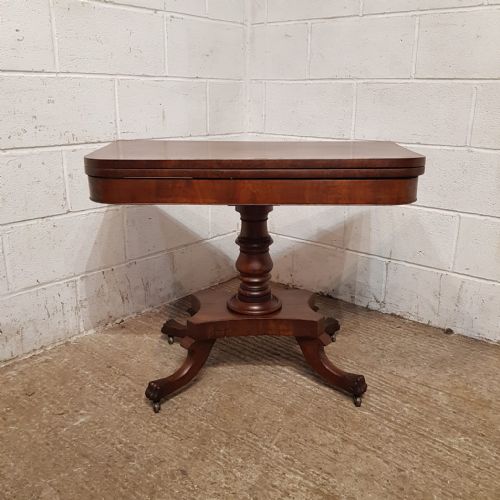
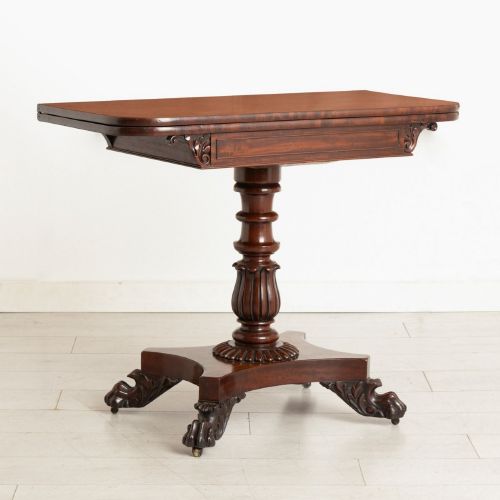
A georgian pedestal games table provides a versatile surface for evening entertainment, moving easily from a compact console or side table to a full playing top. The pieces on this page span the Georgian, Regency, George III, George IV, and William IV periods, alongside nineteenth-century interpretations.
Most examples rely on a central pillar or pedestal rising from a platform base with feet, supporting a hinged top that folds open to reveal a baize-lined interior. Card tables, tea tables, and occasional variants appear frequently across these listings.
Makers utilised rich timbers such as mahogany, rosewood, and satinwood, often embellishing the forms with brass inlay, boxwood stringing, and ebony details.
What varies in quality
The choice of timber sets the baseline for quality, distinguishing plain boards from richly figured flame mahogany and dense, dark rosewood. Master cabinetmakers demonstrated superior skill in the crispness of carved pedestal details, the precision of brass inlay, and the seamless fit of fold-over hinges.
Proportion and stability dictate the upper tier of these pieces, where the pedestal and base maintain balanced weight without looseness in the pivoting mechanism.
The furniture forms span card tables, tea tables, and console tables supported by central pedestals.
William Trotter·George Merrifield
The Georgian Pedestal Games Table Glossary
- Baize
- A coarse woollen fabric used to line the playing surfaces of card and games tables. It provides a durable, tactile texture designed to prevent cards from sliding.
- Crossbanding
- A narrow strip of veneer applied to the border of a table top so that the grain runs at right angles to the main panel. This technique frames the primary timber.
- Console
- A table designed to stand against a wall, often supported by front legs or a pedestal base. Many fold-over tables function in this closed position.
- Penwork
- A decorative technique utilising ink drawn onto light woods like satinwood to create fine linear motifs. It appears on specialised chess and games tables.
- Stringing
- Thin inlaid lines of contrasting wood, such as boxwood or ebony, used to outline panels and edges. It adds subtle geometric definition to the timber surface.
Georgian Pedestal Games Table: Frequently Asked Questions
How do you open the top safely?
Most tables feature a swivel or hinged leaf that rotates on the pedestal to support the opened playing surface.
Lift the upper leaf gently and swing it carefully into position, ensuring the pivoting mechanism bears the weight evenly before lowering it flat.
What were these tables used for?
These pieces served multiple functions in domestic interiors, operating as side or console tables during the day.
By evening, households unfolded the top to reveal a baize surface designated for card games, chess, and social entertainment.
How do I care for the baize?
The woollen playing cloth requires gentle brushing to remove dust and debris accumulated from regular use.
Keep the table away from direct sunlight and excessive moisture to preserve the vibrant colour of the fabric and the surrounding timber.
How do I distinguish Regency from George III?
George III pieces often display cleaner classical lines with mahogany solids and subtle stringing.
Regency examples incorporate bolder rosewood veneers, dramatic brass inlay, pedestal bases with platform feet, and influences from classical antiquity.