





Georgian Pearlware China
Georgian pearlware china brings refined blue and white transfer-printed earthenware to the table, offering collectors historic narrative patterns on refined ceramic bodies.
Georgian Pearlware China
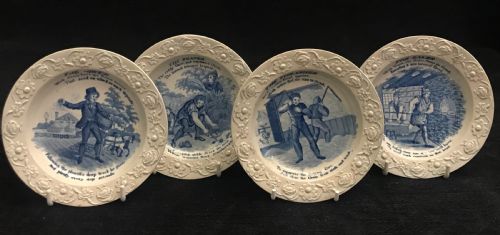
When you search for georgian pearlware china, you are looking at early nineteenth-century earthenware featuring distinct blue and white transfer-printed decoration. The pieces on this page comprise decorative plates, serving platters, serving dishes, and tureens spanning the Georgian and Regency periods.
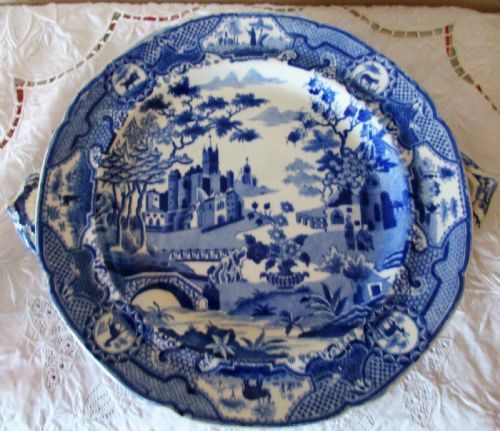
The objects display a variety of pictorial designs, ranging from classic Chinoiserie pagodas and bridges to romantic landscapes like the Gothic Castle and Returning Woodman patterns. You will most frequently meet standard plates and larger serving platters produced by Staffordshire potteries during this era.
Originating around the turn of the nineteenth century, these ceramics bridge the gap between earlier salt-glazed wares and later Victorian mass production. They served practical dining functions in households while showcasing intricate topographical and exotic imagery.
How they were made
Makers formed these items using refined earthenware bodies, applying a subtle bluish-tinted glaze to mask the natural cream colour of the fired clay. This characteristic glaze sits distinctively in the recesses of the ceramic, creating the signature pearl-like appearance.
Decoration relied upon cobalt pigment transferred from copper plates onto the ceramic surface before glazing and high-temperature firing. This transfer-printing technique allowed Staffordshire potteries to produce complex pictorial scenes consistently across plates and tureens.
Georgian Pearlware China Retail Price Guide 2026
Typical asking prices for georgian pearlware china among the pieces listed under this phrase on Sellingantiques today, from the lower quarter to the upper quarter. They describe what is for sale here now, not the wider market.
Elephants and Gothic castles share table space here, proving Georgian potters possessed wildly imaginative travel itineraries.
What varies in quality
The clarity of the cobalt pigment transfer largely dictates visual success, separating sharp, deeply detailed landscapes from blurred or smudged impressions. Print registration and the depth of the blue colouration across the surface show the skill of the individual pottery.
Body weight and the delicacy of moulded or pierced rims also divide standard utility items from finer display pieces. Pierced work on serving dishes requires precise hand-cutting while the clay is soft, marking out more ambitious workshop output.
Spode·William Adams·Brameld and Co.·John Davenport·John Rogers and Son
The Georgian Pearlware China Glossary
- Pearlware
- A refined earthenware developed by Josiah Wedgwood and adopted widely in Staffordshire, characterised by a thin glaze containing a small amount of cobalt to make the ceramic appear whiter.
- Transfer printing
- A decoration method where an engraved copper plate prints an image onto tissue paper, which is then transferred onto the unglazed or biscuit ceramic body.
- Tureen
- A deep covered bowl designed for serving soup, gravy, or vegetables at the dining table, often accompanied by a matching platter.
- Cobalt pigment
- A metallic oxide used under the glaze to achieve the deep, stable blue colour characteristic of early nineteenth-century tablewares.
Georgian Pearlware China: Frequently Asked Questions
How do I identify genuine pearlware?
Authentic pearlware exhibits a characteristic bluish pooling of the glaze, particularly around foot rims and crevices, distinguishing it from later whiteware.
Examination of the potting weight, underside spur marks, and the soft tone of the blue transfer print further helps confirm the period.
Can I use these plates for dining?
While these ceramics remain robust earthenware, centuries of microscopic glaze crazing make modern dishwashing and heavy daily use risky for antique pieces.
Displaying them on plate racks or utilising them strictly for gentle service preserves the fragile cobalt decoration and glaze.
What caused the blue colour variation?
The intensity of the blue depends on the thickness of the cobalt application and the exact temperature inside the pottery kiln during the gloss firing.
Different Staffordshire works maintained proprietary recipes for their cobalt mixes, resulting in shades from pale slate to deep violet-blue.