



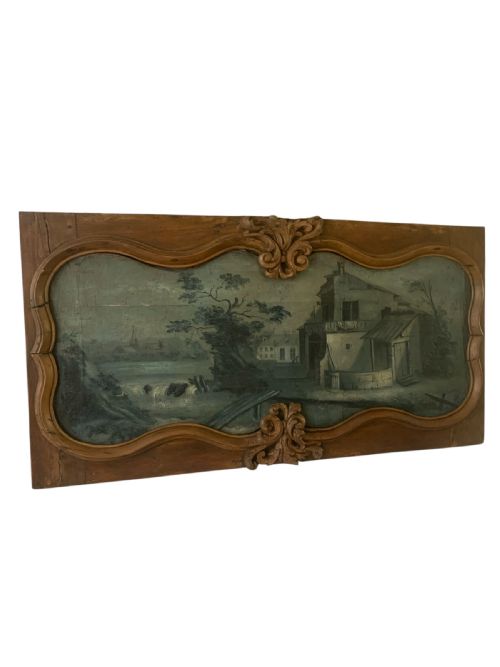


Georgian Landscape Panel
A georgian landscape panel brings the calm of the countryside and the architecture of past centuries directly onto the wall.
Georgian Landscape Panel
When you search for a georgian landscape panel, you encounter a selection of works that capture rural scenes, architectural views, and pastoral settings from the eighteenth and nineteenth centuries. These pieces encompass oil paintings on wood panel and canvas, alongside needlework pictures, silkwork embroidery, and painted overdoor sections.
The objects span periods from the Georgian and Regency eras, with works originating from English, Irish, and Dutch traditions. Alongside framed paintings on wood panels, buyers frequently discover landscape mirrors featuring eglomisé panels and giltwood frames designed to reflect light and space.
The selection ranges from topographical views of English counties to naive depictions and detailed architectural paintings. Each piece offers a tangible connection to historical craftsmanship, whether executed in oil paint, pen and ink, or woven textiles.
How They Were Made
Makers utilised oil paint on wood panels and canvas to render detailed topographical scenes, rural landscapes, and hunting subjects. Artists applied pigments with precision, often working on oak panels or stretched canvas to achieve durable surfaces.
Carved giltwood and gesso formed the frames and trumeau structures, incorporating gold leaf to enhance the reflective quality of mirrors and panels. Craftsmen also employed glass eglomisé techniques, painting and gilding directly onto glass panels within architectural mirror frames.
Textile works relied on needlework and silkwork embroidery, where makers utilised fine threads to construct pictorial landscapes and domestic scenes. Drawing was also practiced, utilising pen and ink on panel to record countryside vistas.
Listings feature oil paint, giltwood, gesso, glass, and gold leaf applied across canvas, wood panels, and textiles.
What Varies in Quality
The fineness of brushwork and the precision of perspective separate accomplished artistic renderings from simpler folk or naive interpretations. Artists who mastered light and spatial depth produced works with greater visual harmony and descriptive power.
Frame construction and surface gilding reveal the skill invested in the object's presentation, particularly in carved giltwood overmantels and pier mirrors. Original materials, intact gilding, and well-preserved wood panels distinguish pieces that retain their historical integrity from those with extensive later alterations.
Hendrik Willem Schweickhardt·Richard Leech·George Lambert
The Georgian Landscape Panel Glossary
- Eglomisé
- A technique involving cold painting and gilding on the reverse side of glass to produce a brilliant decorative panel. This method frequently appears in Regency trumeau mirrors and architectural wall pieces.
- Trumeau
- A decorative wall mirror or panel that incorporates an artwork or painted scene within its upper section. Such pieces were designed to hang between windows or above mantelpieces.
- Overmantel
- A large mirror or panel created specifically to hang above a fireplace mantel. These items often feature triptych glass plates and giltwood mouldings.
- Naive Art
- Artistic production characterised by a childlike perspective, flat perspective, and direct charm. These works lack formal academic training yet convey authentic local character.
Georgian Landscape Panel: Frequently Asked Questions
How do I care for wood panel paintings?
Wood panels require stable indoor humidity to prevent the wood from expanding or contracting excessively. Keep them away from direct heat sources and strong sunlight.
Dust gently with a dry, soft cloth and avoid liquid cleaners on both the painted surface and the surrounding giltwood frame.
What is an eglomisé panel?
An eglomisé panel is a piece of glass decorated on the reverse with gold leaf and paint. This creates a reflective, glossy finish popular in Regency mirrors.
The technique protects the delicate metallic leaf behind the glass, ensuring the decoration endures over centuries.
How do I identify a Regency mirror?
Regency mirrors frequently incorporate classical motifs such as acanthus leaves, columns, and giltwood frames. They often feature triptych plates and integrated landscape panels.
The overall design reflects the influence of neoclassical architecture and the Regency aesthetic prevalent in the early nineteenth century.