
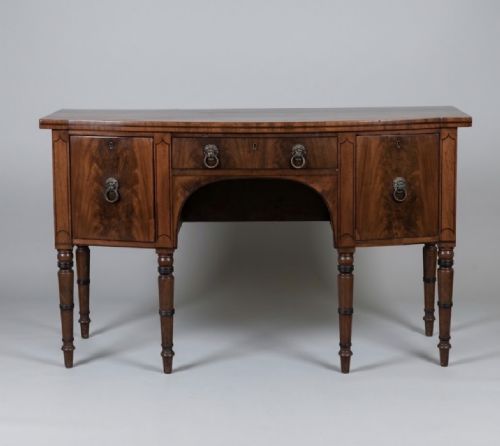
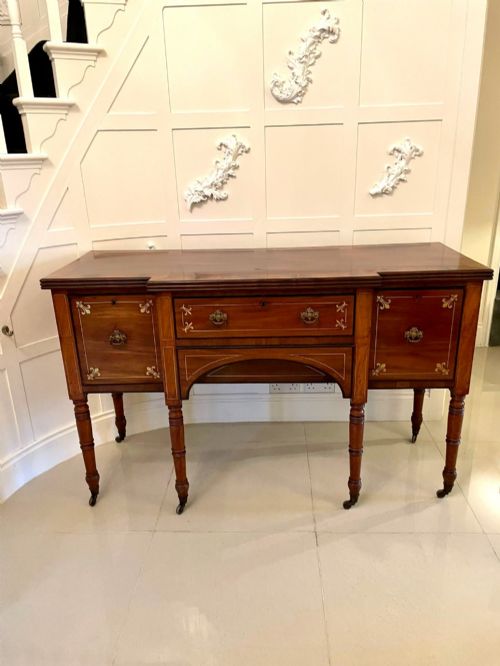
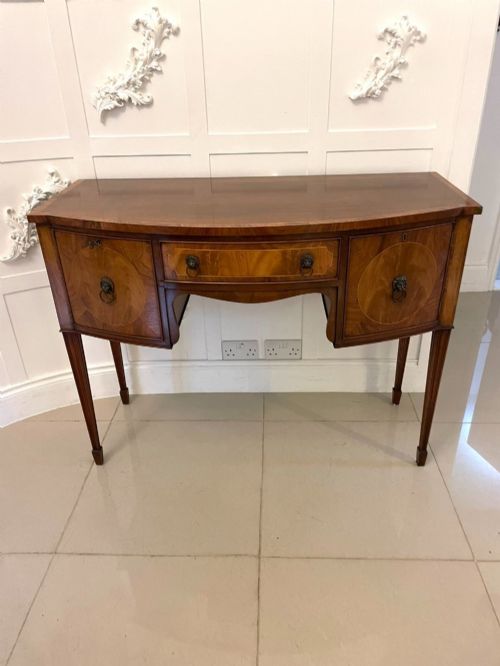
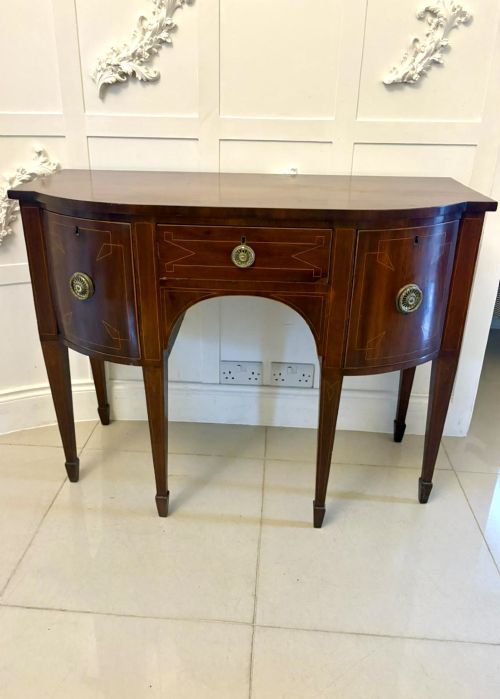
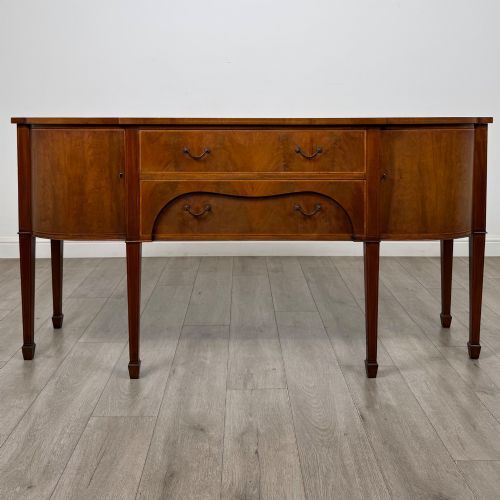
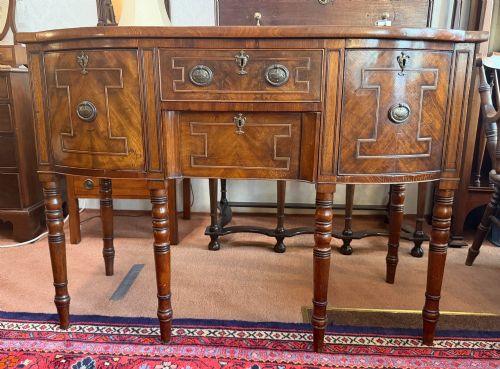
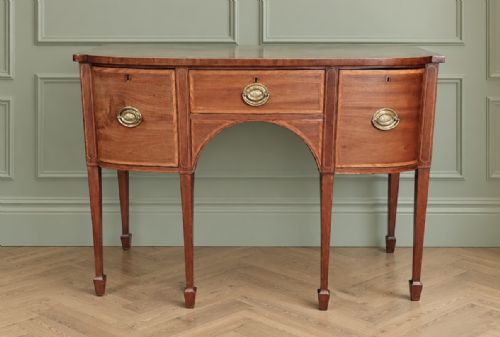
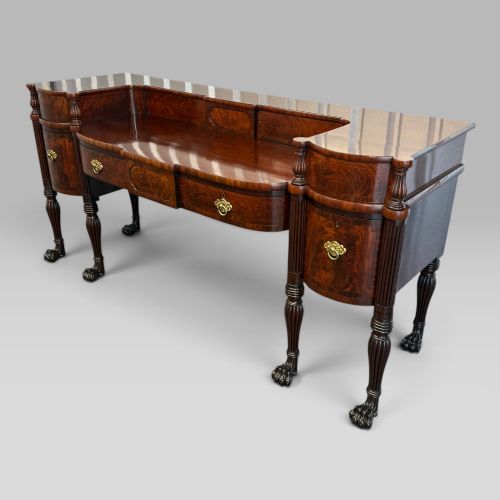
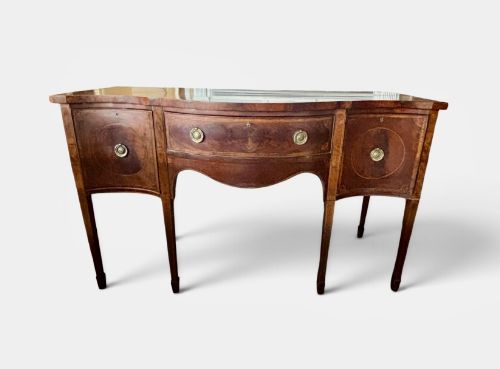
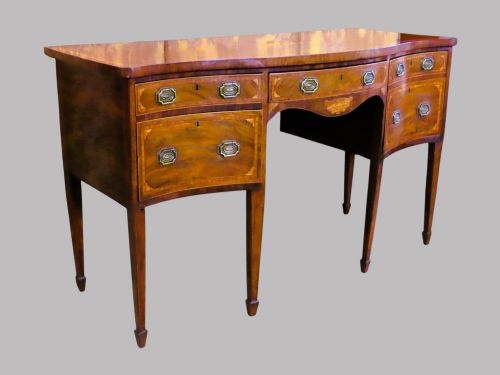
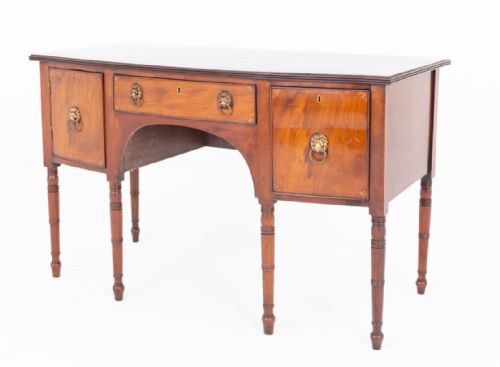
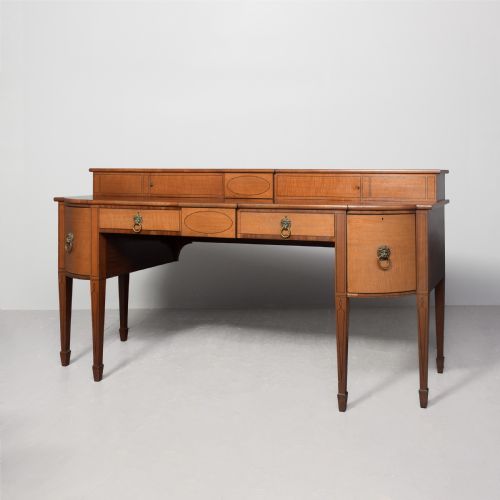
Georgian Inlaid Dining Buffet
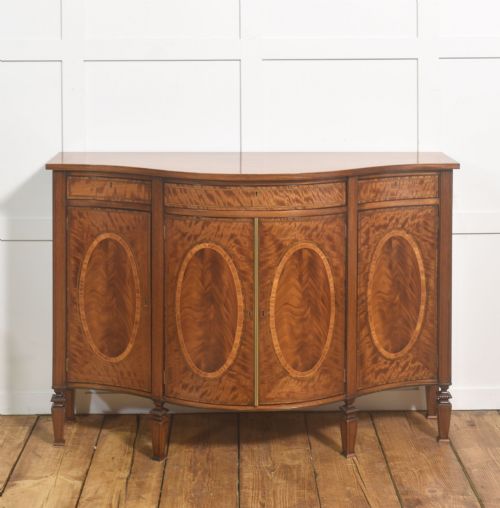
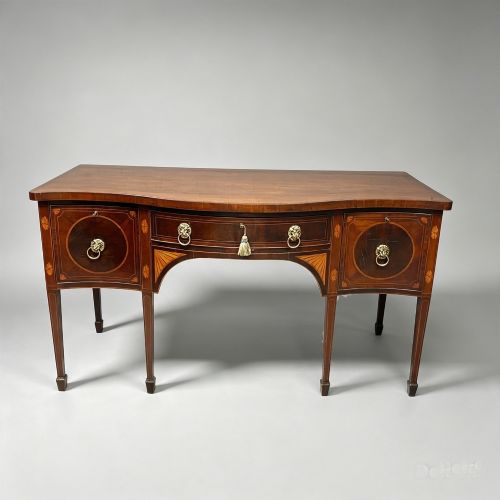
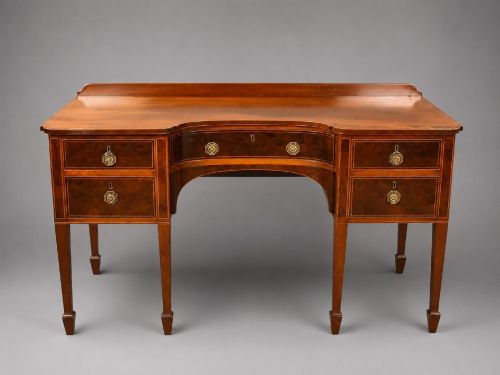
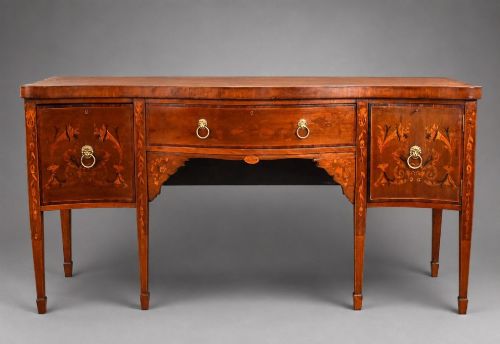
A georgian inlaid dining buffet anchors a room with timber grain, sharp stringing and deep drawers built for hospitality.
Georgian Inlaid Dining Buffet
When you search for a georgian inlaid dining buffet, you encounter large formal servers, bow-front consoles, serpentine commodes and breakfront pedestals designed for grand dining rooms. The pieces appearing here span from the eighteenth-century Georgian era and the Regency period through to Edwardian and Sheraton Revival interpretations.
Makers and workshops from various periods adapted these storage forms to suit changing domestic interiors, resulting in both compact proportions and monumental scale. The lineage stretches from original George III output to later revivals that maintain the classic proportions.
Assessing craftsmanship and distinction
Quality reveals itself in the handling of timber veneers, where superior pieces showcase continuous flame mahogany grain across multiple drawers rather than mismatched cuts. The crispness of the boxwood and satinwood inlay also separates finer work from simpler execution.
Structural complexity marks the upper tier of these pieces, such as serpentine or breakfront shapes that demand advanced woodworking skill to curve timber and drawers precisely. Details like original brass mounts, robust lion paw feet and clean interior secondary woods elevate the standard.
Listings feature mahogany, satinwood, boxwood, ebony and brass across periods spanning eighteenth-century Georgian to Edwardian revival.
The Georgian Inlaid Dining Buffet Glossary
- Inlay
- A technique where pieces of contrasting wood like satinwood, boxwood or ebony are inserted into recessed cavities to form decorative patterns. This adds linear definition to drawer fronts and tabletops.
- Bow-front
- A convex, outwardly curved cabinet front popular during the Georgian and Regency periods. This shape softens the room and increases internal drawer capacity.
- Serpentine
- A front profile defined by a central convex curve flanked by two concave sweeps. It represents significant cabinet-making skill.
- Stringing
- Thin, narrow lines of contrasting wood inlay used to outline panels, drawers and tabletops. It provides a sharp border against darker primary timbers.
- Breakfront
- A piece of furniture where the central section projects forward from the flanking outer sections. This creates architectural depth and visual weight.
- Marquetry
- Elaborate decorative veneer work assembled into pictorial or geometric designs using various coloured woods. It adorns high-status surfaces.
Georgian Inlaid Dining Buffet: Frequently Asked Questions
What is a georgian inlaid dining buffet used for?
These pieces served as the primary storage and serving station in formal dining rooms, holding heavy silver, linen and glassware during feasts.
Today, they function as substantial sideboards in living spaces or dining rooms, providing deep drawer capacity and surface display.
How do I identify a true Georgian piece?
Examine the construction methods, timber choice and secondary woods like oak or pine inside the drawers to establish the period.
Original eighteenth-century pieces display hand-cut dovetails and period-appropriate brass hardware, differing from later Edwardian revival copies.
What is the difference between bow-front and serpentine?
A bow-front curves outward in a single continuous convex arc across the entire width of the cabinet face.
In contrast, a serpentine front weaves in and out with a central convex curve meeting two concave side sections.
How do I care for mahogany and inlaid wood?
Keep the timber away from direct sunlight and dramatic temperature swings to prevent the delicate satinwood or boxwood inlay from lifting.
Apply traditional wax sparingly and buff gently with a soft cloth to maintain the natural sheen of the mahogany grain.