



Georgian Flintlock
When you handle a georgian flintlock, you hold an intricate piece of eighteenth-century engineering that defined personal defence and military might.
Georgian Flintlock
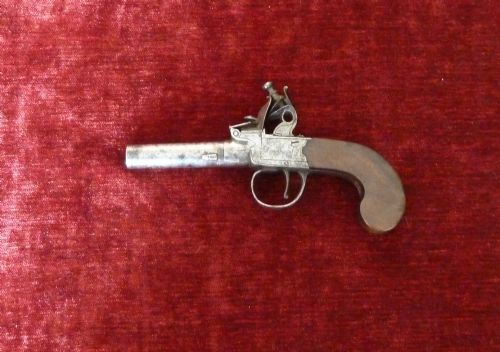
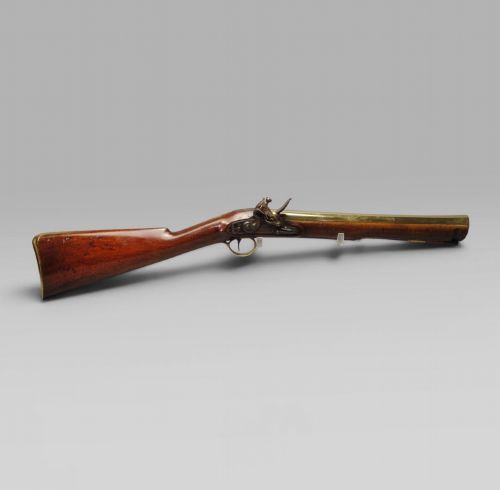
The term georgian flintlock encompasses a varied group of muzzle-loading firearms produced across the eighteenth and early nineteenth centuries, ranging from compact pocket pistols to full-length military muskets and blunderbusses.
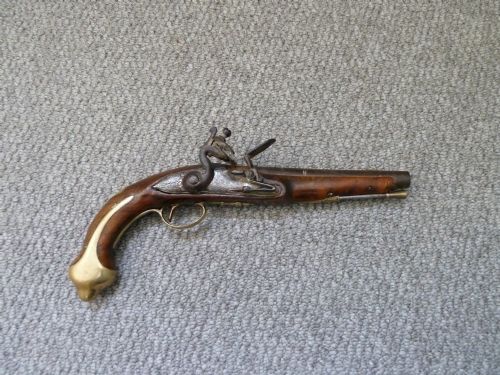
On this page, a buyer encounters everything from regulation cavalry and dragoon service arms bearing Tower markings to civilian pocket pistols and heavy duelling sets created by prominent metropolitan gunsmiths.
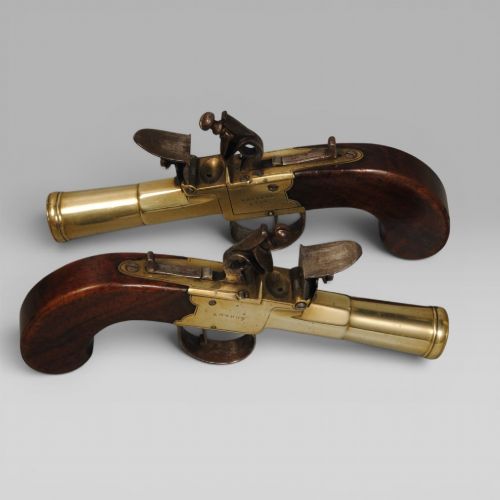
The physical forms span standard brass-barrelled blunderbusses, turn-off Queen Anne types, and regional variations such as Scottish Highland scroll-butt pistols and Ottoman pieces.
How They Were Made
Makers shaped stocks primarily from dense hardwoods like walnut and mahogany, frequently incorporating intricate brass or iron furniture and occasionally delicate silver-wire inlay.
Barrels and lock mechanisms relied on forged steel, iron, and cast brass, with some examples displaying gilt decoration or engraved maker signatures directly upon the metalwork.
Georgian Flintlock Retail Price Guide 2026
Typical asking prices for georgian flintlock among the pieces listed under this phrase on Sellingantiques today, from the lower quarter to the upper quarter. They describe what is for sale here now, not the wider market.
Listings span the eighteenth century into the nineteenth century, uniting domestic pocket arms with military blunderbusses and cavalry pistols.
What Varies in Quality
Quality rests upon the crispness of the lock mechanism, the depth and execution of engraving on the brass or steel, and the overall integrity of the wooden stock.
Makers of high status produced regulated military arms alongside bespoke duelling pistols where proportion, balance, and the precision of the internal flintlock action elevated the piece far above standard utilitarian issue.
Harrison of London·John Campbell of Doune·T. Potts London·Twigg London·Henry Nock·Sargant and Son·James Barber London·Thomas Henshaw London·Timothy Hughes Cork·H.W. Mortimer and Son·John Rimes London·J. Robinson Bootle·Barber of Newark·Meyer and Mortimer
The Georgian Flintlock Glossary
- Flintlock
- A firearm ignition mechanism that uses a flint striking a steel frizzen to create sparks that ignite the gunpowder charge.
- Turn-off
- A barrel design that unscrews from the breech to allow direct loading from the front without a ramrod.
- Blunderbuss
- A firearm with a flared muzzle designed to scatter lead shot effectively at short range.
- Bore
- The interior diameter of the firearm barrel, historically measured by the number of round lead balls of that diameter weighing a pound.
- Proof Marks
- Official stamps struck onto the metal barrel and action confirming the piece passed safety tests under gunpowder pressure.
Georgian Flintlock: Frequently Asked Questions
How do I identify a military flintlock?
Military examples usually display government inspection stamps, Crown ciphers, and Tower markings on the lock plate alongside standard regulation barrel lengths and brass or iron mounts.
These pieces were issued to cavalry, dragoons, and infantry regiments during the eighteenth and early nineteenth centuries.
What is the difference between a pocket pistol and a holster pistol?
Pocket pistols are shorter, often feature turn-off barrels, and were designed for discreet personal carry by civilians travelling through dangerous areas.
Holster pistols are significantly larger, heavier, and made to be carried in saddle holsters by officers and mounted troops.
Were these firearms used in combat?
Many examples on this page served during significant conflicts including the Napoleonic Wars and the American Revolutionary War as standard military sidearms and muskets.
Others remained civilian possessions used primarily for personal protection against highwaymen and thieves.
How should I care for a flintlock stock?
The wooden stocks require stable indoor humidity away from direct heat sources to prevent the timber from drying out and cracking over time.
Metal components benefit from light, protective coats of specialist oil to maintain the finish without harming historical surfaces.