

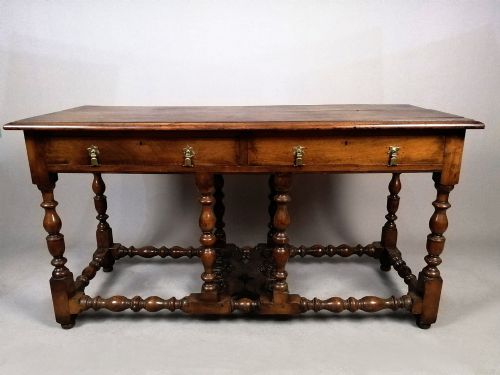
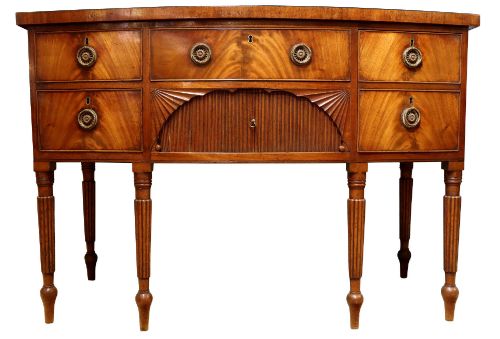
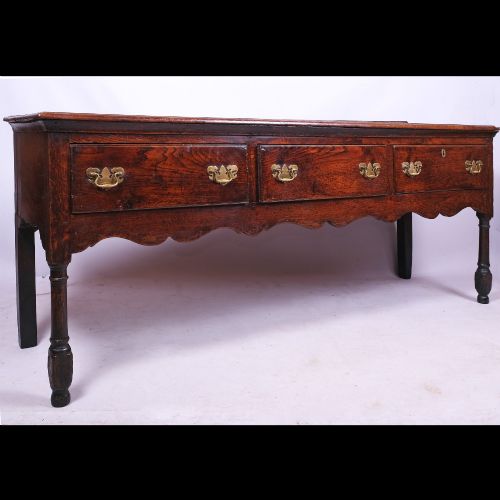
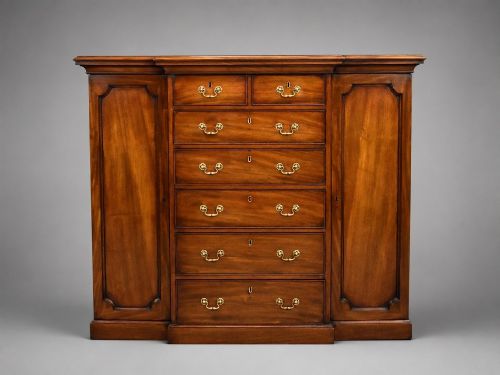


Georgian Dining Room Dresser
A georgian dining room dresser brings honest eighteenth and nineteenth century utility to a modern home, offering deep timber drawers and broad serving surfaces.
Georgian Dining Room Dresser
A georgian dining room dresser unites the functional storage of the eighteenth and nineteenth centuries with the domestic rituals of the dining room. These pieces range from substantial Welsh dressers and long oak base units to refined mahogany bow front sideboards and chiffoniers.
The versions most commonly met on this page date from the Georgian era through to the Victorian period, constructed in regional timbers like oak and walnut as well as imported hardwoods like mahogany. Their forms vary from plain, utilitarian country boards to elegant town pieces finished with boxwood stringing and serpentine fronts.
Buyers seeking a georgian dining room dresser find furniture built to serve a specific domestic purpose, whether holding heavy tableware or providing a surface for carving and service. Each surviving example records the taste and woodworking traditions of its original regional workshop or urban cabinet maker.
How they were made
Cabinet makers built these pieces using solid native oaks, walnuts, and dense imported mahoganies, often employing flame mahogany veneer across prominent drawer fronts and doors to catch the light. Construction relied on traditional joinery techniques such as dovetailed drawer construction and mortise and tenon frames.
Decorative detail on finer urban examples incorporates contrasting boxwood inlay and complex bowed or serpentine front outlines shaped from solid timber. Regional country pieces favoured straightforward plank construction in oak, relying on the natural figure of the wood rather than applied ornament.
Georgian Dining Room Dresser Retail Price Guide 2026
Typical asking prices for georgian dining room dresser among the pieces listed under this phrase on Sellingantiques today, from the lower quarter to the upper quarter. They describe what is for sale here now, not the wider market.
The listings here span the Georgian, Regency, Victorian, and Edwardian periods, utilising oak, walnut, mahogany, and boxwood.
What varies in quality
Quality in a georgian dining room dresser rests upon the selection of timber and the ambition of the original design, moving from utilitarian country oak bases to sophisticated town sideboards in figured mahogany. The crispness of the joinery and the survival of original brass hardware elevate an everyday piece into a masterwork of the cabinet maker's art.
Proportion and surface patination dictate the visual success of the piece, with well-chosen veneers and subtle boxwood stringing marking out the finer workshops. Pieces that retain their deep, warm timber colour and balanced proportions stand apart from heavier, altered examples.
The Georgian Dining Room Dresser Glossary
- Bow front
- A convex, curved cabinet front that projects outward in an arc. This curved profile requires skilled timber shaping and appears frequently on Regency and later sideboards.
- Dresser base
- The lower section of a traditional dresser, featuring drawers and cupboards without the upper plate rack. These sturdy lowboards function well as modern sideboards.
- Chiffonier
- A low cabinet or sideboard developed in the early nineteenth century, usually fitted with shelves or panelled doors below. It provided compact storage for dining rooms.
- Serpentine
- A front outline that curves outward in the centre and inward at the sides in an 'S' shape. This complex profile demands advanced woodworking skill.
- Stringing
- Thin inlay lines of contrasting wood, such as boxwood, set flush into the surface of mahogany or walnut. It creates delicate geometric borders on drawer fronts and legs.
Georgian Dining Room Dresser: Frequently Asked Questions
What is a georgian dining room dresser?
A georgian dining room dresser is a sturdy wooden storage unit or sideboard made during the eighteenth or nineteenth century to hold dining provisions and serving ware.
These pieces encompass regional oak baseboards, Welsh dressers, and refined mahogany sideboards designed for formal dining spaces.
How do I date a dresser?
Dating relies on identifying the primary timber, construction methods, and stylistic details such as curved drawer fronts or inlay patterns.
Earlier pieces often use solid oak with pegged joints, while nineteenth-century examples frequently feature mahogany veneers and boxwood stringing.
Where were these pieces used?
They originated in domestic dining rooms, country houses, and town residences as central furniture for food preparation and storage.
Servants used the wide tops for carving meat and arranging silver before service, while drawers stored linens and cutlery.
How do I live with one?
Integrating a dresser into a modern interior involves placing it in a hallway, living room, or dining area where its deep drawers provide practical storage.
Maintaining the timber with appropriate wax and keeping it away from direct heat sources preserves the antique finish.