



Georgian Corridor Chairs
Georgian corridor chairs are sturdy mahogany and oak reception seats designed for grand hallways, offering striking architectural silhouettes and armorial backs.
Georgian Corridor Chairs
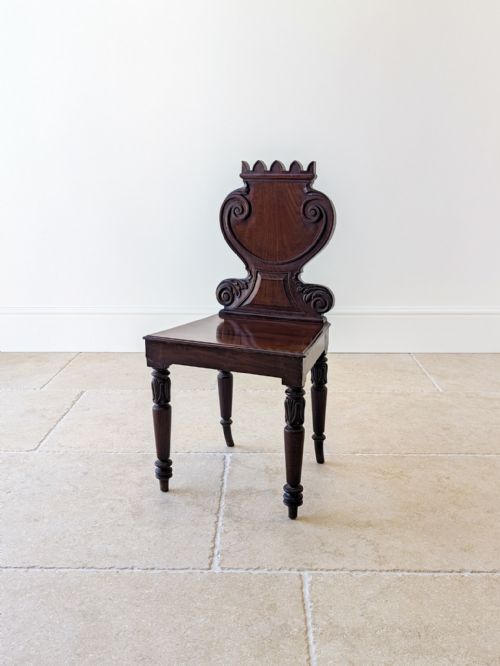
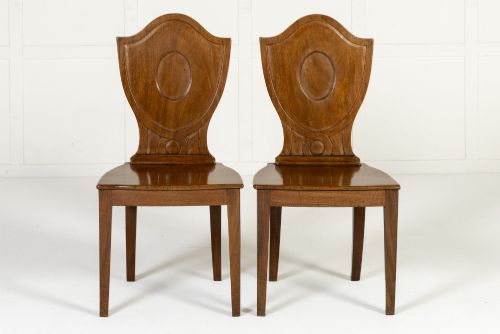
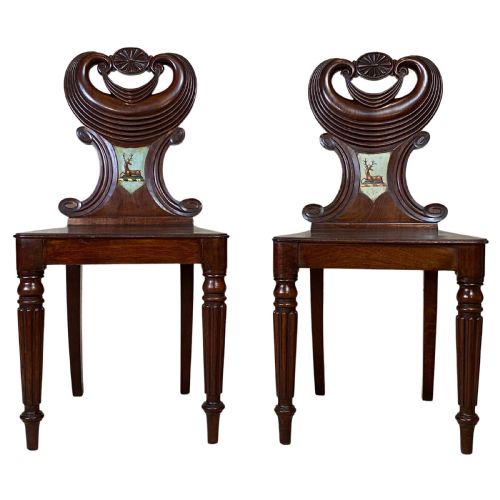
Georgian corridor chairs are functional reception seats designed specifically for hallways and entrance spaces. These pieces appear in forms such as shield back hall chairs and armorial seats.
The pieces on this page span the 18th century, the Regency period, and the 19th century. Oak and mahogany serve as the primary woods for these corridor chairs.
Makers often incorporated decorative elements like Prince of Wales feathers and carved details into the backs. Buyers will frequently encounter pairs dating from around eighteen hundred to eighteen thirty.
How they were made
Cabinetmakers constructed these corridor chairs primarily from solid mahogany and oak timbers. Workshops selected dense hardwoods capable of withstanding heavy daily use in busy entrance halls.
Makers employed traditional joinery techniques alongside detailed carving and inlay work to shape the distinctive shield backs and armorial crests. Skilled artisans carved decorative motifs directly into the solid wood surfaces.
Listings span the eighteenth century, the nineteenth century, and the Regency period, utilising mahogany, oak, and inlay.
What varies in quality
Quality in these corridor chairs depends on the crispness of the carved detail on the back and the choice of timber. Pieces featuring intricate armorials or carved Prince of Wales feathers demonstrate superior craftsmanship.
The integrity of the frame construction and the grain figure of the mahogany or oak dictate the standing of a piece. Finer examples display balanced proportions and robust joinery that survives intact.
Gillows
The Georgian Corridor Chairs Glossary
- Hall chair
- A rigid wooden seat placed in corridors or entrance halls for guests waiting briefly. These items usually feature solid wooden seats without upholstery.
- Shield back
- A chair back shaped in the outline of a heraldic shield. This design gained popularity during the late eighteenth and early nineteenth centuries.
- Regency
- A British design period spanning the early nineteenth century defined by classical restraint and archaeological influence. Furniture from this era often incorporates bold architectural lines.
- Armorial
- A design incorporating a family crest or coat of arms. Makers carved these emblems into the wooden backs of reception chairs.
Georgian Corridor Chairs: Frequently Asked Questions
Where were corridor chairs placed?
These chairs stood along the walls of grand hallways, entrance vestibules, and corridors. They provided temporary seating for visitors waiting to be announced.
Because they occupied high-traffic zones, makers built them to be durable rather than softly upholstered.
Are these chairs comfortable for long sitting?
Corridor chairs feature rigid wooden seats and upright backs rather than cushions. They were designed for brief waits rather than extended lounging.
The upright posture encouraged by the wooden seats suited the formal nature of nineteenth-century reception areas.
How do I identify a Regency period chair?
Regency pieces often display classical motifs influenced by ancient Greek and Roman designs. Look for clean architectural lines and darker mahogany timbers.
Pieces from this era frequently utilise carved crests and robust turned legs.