

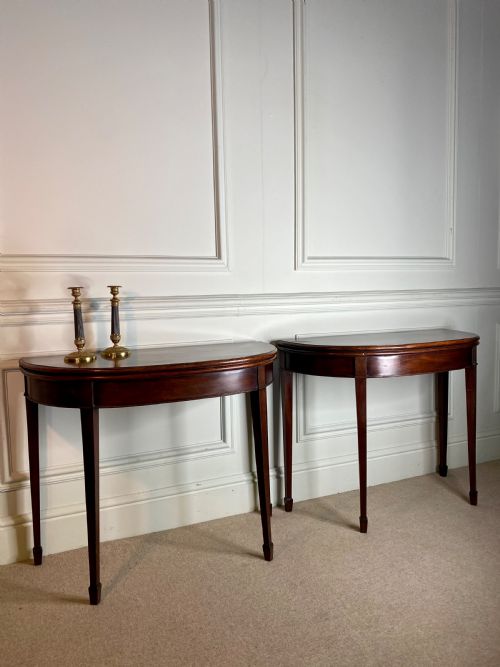


Georgian Card Table Pair
A georgian card table pair brings dual folding surfaces and balanced symmetry into a period interior, combining practical entertaining with cabinet-making skill.
Georgian Card Table Pair
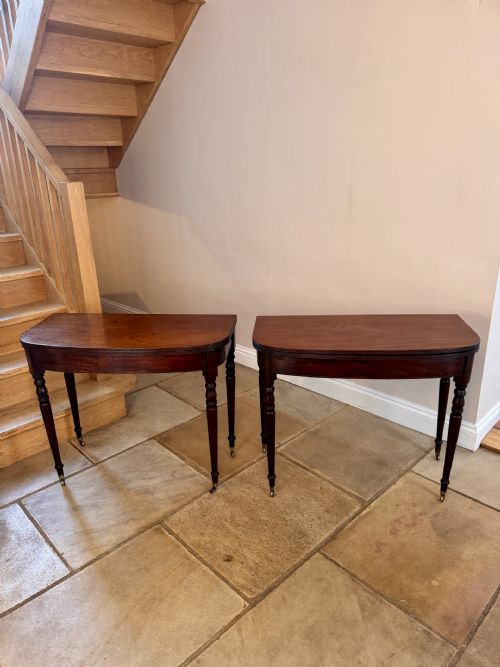
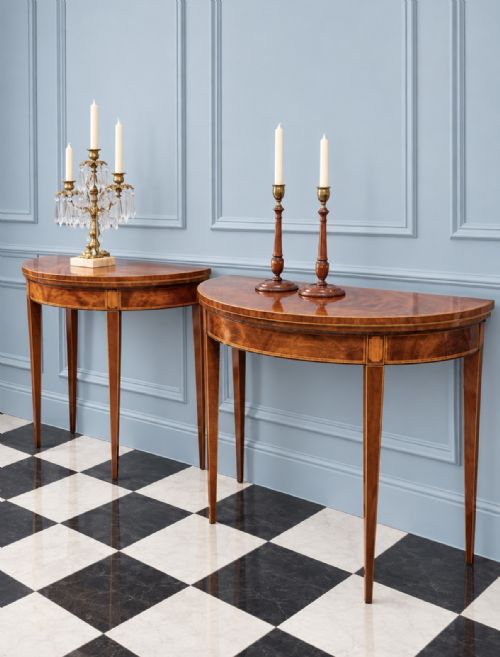
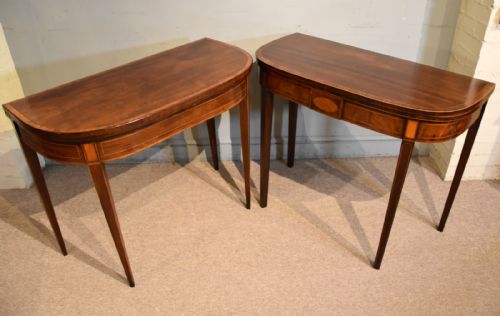
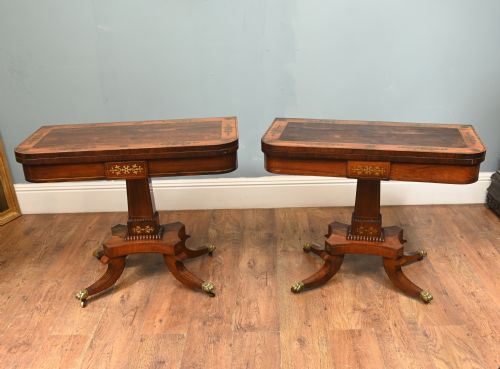
A georgian card table pair consists of two matching folding tables designed for parlour games and tea, most frequently encountered in mahogany and satinwood across this inventory. The selection spans late 18th century examples through to Regency and George IV pieces, often taking the form of demi-lune, D-end, or fold-over tops supported on sturdy legs.
Makers of the period constructed these matched sets for symmetrical placement in a drawing room or formal parlour, where one table could stand closed against a wall while its twin sat opposite. The survival of two matching tables together reflects their original commission as a suite, distinguishing them from single items subsequently paired by dealers.
Distinctions in craftsmanship and materials
Quality separates pieces through the selection of timber figures, where highly figured mahogany and intricate satinwood marquetry elevate a matched set above plain equivalents. The precision of the hinged mechanism and the crispness of inlaid borders also signal superior workshop production.
Matched pairs demonstrate varying degrees of symmetry between the two items, with top-tier examples showing identical grain patterns and uniform fading that indicate they originated from the same bench. The integrity of the secondary timbers and the retention of original brass elements contribute further to a set's standing.
Georgian Card Table Pair Retail Price Guide 2026
Typical asking prices for georgian card table pair among the pieces listed under this phrase on Sellingantiques today, from the lower quarter to the upper quarter. They describe what is for sale here now, not the wider market.
Some tables double as dining surfaces, meaning your evening gin rummy game could accidentally migrate into a formal banquet.
The Georgian Card Table Pair Glossary
- Demi-lune
- A half-moon shape popular for console and card tables during the late 18th century. These tables sit flush against a wall when closed and form a full circle when opened or paired.
- Fold-over top
- A hinged wooden surface that doubles the table area when unfolded for play or dining. The mechanism often relies on a swinging rear leg to support the open leaf.
- Marquetry inlay
- Decorative patterns formed by fitting contrasting veneers into pre-cut recesses within the primary timber. Craftsmen utilised satinwood and boxwood for these detailed geometric or floral motifs.
- Console table
- A table designed to be fixed or placed against a wall, frequently matching the dimensions of a card table in this inventory. They served decorative and functional roles in formal rooms.
Georgian Card Table Pair: Frequently Asked Questions
How were these tables used?
These tables served primarily for card games, social gatherings, and tea in formal parlours during the Georgian and Regency periods. When folded, they functioned as side or console tables against the wall.
Opening the hinged top revealed a baize-lined surface for playing cards, while the lower framework often concealed a small compartment for counters and accessories.
Are matched pairs from the original period?
Many sets were commissioned together as matched pairs to provide symmetry for large drawing rooms, maintaining uniform timber and design. Others are matched pairs assembled later from similar single items sharing comparable styles and dimensions.
Examining the grain patterns, secondary woods, and wear helps determine whether the two pieces originated from the same workshop at the same time.
How do I identify George III from Regency styles?
George III pieces frequently exhibit Sheraton influences with satinwood inlay, straight tapered legs, and refined demi-lune or rectangular proportions. They lean towards neoclassical restraint and balanced geometry.
Regency and George IV examples often display bolder mahogany grains, brass inlay, heavier pedestal bases, or saber legs, reflecting the shift toward classical antiquity in the early 19th century.
How do I care for antique card tables?
Protect the polished mahogany or satinwood surfaces from direct sunlight, excessive heat, and moisture to preserve the original finish and veneer. Use coasters and avoid placing heavy objects on the folding leaves.
Treat the pivoting hinges and folding mechanisms with care when opening the top, ensuring the supporting leg bears the weight evenly to protect the internal joints.