



Georgian Brass Flintlock
Georgian brass flintlock arms are historical mechanical pieces of self-defence and military service valued for their bright metalwork and walnut stocks.
Georgian Brass Flintlock
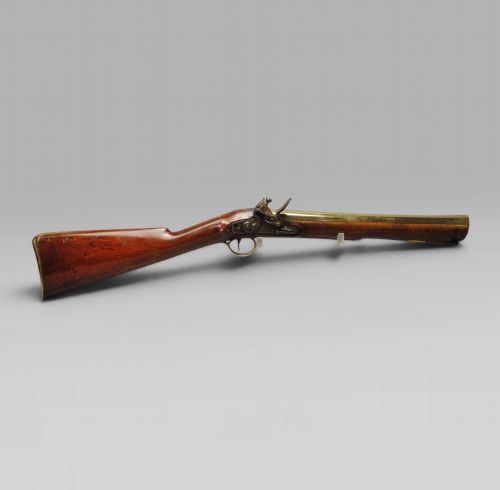
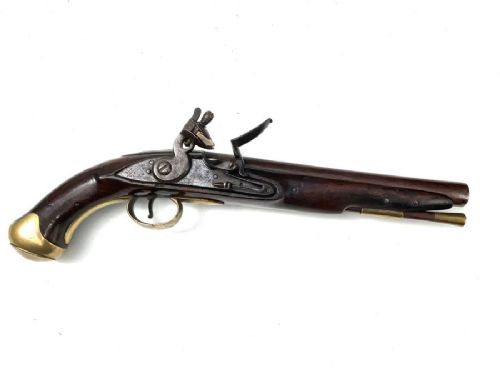
When you search for georgian brass flintlock, you encounter a selection of antique firearms, militia arms, and pocket pieces spanning the eighteenth century and the Regency period. These items include heavy dragoon pistols, blunderbusses, overcoat arms, and duelling pieces originating from British makers.
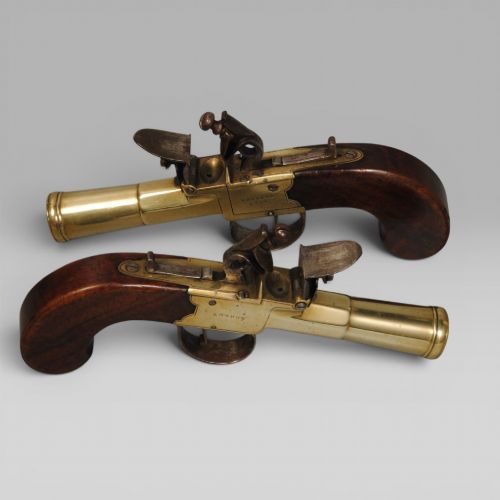
The specimens seen here range from military service sidearms stamped by the Tower Armoury to civilian pocket pistols signed by provincial and London gunsmiths. Many examples date from the late eighteenth century and the Napoleonic era, combining brass barrels with wooden stocks.
The most common versions on this page are brass-barrelled flintlock pocket pistols and military service arms equipped with iron locks and brass furniture. Buyers find both single arms and matched pairs housed in wooden cases.
How they were made
Gunmakers constructed these arms using cast brass for barrels and furniture, paired with forged steel or iron for locks, hammers, and internal springs. Stocks were carved from dense hardwoods such as walnut and mahogany, fitted precisely to the metal components.
Makers utilised mechanical components including flintlock ignition systems, turn-off barrels, and occasional sprung bayonets. Metal parts received proof marks and maker signatures, while brass barrels often displayed bright finishes alongside iron mechanisms.
Listings feature walnut and mahogany stocks paired with brass barrels, iron locks, and occasional baize-lined cases.
What varies in quality
Quality separates through the crispness of maker signatures, the depth of engraving on brass barrels and locks, and the precision of the wood-to-metal fit. Superior pieces retain clear proof marks and well-defined stock contours without excessive wear.
The refinement of the internal flintlock action and the balance of the firearm distinguish standard service issue from master gunsmith commissions. Better specimens preserve original finishes on both the brass components and the timber stocks.
Harrison of London·Henry Nock·Sargant and Son·Thomas Henshaw·H.W. Mortimer and Son·Thomas Anelli·I Parr·John Rimes·J Robinson·Ward and Steele
The Georgian Brass Flintlock Glossary
- Flintlock
- An ignition mechanism that uses a piece of flint held in a cock to strike a steel frizzen, creating sparks to ignite the gunpowder charge. This system dominated firearm design throughout the eighteenth and early nineteenth centuries.
- Blunderbuss
- A muzzle-loading firearm with a flared barrel designed to scatter shot at close range. These arms were widely utilised by coach guards and naval personnel.
- Turn-off pistol
- A firearm featuring a barrel that unscrews from the breech to allow loading from the front of the chamber. This design eliminates the need for a ramrod.
- Boxlock
- A firearm action where the lock mechanism is forged as an integral part of the breech block rather than mounted on a separate side plate. This provides a clean exterior profile.
- Proof marks
- Official stamps struck onto the metal barrels and actions to indicate that the firearm passed safety tests under gunpowder pressure. These marks help identify the city of testing such as London or Birmingham.
Georgian Brass Flintlock: Frequently Asked Questions
How do I clean a brass barrel?
Brass barrels respond well to gentle cleaning with non-abrasive metal polishes designed for antiques to preserve the original surface texture.
Avoid harsh scraping that might remove historical stamps, proof marks, or the mellow patina accumulated over centuries.
Were these pistols used by the military?
Many pieces served with British light dragoons, naval forces, and the Tower Armoury during the Napoleonic wars and Georgian period.
Service arms bear specific inspection marks, Crown stamps, and regulation contractor names on the iron locks.
What is a turn-off barrel?
A turn-off barrel unscrews entirely from the breech section to allow lead shot and powder to be loaded directly into the chamber.
This construction was popular on eighteenth-century pocket and overcoat pistols for quick reloading without a ramrod.
How are pairs matched?
Duelling and pocket pistols were often manufactured as sets in wooden cases, sharing sequential serial numbers or matching maker signatures.
Both pieces typically exhibit identical barrel lengths, timber grains, and brass furniture styling.