

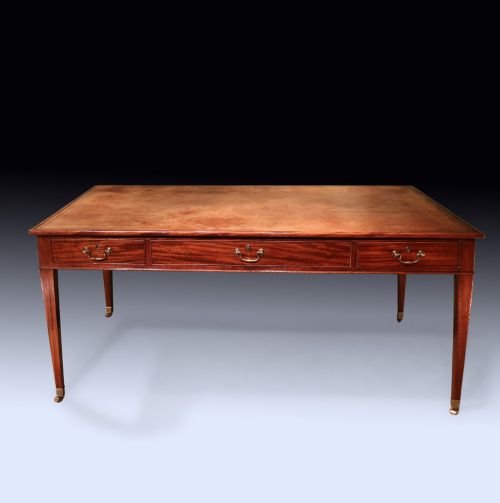
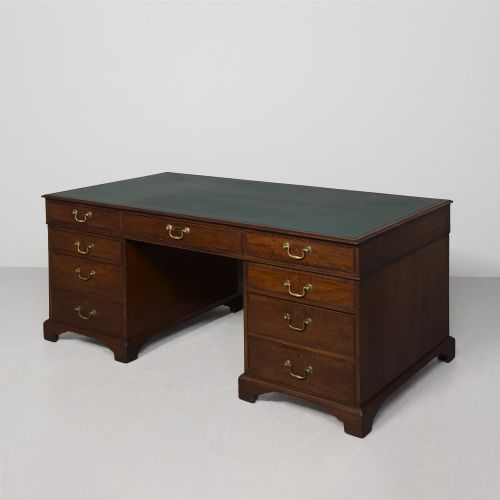
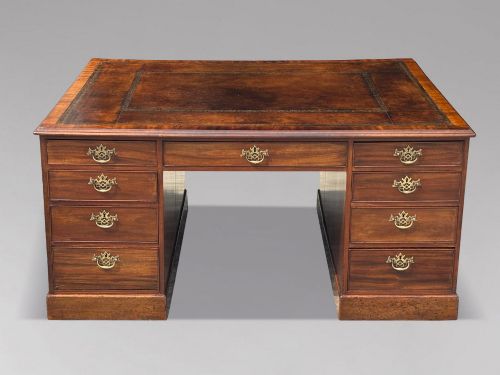
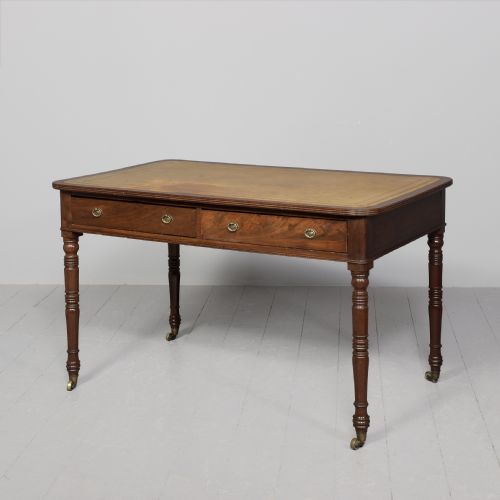


George III Partners Desk
A george iii partners desk is a substantial double-sided workspace built for two to face one another, offering generous drawers and leather tops.
George III Partners Desk
A george iii partners desk is typically encountered as a large mahogany pedestal or library table dating from the eighteenth century into the nineteenth century. These pieces are double-sided by design, featuring banks of drawers or cupboards on both faces so that two people can work opposite each other.
The selections span the Georgian period, including pieces from around seventeen eighty up to eighteen hundred, alongside later nineteenth century revivals and library tables. Forms range from standard pedestal desks with numerous small drawers to writing tables and freestanding kneehole desks.
Materials and construction
The primary material seen across these items is mahogany, frequently paired with inset leather writing surfaces and brass hardware such as handles and locks. Walnut and marquetry inlay also appear in the record, showing variety in the timber selected for the outer surfaces.
Cabinetmakers utilised sturdy construction methods to support the dual-sided configuration, incorporating multiple drawers, crossbanding, and freestanding pedestals designed to be viewed from all angles in a library or study.
George III Partners Desk Retail Price Guide 2026
Typical asking prices for george iii partners desk among the pieces listed under this phrase on Sellingantiques today, from the lower quarter to the upper quarter. They describe what is for sale here now, not the wider market.
The listings show mahogany as the primary timber, complemented by walnut, brass hardware, and inset leather writing surfaces.
Judging quality
Quality in a george iii partners desk is evident in the choice of timber figure, such as flame mahogany or walnut, and the crispness of any marquetry inlay or crossbanding. The presence of original handles and functioning locks, including named mechanisms, contributes significantly to the standing of a piece.
Proportion and scale also separate standard examples from finer works, particularly where larger library tables or substantial eighteen-drawer formats maintain balanced symmetry across both sides of the structure.
Gillows of Lancaster
The George III Partners Desk Glossary
- Partners desk
- A large double-sided desk designed with workspaces and drawers on opposing faces so two individuals can work face-to-face. This form originated to accommodate business associates or bankers sharing a single table.
- Pedestal desk
- A freestanding desk comprising two supporting piers or pedestals of drawers with a central desktop spanning across them. These often feature cupboards or matching drawers on the reverse side.
- Crossbanding
- A decorative border technique where strips of veneer are laid running perpendicular to the main grain of the furniture. This creates a contrasting frame around drawer fronts or tabletops.
- Marquetry
- The art of applying pieces of veneer to a structure to form decorative patterns or pictures. It utilises various coloured woods to achieve intricate surface ornamentation.
- Library table
- A large freestanding table used for reading and writing, finished on all sides. These pieces often serve a similar function to desks but without pedestals enclosing the lower space.
George III Partners Desk: Frequently Asked Questions
What is a partners desk?
A partners desk is a large double-sided writing table built with drawers and storage on both opposing faces. This layout allowed two people to sit opposite each other and work simultaneously.
These pieces typically sat in the centre of a grand library or study rather than pushed against a wall. Their freestanding nature meant every side required careful finishing and detailing.
How do I date a george iii desk?
Dating relies on observing timber choices, construction techniques, and stylistic markers recorded across the Georgian period and subsequent revivals. Mahogany and walnut were dominant during the eighteenth century, while later nineteenth-century pieces often reflect earlier Chippendale or revival influences.
Hardware such as original brass handles and specialised locks can also offer clues to the approximate decade of manufacture. Comparing the secondary woods inside the drawers helps confirm the period of construction.
Where should I place a partners desk?
Because these desks are finished on all sides, they are best positioned in the middle of a room rather than against a wall. This allows access to the drawers and workspace from both directions.
Ensure there is sufficient surrounding floor space to pull out chairs on either side. Placing the desk in a library or large study highlights its dual-sided architectural form.