

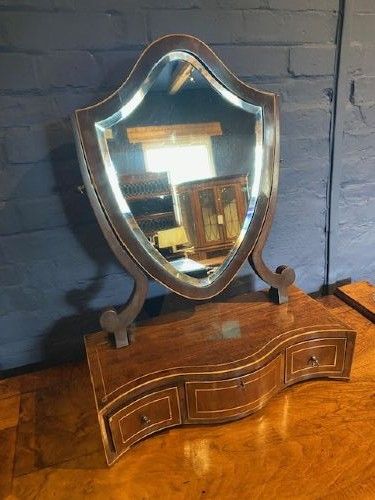
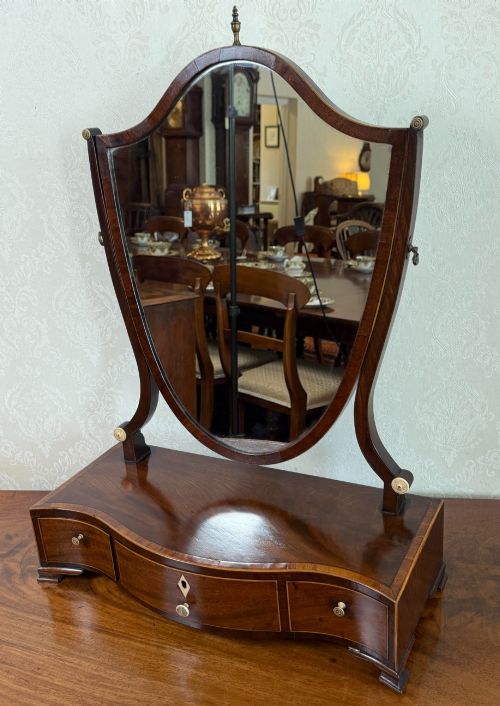
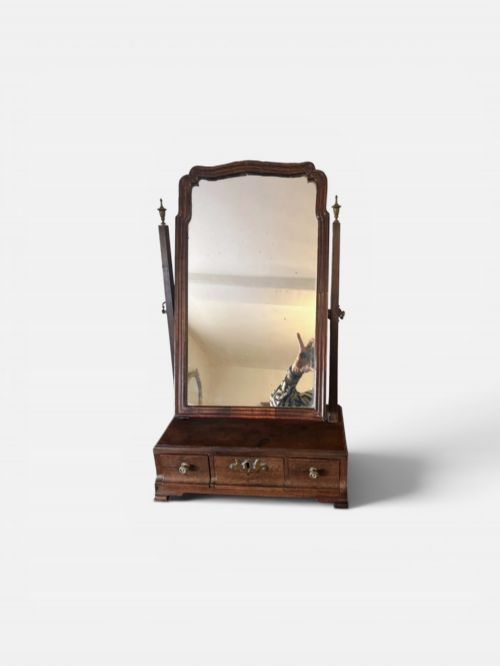


George I Toilet Mirror
A george i toilet mirror sits upon a dressing surface, offering a framed reflection framed in walnut or mahogany.
George I Toilet Mirror
A george i toilet mirror represents a table-top glass designed for grooming and dressing within the bedchamber. These pieces combine a tilting mirror plate mounted on upright arms above a miniature bureau or box base fitted with small drawers.
While bearing the name of the earliest Georgian reign, buyers here encounter numerous examples spanning the broader Georgian era alongside later Regency and Edwardian interpretations. The form survives predominantly in mahogany and walnut, occasionally incorporating burr veneers or parcel-gilt details.
Dressing glasses and box base dressing mirrors appear interchangeably in the record alongside traditional toilet mirrors. Most pieces utilise simple rectangular frames or serpentine outlines supported by sloping or box-shaped lower sections.
Materials and construction
Cabinet makers constructed these frames and box bases using dense hardwoods such as mahogany and walnut, frequently selecting timber with prominent figuring or burr patterns. Secondary timbers lined the small internal drawers while brass pivots or swing-lock hardware enabled the glass to tilt.
Giltwood elements and parcel-gilt accents added decorative contrast to mahogany or walnut surfaces, while select examples incorporated satinwood, harewood, or bone inlay. Mirror glass rested within rebated wooden frames, secured by thin backboards.
George I Toilet Mirror Retail Price Guide 2026
Typical asking prices for george i toilet mirror among the pieces listed under this phrase on Sellingantiques today, from the lower quarter to the upper quarter. They describe what is for sale here now, not the wider market.
Some miniature drawers hide secret compartments just large enough for a love letter or a coin.
Judging quality in these mirrors
The distinction between ordinary and superior pieces rests upon the selection of timber figure and the crispness of the cabinet work. Well-figured walnut or mahogany grain elevates a simple box base, whereas plain timber yields a more utilitarian appearance.
Proportion and execution of the miniature drawers dictate the refinement of the piece. Fine mouldings, neat dovetail joints in the drawer construction, and original brass hardware separate better examples from later replacements.
John Franklin London
The George I Toilet Mirror Glossary
- Box base
- A miniature chest of drawers forming the lower support for the pivoting mirror frame. It provides stability and storage for small personal items.
- Parcel-gilt
- Partially gilded woodwork where gold leaf highlights specific carved details or mouldings against a dark wood background.
- Serpentine
- A curved outline featuring a convex centre flanked by concave wings. This shape appears frequently on the front edge of drawer bases.
- Swing frame
- A mirror plate mounted on two vertical side posts using threaded pins or pivots that allow the glass to tilt forward or backward.
- Burr veneer
- Thin slices of timber sliced from irregular growths on trees, producing intricate swirling patterns. It is applied to primary display surfaces.
George I Toilet Mirror: Frequently Asked Questions
Where did people place a toilet mirror?
These mirrors rested upon a chest of drawers, a dedicated dressing table, or a writing desk within a bedchamber. They provided a portable reflection surface before fitted wall mirrors became common.
Their compact footprint allowed owners to position them near natural window light for shaving, styling hair, or applying cosmetics.
How do I distinguish walnut from mahogany pieces?
Walnut pieces generally date from the earlier decades of the eighteenth century, displaying warmer brown tones with darker grain figuring. Mahogany examples appear more frequently from the mid-eighteenth century onward, showing a deeper reddish-brown hue.
Inspect the weight and grain structure of the wood to confirm the primary material used by the cabinet maker.
Are the mirror plates original?
Many surviving mirrors retain later replacement glass because original mirror plates deteriorated or cracked over centuries of use. Older glass often exhibits minor distortion, slight foxing, or thin bevelling along the edges.
Examine how the glass is secured within the wooden rebate to understand its age relative to the frame.
How should I clean the wood and glass?
Dust the mahogany or walnut surfaces regularly with a soft, dry cloth to protect the polished finish. Avoid using modern silicone sprays or harsh chemical polishes that can damage old timber.
Clean the mirror plate gently with a damp cloth applied to the glass rather than spraying liquid directly near the wooden frame.