




French Timepiece Set
A French timepiece set brings a matched centrepiece clock and side garnitures together to dress a mantelpiece with period elegance.
French Timepiece Set
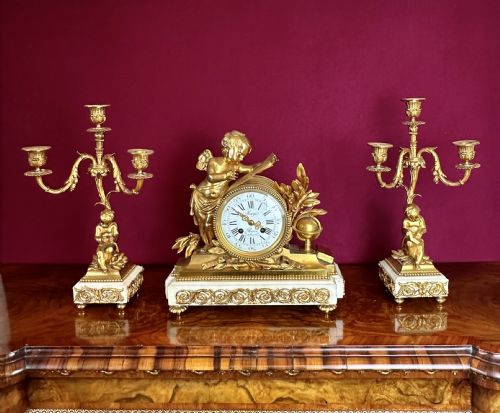
A french timepiece set typically comprises a main mantel clock accompanied by matching side garnitures such as urns or sculptural figures. These arrangements span periods from the eighteenth century through the Victorian era and into the Art Deco movements of the 1920s and 1930s.
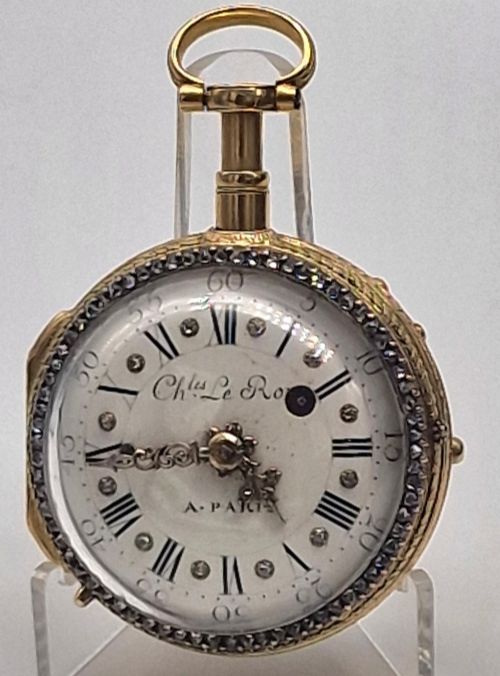
The pieces appearing on this page include mantel clock garnitures, eight day striking clock sets, and pocket watches by makers like Charles Le Roy and AD Mougin. Victorian and Art Deco styles dominate the selections currently available to buyers.
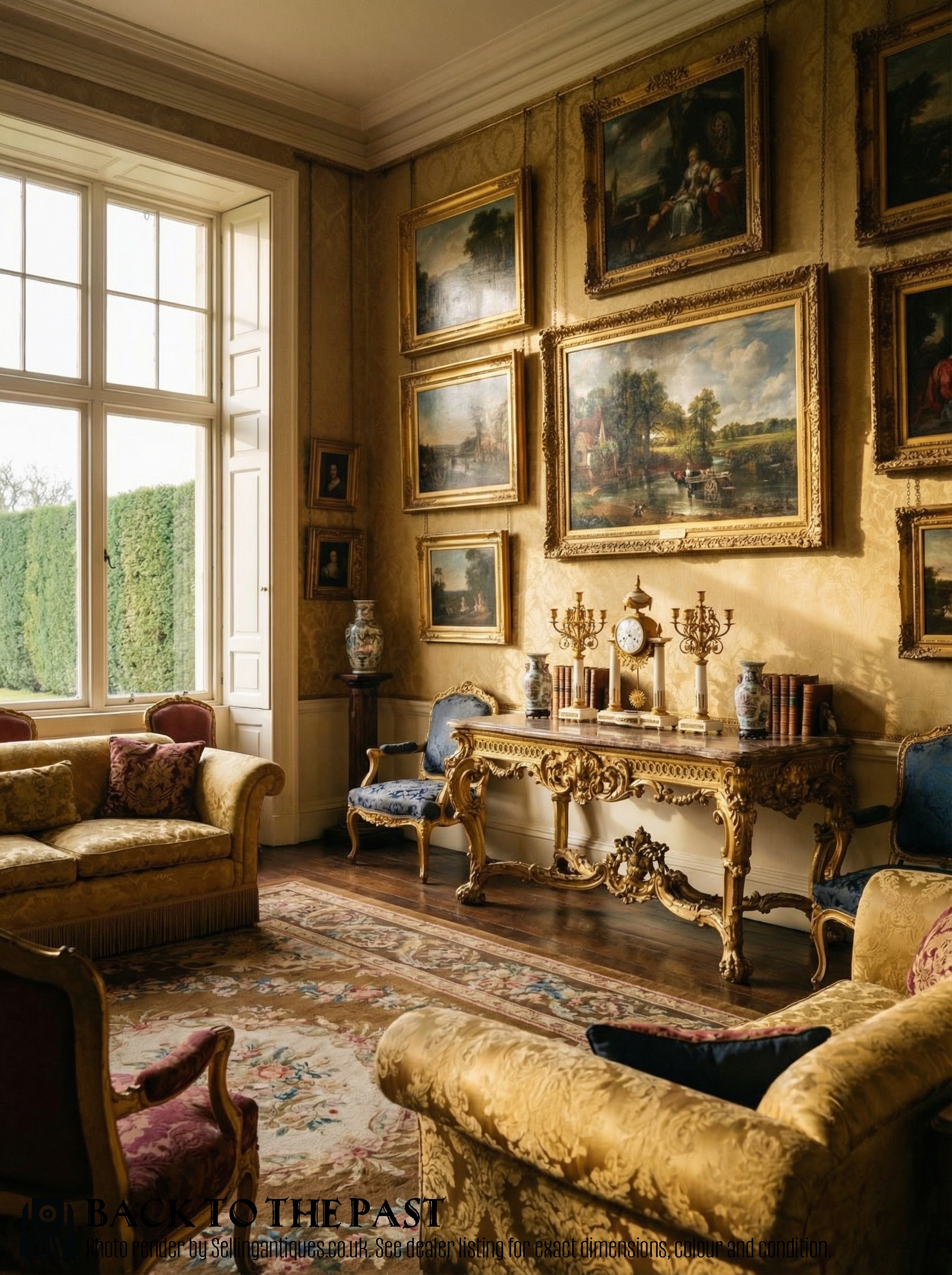
Mantel clock sets serve both a decorative and a timekeeping function, designed specifically to anchor the visual symmetry of a room. The inclusion of matching garnitures elevates a simple clock into a comprehensive decorative ensemble.
Materials and construction
Construction relies heavily on traditional metalwork and masonry, with brass, ormolu, gilt bronze, and spelter forming the structural and decorative bodies. Marble and onyx frequently provide heavy, stable bases for the clock movements and flanking garnitures.
Dials incorporate delicate enamel work for numerals and chapter rings, protected beneath glass bezels. Sculptural elements, such as the Michel Decoux German Shepherd dog sculpture, demonstrate the integration of cast metal art within the clock set framework.
Materials recorded across the inventory include marble, onyx, brass, gilt bronze, ormolu, and spelter paired with enamel dials.
Evaluating quality and execution
The refinement of the casting and the crispness of the chasing on gilt bronze, ormolu, and spelter separate standard examples from finer works. Superior sets display meticulous detail in sculptural figures and architectural mounts.
The integration of the garniture pieces with the central clock determines the overall harmony of the set. High-quality examples utilise premium materials like marble and onyx alongside robust movements such as eight-day striking mechanisms.
Charles Le Roy·Michel Decoux·AD Mougin
The French Timepiece Set Glossary
- Garniture
- A set of matching decorative vessels or figures designed to flank a central clock on a mantelpiece. These pieces complete the visual symmetry of the arrangement.
- Ormolu
- Gilded bronze produced by applying a mercury-gilding technique to a bronze base. This finish provides a rich golden appearance characteristic of fine antique metalwork.
- Spelter
- A zinc alloy frequently used as a cost-effective alternative to bronze for sculptural figures in clock sets. It is often painted or bronzed to imitate heavier metals.
- Enamel
- A glassy substance fused to a metal dial through firing, used to create durable white or coloured backgrounds for clock numerals. It offers a smooth, polished surface that resists fading.
- Quarter repeating
- A complication in pocket watches and clocks that chimes the hours and quarters when activated by a pendant or lever. This mechanism represents a higher level of horological craftsmanship.
French Timepiece Set: Frequently Asked Questions
What is a French clock garniture?
A French clock garniture is a matched set consisting of a central mantel clock and two flanking decorative pieces, such as urns or sculptures. These items are designed to sit together on a mantelpiece or sideboard.
The matching side pieces balance the composition, creating a formal and symmetrical display typical of Victorian and earlier interior decoration.
How do eight day striking clocks work?
An eight day striking movement requires winding approximately once a week to maintain both the timekeeping and the hourly or quarterly chime functions. These mechanical movements utilise springs or weights to drive the gears.
Collectors appreciate these movements for their reliability and the traditional acoustic character they bring to a room through their striking mechanism.
What materials are used in these sets?
Makers utilised a variety of materials including marble, onyx, brass, gilt bronze, and ormolu for the bodies and architectural housings. Enamel dials and glass covers protect the delicate clock faces.
Sculptural elements in the sets are often cast from spelter or bronze, sometimes featuring detailed patination or gilding to enhance their visual depth.
How do I date a French timepiece set?
Dating relies on stylistic clues, such as the neoclassical motifs of the nineteenth century or the geometric lines of Art Deco pieces from the 1920s and 1930s. Maker signatures on the dial or movement backplate also provide definitive historical markers.
Materials like onyx and specific casting styles further help narrow down the period of manufacture, distinguishing Victorian interpretations from earlier eighteenth-century designs.