



French Second Empire Table
When you handle a french second empire table, you meet heavy walnut, inset marble tops and gilt bronze mounts that define mid-nineteenth century luxury.
French Second Empire Table
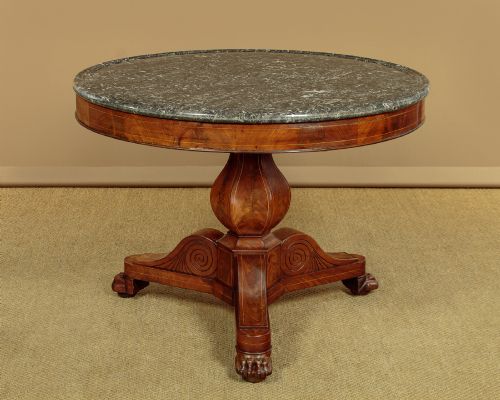
A french second empire table usually appears as a round marble top gueridon centre table, a bureau plat writing desk or a side table built during the napoleon iii period around the eighteen sixties and eighteen seventies.
Makers of this era favoured rich timbers like rosewood, ebony and burr walnut, often paired with elaborate gilt bronze mounts, porcelain plaques or brass inlays.
While the evidence also records occasional card tables and dressing tables from the archive, the circular centre table with a stone top remains the form most frequently encountered in daily search results.
Distinctions in craftsmanship and design
Quality rests in the crispness of the bronze casting and the depth of the hand-chasing on ormolu mounts, where sharper, more articulate details separate superior works from simpler commercial production.
The choice and execution of timber veneer also dictate worth, with figured burr walnut, rosewood and boulle marquetry demanding greater skill from the joiner than plain stock.
Structural integrity of heavy marble tops and the precision with which bronze mounts fit the underlying woodwork indicate the workshop standard.
Listings span eighteen hundred to nineteen twenty, though nineteen-century napoleon iii pieces predominate alongside nineteenth-century french revival styles.
Japy Frères·Auguste Cain·Eurotrope Bouret·Deniere and Cailleaux·P.H. Mourey
The French Second Empire Table Glossary
- Gueridon
- A small round occasional table, typically supported by a central pillar or three legs. These often feature inset marble tops in this category.
- Ormolu
- Gilded bronze used extensively for decorative mounts and decorative hardware. The technique involves applying a gold amalgam to the metal base.
- Bureau Plat
- A flat-topped writing table fitted with drawers across the frieze. They frequently include leather writing surfaces and elaborate bronze trims.
- Boulle
- A style of marquetry using brass and tortoiseshell inlaid into dark woods. It appears frequently on revived furniture forms of the nineteenth century.
French Second Empire Table: Frequently Asked Questions
How do I identify a second empire table?
Look for heavy timber construction, typical of the napoleon iii period, combined with classical bronze mounts and heavy marble inserts.
The presence of revival styles, dark woods like ebony and walnut, and detailed cast metalwork generally point to this mid-nineteenth century origin.
Were these tables used for writing or display?
Tables from this era served multiple functions depending on their form, from centre tables meant for display to specific bureau plat writing desks.
Round gueridon tables usually held lamps or ornaments in reception rooms, whereas side tables and desks provided functional surfaces for correspondence.
What woods were used for these pieces?
Cabinetmakers utilised dense native and exotic timbers, most notably walnut, burr walnut, mahogany, rosewood and ebony.
These woods provided stable bases for intricate veneers and contrasted sharply with the bright gilt bronze and brass mounts applied to the frames.
How do I care for marble and bronze?
Marble tops require simple cleaning with mild soap and water, avoiding acidic substances that can etch the polished stone surface.
Bronze mounts need only gentle dusting with a soft cloth to preserve the original gilding without stripping the historic finish.