






French Rural Landscapes
French rural landscapes capture the quiet charm of provincial life through oil on canvas and watercolour.
French Rural Landscapes
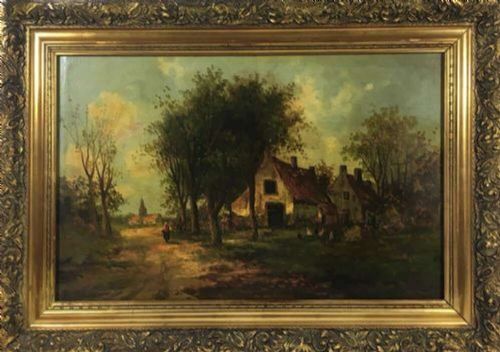
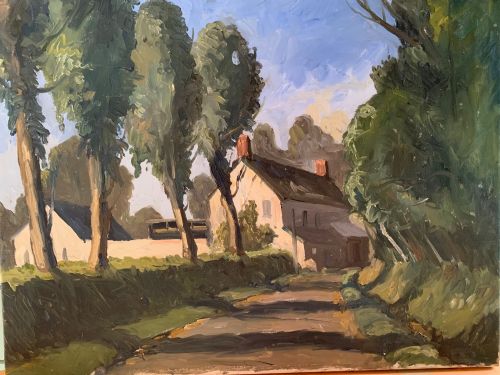
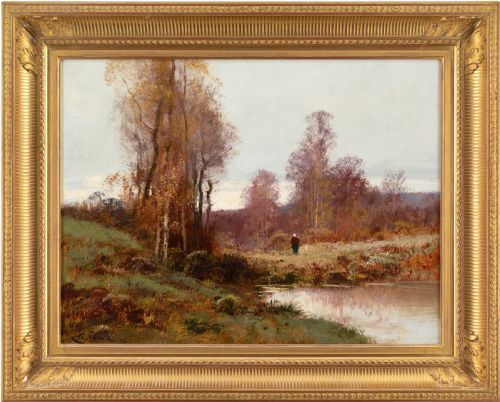
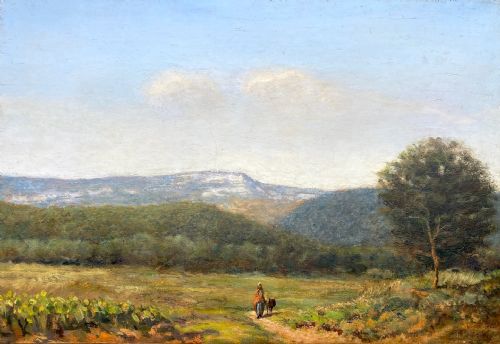
When you search for french rural landscapes, you encounter artwork depicting farmyards, rivers, and country lanes from the nineteenth and twentieth centuries. These paintings often show figures working the land, tending livestock, or resting near farmhouses in regions like Provence, Brittany, and Normandy.
The pieces on this page span several artistic movements, including Post-Impressionism, the Barbizon School, and French Realism. Canvases range from intimate watercolours on paper to large oil paintings housed in traditional frames.
Materials and technique
Artists painted primarily with oil paint on canvas, though some works utilise oil on panel or pastel and watercolour on paper. Canvases are frequently stretched over wooden frames and occasionally set within giltwood surrounds.
Brushwork varies from the blended realism of nineteenth-century academic painters to the looser, expressive strokes of post-impressionist and post-impressionist-influenced colorists working in the early twentieth century.
French Rural Landscapes Retail Price Guide 2026
Typical asking prices for french rural landscapes among the pieces listed under this phrase on Sellingantiques today, from the lower quarter to the upper quarter. They describe what is for sale here now, not the wider market.
The listings span from the 1860s through the 1950s, utilising oil paint, pastel, and watercolour on canvas, paper, and wood.
Judging quality
Quality rests upon the artist's ability to capture light, atmosphere, and natural proportions within the provincial setting. Stronger works display confident brushwork and harmonious colour palettes that convey the distinct mood of seasons and regions.
Condition plays a role, with preference given to canvases retaining their original stretchers, stable paint layers, and period frames without intrusive modern restoration.
Th Thibault·Charles Clair·Raimond Louis Lecourt·Majorie Hoare·ROBERT MCGREGOR·EUGENE BATTAILLE·ANTOINE BOUVARD·Henri Joseph Harpignies
The French Rural Landscapes Glossary
- Barbizon School
- A nineteenth-century French art movement focused on tonal realism and painting outdoors in nature. Artists of this circle prioritized mood and naturalistic light over grand historical subjects.
- Post-Impressionism
- A diverse artistic development following Impressionism where painters explored structural form and expressive colour. Works from this movement often employ visible, deliberate brushstrokes.
- Oil on Canvas
- A traditional painting medium consisting of pigments suspended in drying oils applied to stretched woven fabric. This combination allows for rich colour depth and textured application.
- Giltwood
- Wood carved and coated with a thin layer of gold leaf or metallic gilt paint. It is commonly found on antique picture frames surrounding nineteenth-century paintings.
French Rural Landscapes: Frequently Asked Questions
What subjects appear in french rural landscapes?
These artworks depict agricultural life, including farmyards, working horses, cattle by streams, and washerwomen by rivers. Scenes often feature specific regions such as Provence, Brittany, and Normandy.
Artists also recorded quiet country paths, haystacks, rolling hills, and village street scenes under varying seasonal light.
How do I date an antique painting?
Dating relies on stylistic clues, stretcher construction, canvas types, and artist signatures recorded on the work. Barbizon and realist works typically date to the mid or late nineteenth century.
Later pieces from the 1920s and 1930s often reflect post-impressionist or early modern handling of colour and form.
How should I frame and display these artworks?
Many pieces retain their original giltwood or wooden frames, which complement the period aesthetic of the canvas. Hang paintings away from direct sunlight and damp environments to protect the oil paint and canvas.
Proper wall lighting can enhance the texture of the brushwork and the depth of the palette.
What is the difference between oils and watercolours here?
Oil paintings use pigments bound in oil on canvas or panel, offering rich texture, deep layering, and robust durability. Watercolours and pastels use paper supports, yielding lighter, more delicate translucent effects.
Watercolours and pastels from this period typically require protective glass framing.