

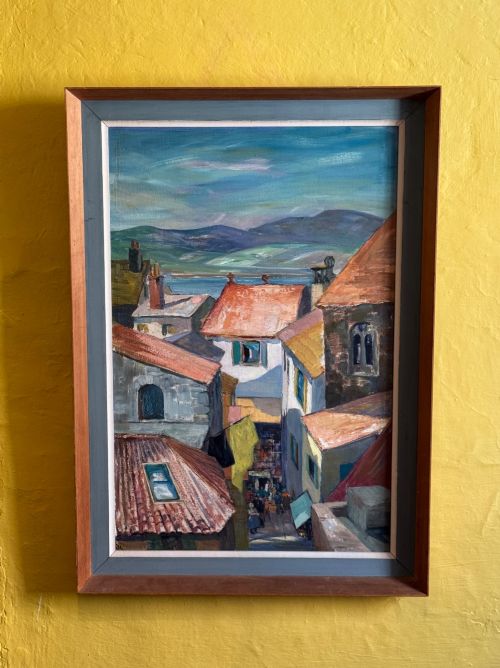


French Riviera Landscape Painting
A french riviera landscape painting captures the brilliant southern light and coastal charm of the Mediterranean coast, bringing warmth and colour into a room.
French Riviera Landscape Painting
A french riviera landscape painting typically depicts coastal towns, harbours, and sea views from destinations such as Cannes, Monaco, Antibes, and Toulon. These works record the distinctive light and scenery of the south of France across various decades from the Victorian era through the mid-century.
Buyers will encounter several stylistic approaches on this page, ranging from mid-century impressionism and post-impressionism to naive art and Victorian realism. Common subjects include busy ports, quiet sea fronts, street views, and sunlit coastal architecture.
The physical formats vary from traditional oil on canvas to oil on board, often presented in wood frames or gesso settings. Dating spans from the late nineteenth century around eighteen sixty through the nineteen sixties.
Materials and technique
Artists working in this regional genre relied primarily on oil paint applied to canvas or rigid board surfaces. This medium allowed creators to build texture and capture the intense glare and Mediterranean palette characteristic of the Cote d'Azur.
Framing often involves wood and gesso structures that complement the period of the painting. Some examples incorporate textured overpainting or print embellishments alongside traditional brushwork.
French Riviera Landscape Painting Retail Price Guide 2026
Typical asking prices for french riviera landscape painting among the pieces listed under this phrase on Sellingantiques today, from the lower quarter to the upper quarter. They describe what is for sale here now, not the wider market.
The selection includes works by British and continental painters capturing the Cote d'Azur.
Assessing quality and character
The distinction in quality rests upon the artist's handling of light, atmosphere, and spatial depth rather than mere condition. Stronger examples convey the distinct luminosity and topography of the southern coast with assured brushwork.
Compositional balance and the vitality of the paint surface separate standard decorative works from more compelling artistic interpretations of harbours and coastal towns.
Evelyn Harris·Erich Mercker·Cecil Rochfort D'Oyly-John·Edward Henry Holder
The French Riviera Landscape Painting Glossary
- Oil on canvas
- A traditional painting medium where oil paint is applied to a stretched woven fabric support. This combination provides a resilient and responsive surface for expressive brushwork.
- Post-impressionism
- An art movement extending beyond impressionism that prioritizes symbolic content and vivid colours over a naturalistic rendering of light. Works in this style often emphasise bold outlines and simplified forms.
- Gesso
- A plaster mixture applied as a smooth base for painting or used to mould decorative details on picture frames. It creates a rigid ground that accepts gilding and paint.
- Naive art
- A classification for work produced by self-taught artists whose style lacks traditional academic perspective and proportion. These pieces often feature charming simplification and direct observation.
French Riviera Landscape Painting: Frequently Asked Questions
What subjects appear in these paintings?
The works primarily feature southern French coastal locations, including harbours, fishing ports, street views of Antibes, and sea fronts in Cannes and Monaco.
Scenes range from busy quays and moored boats to sunlit townscapes and quiet coastal vistas.
How do I date a painting?
Dating relies on stylistic clues, framing materials, and recorded signatures or biographical dates of the artists involved. Mid-century works often show post-impressionist or modern influences, while nineteenth-century pieces tend toward realism.
Examining the reverse of the board or canvas can also reveal period labels, inscriptions, or dealer marks.
Where should I hang one?
These coastal scenes suit spaces that benefit from warm colour and natural light, such as living rooms, studies, or hallways. Their subject matter brings an open, airy feel to interior walls.
Keep them away from direct sunlight and damp environments to protect the oil paint and wood frames.
What is naive art?
Naive art is produced by artists without formal academic training, resulting in a distinctive style that ignores traditional perspective rules. These pieces often charm viewers through honest observation and bright, direct application of paint.
Such works offer a fresh, unvarnished perspective on southern French towns and harbours.