



French Putti Clock
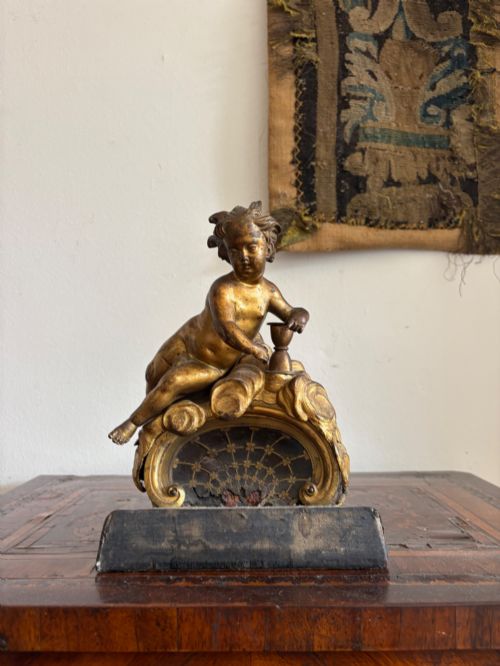
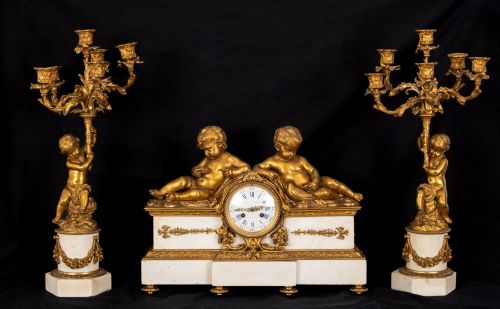
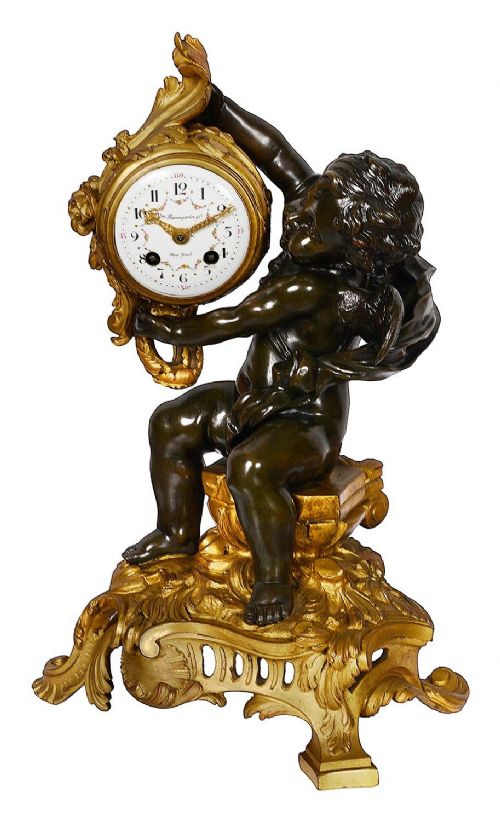
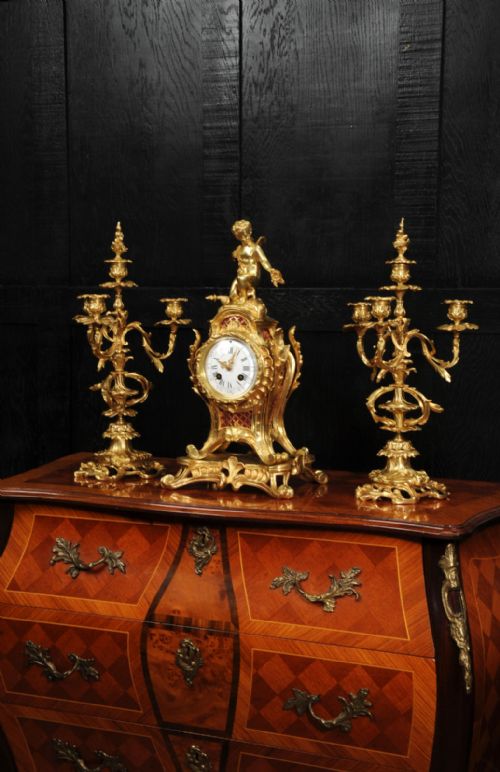
These pieces are a french putti clock, combining gilded metalwork and figural cherubs to anchor a mantelpiece with sculptural grace.
French Putti Clock
A french putti clock typically presents winged cherubs or putti interacting with the dial, flanking the case, or riding the finial. These figural timepiece forms emerge most often from nineteenth-century workshops styled in French Rococo, Louis XVI, and neoclassical revivals.
Buyers will encounter freestanding mantel clocks alongside matching clock garnitures and sets that include coordinating candelabras. The architectural framing shifts from white and red marble plinths to cast bronze cases and cartel wall clocks.
The decorative vocabulary draws heavily on eighteenth-century court aesthetics, reinterpreted during the Victorian era through heavy gilding and sculptural bronze casting. Cherubs appear variously as musicians, cupids, or classical attendants leaning against porcelain dials.
Materials and construction
Foundry workers cast the primary structural elements in bronze and brass before applying mercury gilding or modern electroplated ormolu to achieve a bright, uniform golden lustre. White and red marble bases provide a heavy, contrasting plinth that grounds the lighter metal figures.
Clockmakers fitted mechanical movements behind hand-painted enamel dials, frequently incorporating porcelain panels decorated in the Sevres or Meissen manner. Individual putti figures and decorative mounts were cast separately and pinned or screwed directly to the main ormolu chassis.
Listings feature works spanning the nineteenth century, utilising gilt bronze, white marble, and hand-painted enamel across Rococo and Louis XVI revival styles.
Assessing quality and execution
The sharpness of the chasing separates superior bronze and ormolu castings from softer production pieces, as skilled artisans hand-chiselled surface details into the metal after casting. Crisp feather work on the putti wings and deep relief in the scrollwork indicate a higher workshop standard.
The integration of the clock set demonstrates the maker's ambition, where matching candelabras and figural bases share the exact same patination and casting hand. Superior examples pair finely painted enamel dials with heavy marble plinths and fully signed clockmaker movements.
Le Roy Paris·Leon Message·Jollet et Cie·Phillipe H Mourey·Bellenot Paris·John Bennett
The French Putti Clock Glossary
- Ormolu
- A technique of applying finely ground high-carat gold to a bronze object, creating a rich golden surface finish. This finish defines the bright appearance of nineteenth-century decorative metalwork.
- Putto
- A plump, naked child figure, frequently winged, derived from classical art and Renaissance sculpture. In these horological pieces, they act as allegorical companions to the clock dial.
- Garniture
- A set of matching decorative objects designed to be displayed together on a mantelpiece, usually comprising a central clock flanked by matching candelabras or urns. These matched sets provide balanced symmetry in period interiors.
- Cartel clock
- A wall-mounted clock housed in an ornate scrollwork case made of metal or wood. The style originated in France and relies on wall suspension rather than a mantel shelf.
- Sevres style
- A descriptor for porcelain decorated with rich coloured grounds and hand-painted gilt highlights, imitating the famous French royal manufactory. These ceramic elements appear frequently on clock dials and inset panels.
French Putti Clock: Frequently Asked Questions
What is a french putti clock?
A french putti clock is a mantel or shelf timepiece featuring sculptural figures of winged cherubs or cupids integrated into the ormolu or bronze case. These decorative clocks draw on French Rococo and Louis XVI revival styles popular during the nineteenth century.
They serve as both functional timekeepers and ornamental centerpieces, often accompanied by matching side candelabras as part of a larger garniture set.
How do I date a cherub clock?
Dating relies on examining the casting materials, dial construction, and style markers such as Victorian revival motifs or nineteenth-century French registry marks. Ormolu quality, marble types, and movement signatures offer further clues to the decade of manufacture.
Most surviving examples date from the mid to late nineteenth century, reflecting the Victorian appetite for revivalist French decorative arts.
What materials are used in these clocks?
The primary materials include cast bronze finished with ormolu, white or red marble bases, and hand-painted enamel or porcelain dials. Glass bezels protect the face, while secondary metals form the internal gear trains.
Contrasting surfaces of polished gold-toned metal against cool stone create the characteristic visual balance of the period.
How do I care for an ormolu clock?
Ormolu surfaces require gentle dusting with a soft, dry brush to prevent the accumulation of grit in the chased recesses. Avoid harsh chemical cleaners or abrasive cloths that can strip the delicate gold surface layer.
Keep the clock away from direct sunlight and damp environments to protect both the metal patination and the internal mechanical movement.
What is a clock garniture?
A clock garniture is a matching three-piece set consisting of a central clock flanked by two matching side pieces, such as candelabras or decorative urns. These sets were designed to create a balanced arrangement across a mantelpiece.
They share identical styling, metal casting techniques, and materials like ormolu and marble.