



French Onyx Mantel Clock
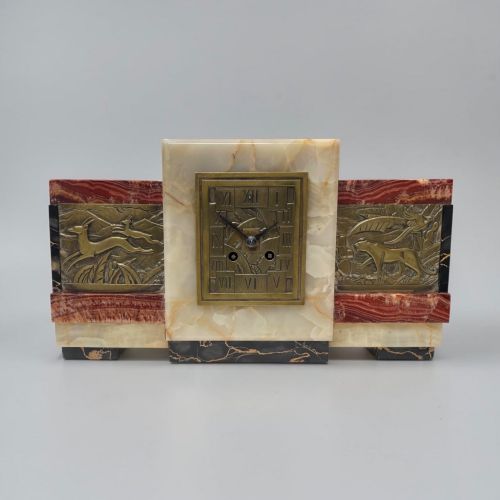
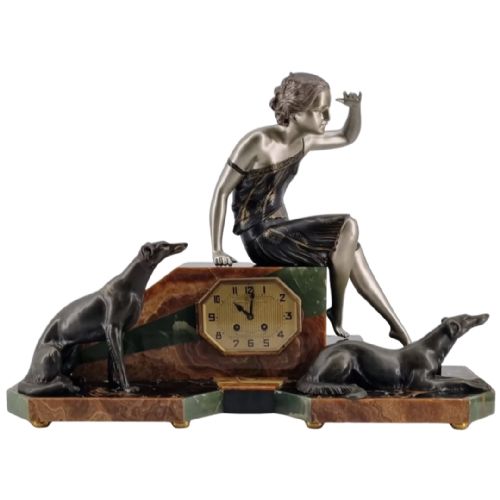
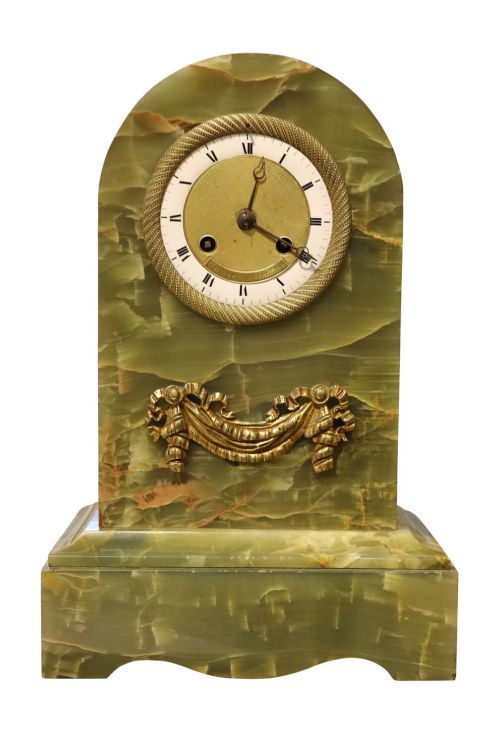
These French onyx mantel clock examples combine rich banded stone with metal mounts and enamel dials to anchor a room.
French Onyx Mantel Clock
A french onyx mantel clock brings heavy stone presence to a room, appearing in forms from simple architectural blocks to elaborate garniture sets with matching side pieces. These pieces span the nineteenth century through the art deco period, taking influence from Louis XVI revival styles and later modernist geometric shapes.
Buyers encounter single mantel clocks alongside full garniture sets that include matching side urns or candelabra. The materials range from plain banded onyx and green onyx to combinations involving marble, brass, gilt bronze, and spelter sculptures.
The periods represented stretch across Victorian, Second Empire, Belle Epoque, and Art Deco eras, showing how tastes shifted from ornate classical figures toward streamlined geometric silhouettes by nineteen twenty.
Materials and construction
Makers shaped solid blocks of onyx and marble to form the heavy architectural cases, often contrasting pale or green stone with polished brass and gilt bronze mounts. Enamel dials with delicate numerals provide the face of the clock, protected behind flat or bevelled glass bezels.
Figural elements cast in spelter or bronze frequently top or flank the stone case, depicting classical subjects, animals, or literary figures. Champleve enamel and ormolu details are applied to enhance the decorative scheme of the more elaborate garniture sets.
French Onyx Mantel Clock Retail Price Guide 2026
Typical asking prices for french onyx mantel clock among the pieces listed under this phrase on Sellingantiques today, from the lower quarter to the upper quarter. They describe what is for sale here now, not the wider market.
Listings feature pieces spanning from early nineteenth-century works through to nineteen thirty art deco designs, using onyx, green onyx, marble, spelter, and gilt bronze.
Quality variations
The distinction between standard production and the finest work lies in the crispness of the bronze or ormolu casting and the depth of the onyx mineral patterns. Hand-painted enamel dials and signed movements by named makers elevate an example well above plain utility pieces.
The integration of the side garnitures with the central clock determines the coherence of a set. Well-matched stone blocks and unified sculptural themes separate grand salon pieces from simpler domestic timepieces.
Charles à Orléans·Uriano·Auguste Moreau
The French Onyx Mantel Clock Glossary
- Garniture
- A set of matching decorative objects, typically a central clock accompanied by two side pieces such as urns or vases. These were designed to sit harmoniously on a mantelpiece.
- Spelter
- A zinc alloy commonly used as a less expensive substitute for bronze to cast sculptural figures on clock cases. It is often given a bronze-coloured finish.
- Ormolu
- Gilded bronze used for decorative mounts and accents on furniture and clock cases. The technique involves applying a gold amalgam to heated bronze.
- Champleve
- An enamelling technique where troughs are dug into the metal surface and filled with coloured vitreous enamel before firing. It frequently appears on nineteenth-century clock dials and bezels.
- Regulator
- A precision pendulum clock designed for high accuracy. In nineteenth-century French pieces, this often translates to a visible pendulum housed within a glass and metal case.
French Onyx Mantel Clock: Frequently Asked Questions
What is a clock garniture set?
A clock garniture is a matching ensemble consisting of a central clock flanked by two decorative side pieces, such as urns or candelabra. These sets were designed to create a symmetrical display across a mantelpiece.
The matching side pieces share the same stone, metal mounts, and stylistic motifs as the main clock body, creating a unified decorative statement.
How do I wind an antique French clock?
Antique French movements typically use a key inserted into winding holes on the enamel dial to tension the springs. Care must be taken not to overwind the mechanism.
Most of these movements require a pendulum to be properly seated and beat evenly to keep accurate time after moving.
How do I tell Victorian from Art Deco clocks?
Victorian and Second Empire pieces lean heavily on classical symmetry, ornate bronze mounts, and mythological figures. They use rich green onyx alongside heavy marble and gilt details.
Art Deco pieces, emerging around nineteen twenty, favour streamlined geometric silhouettes, stylised animal figures like greyhounds, and simplified stone forms.
Where should I place a heavy stone clock?
Onyx and marble clock cases are remarkably heavy and require a sturdy, level surface capable of supporting considerable weight. A solid mantelpiece or heavy sideboard is ideal.
Placing the clock away from direct sunlight and damp areas helps protect the delicate enamel dials and metal patination over time.