
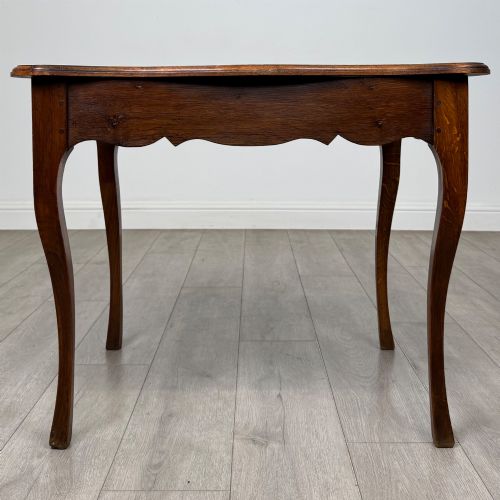
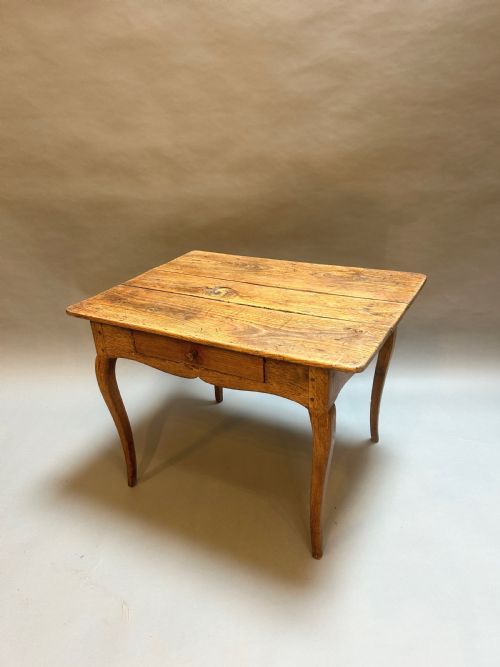


French Oak End Tables
French oak end tables bring sturdy utility and understated grain to a room, offering practical surface space rooted in continental craftsmanship.
French Oak End Tables
French oak end tables encompass side tables, occasional pieces, and bedside cabinets sourced from periods spanning the eighteenth century through to the early twentieth century. These low or compact surfaces bring practical utility to a room without dominating the floor space, often displaying regional character from provincial workshops.
Buyers browsing french oak end tables most frequently encounter side tables and occasional tables originating from the nineteenth and early twentieth centuries. Pieces range from austere rustic country designs to refined provincial interpretations bearing the distinct stamp of regional French cabinetmaking.
How they were made
Construction relies heavily on solid oak timbers, occasionally paired with secondary woods like pine or beech for internal framing and drawer construction. Workshops utilised traditional joinery methods to ensure stability, selecting dense timber suited to daily domestic service.
Metal elements such as brass or iron appear on handles, hinges, and structural brackets, providing functional contrast to the warm timber. Bleaching techniques and natural waxing accentuate the grain pattern without masking the inherent texture of the oak.
Current listings feature pieces spanning the 18th century, 19th century, Edwardian period, and 1920, constructed from oak, brass, iron, pine, beech, and hornbeam.
What varies in quality
The standard of timber selection and joinery execution largely separates standard utility items from finer provincial examples. Pieces featuring robust timber framing and minimal structural alteration retain greater integrity over centuries of use.
Proportion and surface finish further distinguish the work, where subtle hand-planing and period-appropriate hardware enhance the visual weight of the oak.
The French Oak End Tables Glossary
- Provincial
- Made in the regions outside Paris, typically displaying local stylistic quirks and sturdy, utilitarian construction. These pieces reflect the specific vernacular traditions of their distinct geographic origins.
- Occasional table
- A small, movable piece of furniture designed for specific, intermittent use rather than central placement in a room. Such tables provide convenient surfaces for lamps, books, or drinks.
- Bleached oak
- Timber treated with chemical agents to lighten its natural tone, a finish particularly common on continental side tables and cabinets. This process highlights the porous grain while softening the overall visual impact of the wood.
- Bedside cabinet
- A small enclosed storage unit positioned beside a sleeping berth, usually featuring a cupboard door or drawer. They combine concealed storage with a compact upper surface.
French Oak End Tables: Frequently Asked Questions
What periods do these tables span?
The selection spans from the eighteenth century through the nineteenth century and into the Edwardian era and early twentieth century. This timeline captures both formal provincial items and robust farmhouse iterations.
Earlier examples from the eighteenth century demonstrate hand-hewn joinery, while twentieth-century pieces often reflect simplified Arts and Crafts influences or regional provincial styles.
What materials are used alongside oak?
While oak forms the primary structural and visible timber, secondary woods like pine, beech, and hornbeam occasionally appear in concealed areas such as drawer linings or internal frames. Metal components including brass and iron are utilised for handles and structural hardware.
These complementary materials were chosen for their durability and functional strength, supporting the heavy oak framework without compromising the overall aesthetic.
How do I identify provincial styles?
Provincial furniture is characterised by simpler ornamentation and heavier proportions than Parisian work, reflecting the practical needs of regional households. Local craftsmen adapted urban trends using readily available native timbers.
Look for honest joinery, regional turning patterns, and utilitarian forms such as side tables and bedside cabinets designed for specific domestic tasks.
Where were these tables used?
These tables served practical roles across various rooms, functioning as bedside storage units, side tables in parlours, or auxiliary surfaces in kitchens and workrooms. Their compact footprints made them easily movable where extra surface space was required.
In modern interiors, they function effectively as end tables, providing practical tabletop space and storage while introducing historical texture.