

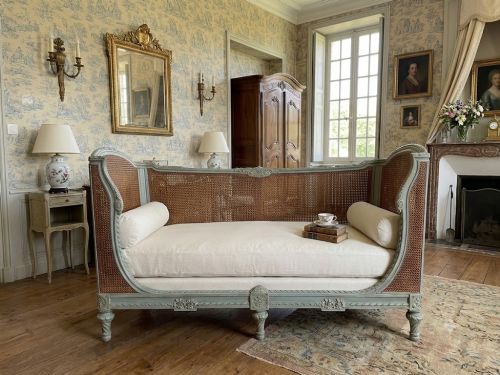


French Neoclassical Settee
A french neoclassical settee brings restrained classical lines and carved proportion to a room, offering both formal seating and architectural elegance.
French Neoclassical Settee
When you search for a french neoclassical settee, you are looking at seating forms shaped by 18th century taste and later revivals spanning the nineteenth and early twentieth centuries. These pieces encompass Louis XVI style sofas, French Empire revivals, and painted caned day beds that draw on classical antiquity.
The versions most likely to meet you on this page include giltwood frames, painted beech woodwork, and canework couches dating from the Edwardian period back to the eighteenth century. They appear as two seat sofas, triple back settees, and larger salon pieces designed for formal reception rooms.
How they were made
Makers shaped these frames primarily from solid timbers like beech and mahogany, alongside carved giltwood. Artisans applied cream paint and gilt finishes to the wooden structures to achieve the desired decorative surface.
Many examples incorporate woven cane panels for backs and seats, while others rely on traditional upholstery using fabric and linen. Metal elements such as ormolu mounts appear on Empire revival pieces, fixed directly to the mahogany frames.
French Neoclassical Settee Retail Price Guide 2026
Typical asking prices for french neoclassical settee among the pieces listed under this phrase on Sellingantiques today, from the lower quarter to the upper quarter. They describe what is for sale here now, not the wider market.
Several pieces feature caned backs that let the breeze through, proving that eighteenth-century designers understood indoor climate control.
What varies in quality
The standard of a settee rests on the crispness of the wood carving and the integrity of the structural joinery. Hand-carved giltwood and detailed ormolu mounts indicate a higher grade of craftsmanship than simpler painted softwood frames.
The survival and condition of original canework or traditional upholstery also determine the standing of a piece. Finer examples retain intact cane panels and well-proportioned frames that reflect the classical symmetry of the design.
The French Neoclassical Settee Glossary
- Giltwood
- Timber coated with gold leaf or a gold-coloured finish. This technique highlights the carved ornamentation on formal seating.
- Canework
- Woven cane material used to form breathable panels for backs and seats. It is found frequently on French painted day beds and settees.
- Ormolu
- Gilded bronze ornamentation applied to furniture. This material characterises French Empire revival pieces.
- Louis XVI Style
- A design aesthetic defined by straight lines, classical symmetry, and geometric forms. It contrasts with the flowing curves of earlier rococo work.
French Neoclassical Settee: Frequently Asked Questions
How do I identify a neoclassical settee?
Look for straight tapered legs, fluted columns, and symmetrical neoclassical motifs carved into the wood. These structural details separate the style from more curved earlier designs.
The use of giltwood, paint, and canework also points towards these classical French revival forms found across the nineteenth and early twentieth centuries.
Were these settees used in bedrooms?
Certain forms, such as caned day beds and smaller settees, served functional roles in private chambers and boudoirs as well as formal salons. Their lighter frames allowed for flexible placement within domestic spaces.
Larger triple back settees and salon suites remained primarily in reception rooms for entertaining guests.
Can I use a historic settee daily?
These pieces function well in modern interiors provided you respect their age and structural construction. Placing them away from direct heat sources protects the timber and original finishes.
Upholstered and caned surfaces benefit from gentle care to preserve the integrity of the materials over time.
What is the difference between Empire and Louis XVI styles?
Louis XVI style focuses on restrained classical proportions, straight lines, and light painted or gilt frames. It draws inspiration from ancient Greek and Roman architecture in a delicate manner.
Empire style, conversely, utilises heavier mahogany timbers and prominent ormolu mounts, reflecting the militaristic grandeur of the Napoleonic era.