



French Marble Inkwell
A french marble inkwell brings the weight of the nineteenth-century writing desk into a modern room, combining stone and metal with functional design.
French Marble Inkwell
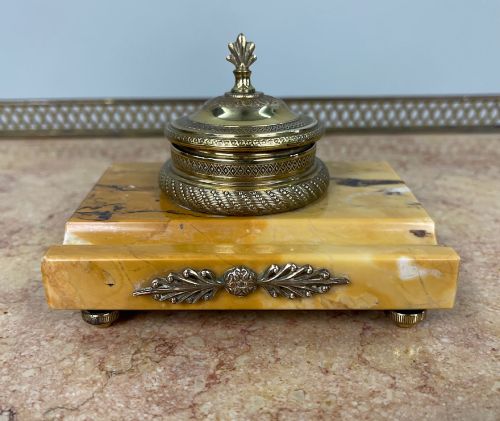
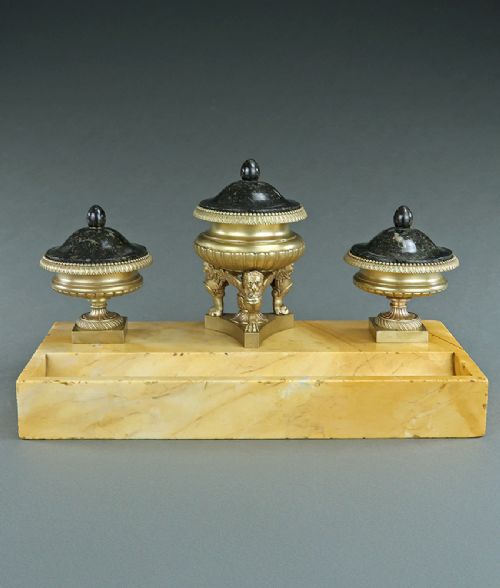
A french marble inkwell is a desk accessory designed to hold writing fluid, appearing in forms such as single inkwells, double inkwells, and larger desk sets. These pieces date across the nineteenth century, spanning periods from the early 1800s through to nineteen twenty, with many examples originating from around eighteen seventy.
Buyers will encounter various stylistic interpretations on this page, including French Empire, Neoclassical, Art Nouveau, and French Second Empire. The objects range from simple stands with brass and marble to elaborate architectural pieces featuring patinated or gilded bronze mounts.
The primary material foundation of these pieces relies on stone bases, specifically Sienna marble, green marble, vert marble, and onyx marble. Metal elements sit upon or mount these stones, creating functional desk accessories that doubled as decorative desk top ornaments.
Materials and construction
Makers shaped natural stone into heavy bases and reservoirs, employing varieties like Sienna and vert marble to provide a solid foundation for desk sets. These stone components were cut, smoothed, and fitted to receive metal mounts and ink containers.
Metals such as ormolu, gilt bronze, patinated bronze, and brass were cast and chased to create decorative mounts, figural elements, and lids. Craftspeople combined these cast metal components with the marble bases using pins, screws, or direct mounting techniques.
French Marble Inkwell Retail Price Guide 2026
Typical asking prices for french marble inkwell among the pieces listed under this phrase on Sellingantiques today, from the lower quarter to the upper quarter. They describe what is for sale here now, not the wider market.
The object forms on this page include desk sets, inkstands, desk accessories, and individual inkwells.
Judging quality
Quality in a french marble inkwell rests upon the crispness of the bronze casting and the precision of the marble cutting. Finer pieces display sharply detailed chasing in the ormolu or patinated bronze, whereas lesser examples show softer, generalized surface work.
The selection and integration of the stone also define the piece, with high-quality items using richly figured Sienna or green marble fitted seamlessly with their metal mounts. Weight, balance, and the proportion of metalwork to stone distinguish standard desk items from superior studio productions.
Lefebvre of Belgium·Albert Marionnet·Jules Dalou
The French Marble Inkwell Glossary
- Ormolu
- Gilded bronze produced by applying a finely ground gold-mercury amalgam to a bronze object and heating it. This technique creates a durable, golden surface common on nineteenth-century desk stands.
- Sienna marble
- A yellow-brown Italian marble marked by dark veining and rich colour variation. Makers utilised this stone for high-status neoclassical and empire desk accessories.
- Encrier
- A French term for an inkstand or inkwell. The word frequently appears in descriptions of nineteenth-century desk furniture.
- Patinated bronze
- Bronze that has been chemically treated to alter its surface colour and tone. This treatment darkens the metal to achieve antiqued brown or greenish finishes.
French Marble Inkwell: Frequently Asked Questions
What is a french marble inkwell?
A french marble inkwell is a nineteenth-century desk accessory that pairs a stone base with metal mounts, designed to hold ink for writing.
These objects range from compact single inkwells to larger desk sets featuring brass, bronze, or ormolu details.
How were these inkwells used?
They sat on writing desks to hold ink reservoirs and quill pens or early fountain pens for daily correspondence.
Many also functioned as decorative centrepieces for libraries and studies, reflecting the taste of the nineteenth-century interior.
How do I date a french marble inkwell?
Dating relies on the stylistic markers present in the bronze mounts and the choice of marble, alongside structural clues.
Periods represented on this page include the French Empire, Neoclassical, and Art Nouveau styles spanning the nineteenth and early twentieth centuries.
How do I care for marble and bronze?
Marble requires gentle cleaning with a dry or slightly damp cloth to avoid staining the porous stone surface.
Bronze and ormolu mounts should be kept free of dust without using abrasive metal polishes that can remove the historic surface finish.