


French Gold Religious Jewellery
French gold religious jewellery combines devotional devotion with delicate craftsmanship, offering small wearable works of art that collectors prize for their intricate metalwork and spiritual imagery.
French Gold Religious Jewellery
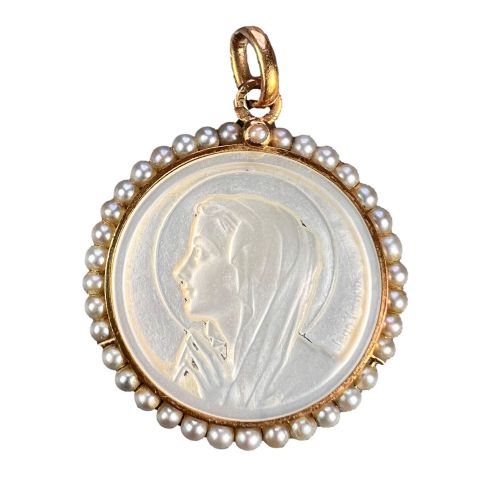
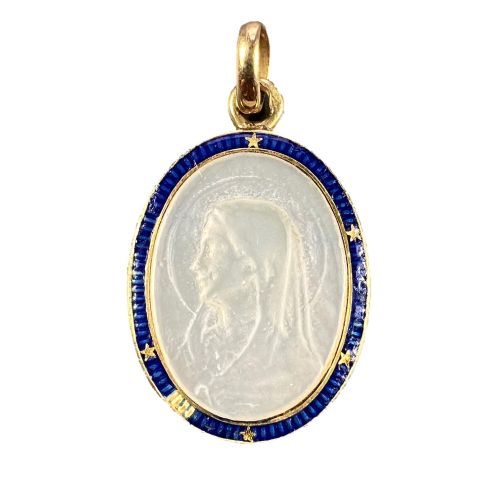
French gold religious jewellery consists primarily of pendants, medals, and charms made from various tones of yellow, rose, and white gold. These devotional pieces often depict figures such as the Virgin Mary, Madonna and Child, Saint Christopher, and various saints or sacred symbols like the Maltese Cross.
Buyers will most frequently encounter nineteenth- and early twentieth-century pieces spanning the Georgian, Victorian, Art Nouveau, and Art Deco periods. The forms range from simple engraved circular medals to elaborate multi-part pendants incorporating floral motifs and symbolic imagery.
Originating predominantly from French workshops and named designers, these items served personal, protective, or commemorative functions. Today, they remain sought after both for their historical association with French religious art and their refined decorative execution.
How they were made
Goldsmiths utilised 18-carat yellow, rose, and white gold as the primary structural metal, shaping the pieces through casting, stamping, and meticulous hand engraving. Surface details were often enhanced with applied borders, raised reliefs, and textural contrasts between polished and matte finishes.
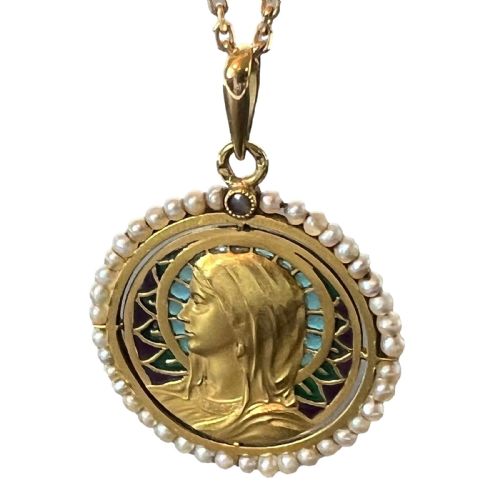
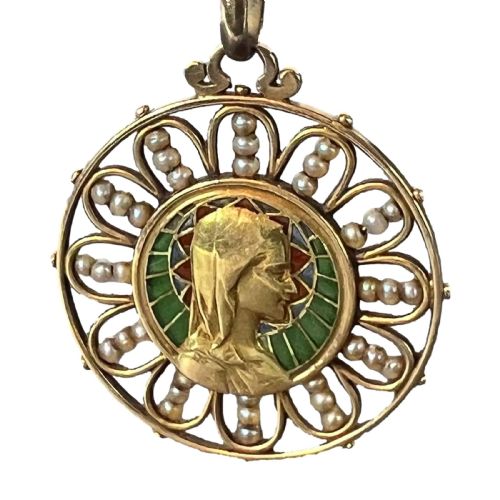
Colour and lustre were introduced through traditional decorative techniques such as enamel work, including translucent plique-a-jour enamel that allows light to pass through the design. Craftsmen also integrated organic materials like mother-of-pearl backgrounds, seed pearls, and occasional diamonds to accent the central devotional figures.
Among the sacred icons, a lone deer hunting horn charm hides quietly in the gold collection.
What varies in quality
The complexity and preservation of supplementary materials also determine overall standing. Pieces featuring intact plique-a-jour or polychrome enamel, secure seed pearl settings, and well-preserved mother-of-pearl panels demonstrate higher craftsmanship than simpler, plain metal stampings.
Emile Monier·Paul Brandt·Mazzoni·Pageli Perriat·Emile Dropsy·Guilbert·Vernon·Sellier·Rasumny·Ovide Yencesse·Tairac
The French Gold Religious Jewellery Glossary
- Plique-a-jour
- Enamelling technique where enamel is applied within a cellular framework without a backing, resembling miniature stained glass. This method allows light to illuminate the translucent colours.
- Medallion
- A large medal-like pendant, often oval or circular, featuring sculpted religious iconography. They were frequently worn on chains as personal talismans or devotional statements.
- Seed pearl
- Very small natural pearls used to accent borders or decorative motifs. They add a delicate, luminous texture to the surrounding goldwork.
- Maltese cross
- An eight-pointed cross symbolising various Christian virtues. In these pieces, it appears rendered in gold and enamel as a pendant or charm.
- Mother-of-pearl
- The iridescent inner layer of mollusc shells utilised as a backing material. It provides a shimmering, opalescent ground for applied gold figures.
French Gold Religious Jewellery: Frequently Asked Questions
What periods do these pieces come from?
The available items span from the Georgian era through the Victorian period, Art Nouveau, Art Deco, and into the mid-twentieth century.
Most examples cluster around the late nineteenth and early twentieth centuries, reflecting the height of French devotional medal production.
Who are the figures shown on the medals?
The most common subjects are the Virgin Mary, the Madonna and Child, and various patron saints like Saint Christopher and Saint John the Baptist.
Other representations include the Sacred Heart, holy doves, angels, and specific regional Marian titles such as Notre Dame of Lourdes.
How were these religious medals worn?
Historically, owners wore them suspended from chains around the neck as personal pendants, devotional amulets, or travel protectors.
They also appeared attached to charm bracelets or carried within pocket watch chains as private expressions of faith.