

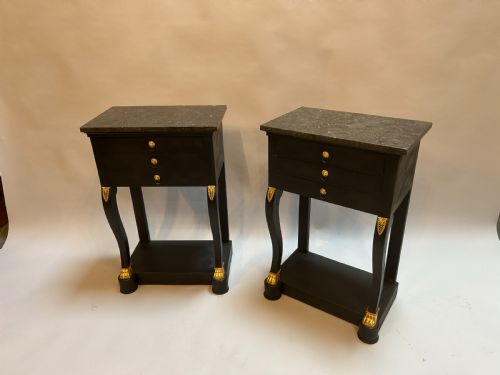


French Empire Pedestal Cabinet
These french empire pedestal cabinet pieces bring neoclassical symmetry and rich mahogany warmth to an interior, built for serious collectors.
French Empire Pedestal Cabinet
A french empire pedestal cabinet represents a distinct neoclassical form defined by vertical proportion, cylindrical or rectilinear carcasses, and classical restraint. These pieces serve primarily as bedside cabinets, side stands, or small display units that anchor a room with architectural presence.
The pieces appearing in this category span the nineteenth century alongside later revival periods up to nineteen twenty, reflecting both original classical output and subsequent interpretations. Surviving examples frequently emerge in pairs, particularly as bedside chests or stands intended to flank a bed or anchor architectural corners.
Makers and workshops across these periods adopted varied forms, ranging from hexagonal side tables and tambour door bedside cabinets to cylindrical display stands. Mahogany remains the dominant structural timber across these iterations, frequently paired with contrasting marble tops and metallic mounts.
Construction and Materials
Makers relied heavily on solid and veneered mahogany, sometimes enhanced by flame mahogany figuring or satinwood accents to provide visual depth on cylindrical and flat surfaces. Cabinet carcasses were constructed to support heavy inset marble tops, which required stable framing underneath to prevent warping.
Decoration relied on cast and chased ormolu, gilt metal, and brass mounts applied along corners, friezes, and drawer surrounds to accentuate the rectilinear and curved lines. Glass panels feature in specialised display cabinets, while tambour doors appear on select bedside pieces to conceal internal storage efficiently.
French Empire Pedestal Cabinet Retail Price Guide 2026
Typical asking prices for french empire pedestal cabinet among the pieces listed under this phrase on Sellingantiques today, from the lower quarter to the upper quarter. They describe what is for sale here now, not the wider market.
Markers of Quality
Superior examples separate themselves through the crispness of their ormolu or brass mounts and the quality of the timber selection, such as matched flame mahogany veneers. The weight and grade of the inset marble top, alongside the precision of joinery in curved tambour doors or cylindrical carcasses, dictate the tier of execution.
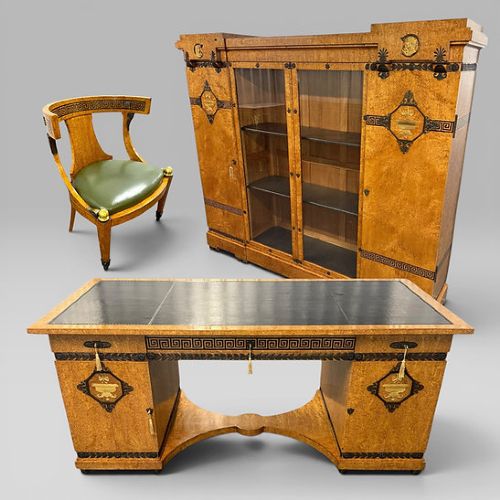
Maker attribution elevates certain office sets and cabinets, particularly when stamped or associated with documented workshops like Mercier Frères. The integration of structural hardware and the preservation of original gilding further distinguish higher-grade historical production from standard revival work.
Mercier Frères
The French Empire Pedestal Cabinet Glossary
- Ormolu
- Gilded bronze mounts applied to furniture. This technique imparts a rich metallic contrast against dark mahogany surfaces.
- Tambour
- A sliding door made of narrow vertical strips of wood glued to a canvas backing. This mechanism allows access to curved cabinet interiors without swinging doors.
- Flame mahogany
- Mahogany veneer exhibiting a distinctive flame-like grain pattern. Cabinetmakers prized this figure for prominent door and drawer fronts.
- Neoclassical
- A style reviving classical Roman and Greek motifs. It emphasises symmetry, proportion, and restrained architectural ornament.
French Empire Pedestal Cabinet: Frequently Asked Questions
How were these cabinets used historically?
Historically, these pieces served as bedside tables, washstand supports, or refined display pedestals for art objects.
Their compact vertical footprint allowed them to fit neatly into tight architectural spaces while providing enclosed storage.
How do I care for mahogany and marble?
Mahogany surfaces benefit from occasional waxing with traditional beeswax to maintain the timber lustre and prevent drying.
Marble tops require simple wiping with a damp cloth and immediate attention to acidic spills to protect the polished stone.
How can I tell the period?
Period identification relies on examining construction techniques, fastener types, wood ageing, and stylistic consistency with nineteenth-century or revival outputs.
Original hardware, hand-cut dovetails, and specific mount casting methods offer clear indicators of manufacture date.