


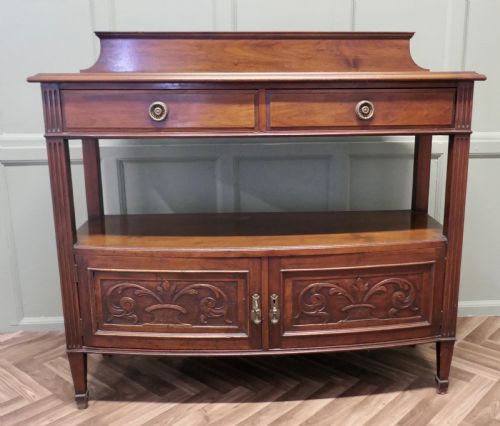


French Dining Room Cabinet
A French dining room cabinet brings genuine continental character to a home, offering substantial storage alongside timeless proportions.
French Dining Room Cabinet
A French dining room cabinet encompasses practical storage furniture designed for food preparation, service, and tableware storage, drawing from regional and formal traditions. When searching for a French dining room cabinet, buyers encounter diverse forms ranging from low buffets and sacristy cabinets to sophisticated credenzas and chiffoniers.
The selection spans centuries of design, featuring 18th-century French provincial oak pieces alongside 19th-century walnut creations and later 1930s interpretations. Regional pieces often lean toward French provincial styles, while formal urban workshops produced ornate Louis XV and Louis XVI revival iterations.
Makers utilised distinct regional aesthetics, shifting from rustic oak utility pieces to highly decorative burr walnut credenzas with mirrored backs. These cupboards serve equally well in modern dining spaces as statement sideboards or in hallways as grand storage cabinets.
How they were made
Cabinetmakers relied heavily on solid timber construction, selecting figured walnut, burr walnut, and robust oak for the primary carcases and doors. Parquetry tops and intricate carving demonstrate the high level of joinery skill applied to these dining room storage pieces.
Decorative embellishments frequently incorporated cast or gilt ormolu mounts, brass hardware, and delicate glass panels within mirrored back structures. Iron fittings provided structural reinforcement on earlier provincial examples, ensuring long-term durability for heavy daily use.
French Dining Room Cabinet Retail Price Guide 2026
Typical asking prices for french dining room cabinet among the pieces listed under this phrase on Sellingantiques today, from the lower quarter to the upper quarter. They describe what is for sale here now, not the wider market.
Sacristy cabinets once stored church linens before finding new life holding fine dining napkins.
What varies in quality
Quality rests upon the selection of timber veneers and the crispness of hand-carved details across the doors and panels. Superior examples exhibit tightly matched burr walnut figures and sophisticated parquetry geometric patterns.
The integration of original ormolu mounts and authentic brass hardware distinguishes standard utility pieces from higher-status exhibition grade furniture. Internal construction, including dovetailed drawer boxes and well-fitted timber shelving, also marks the distinction between workshop grades.
The French Dining Room Cabinet Glossary
- Credenza
- A sideboard or display cabinet originally developed in Italy and widely adopted in France for formal dining rooms. These pieces often feature glass doors or mirrored upper sections.
- Chiffonier
- A compact sideboard or low cabinet typically fitted with drawers and doors below a raised shelf. The form gained popularity during the nineteenth century for dining and drawing rooms.
- Ormolu
- Gilded bronze mounts applied to furniture for decorative effect. Master craftsmen chased the metal surfaces by hand before applying gold leaf.
- Parquetry
- Geometric wood inlay work arranged in patterns such as chequers or chevrons. Craftsmen used contrasting timber tones to create visual depth on table and cabinet tops.
- Burr Walnut
- Timber taken from the abnormal growth of a walnut tree, yielding swirling grain patterns. Cabinetmakers sliced this wood into thin veneers for high-status surfaces.
French Dining Room Cabinet: Frequently Asked Questions
How do I style a French dining room cabinet?
Pair the wooden tones with neutral walls to let the natural grain and carving take centre stage in the room.
Use the surface for serving during meals or display ceramic tableware and glassware above.
Can I use a credenza in a modern dining room?
These cabinets offer deep storage for modern dining accessories while introducing historical depth to contemporary interiors.
The varied internal shelving easily accommodates modern dinnerware and glassware.
What is the difference between a buffet and a credenza?
Buffets traditionally sit lower and focus purely on storage for food and service items within dining spaces.
Credenzas often incorporate display elements, glass panels, or mirrored backs suited for formal rooms.
How do I identify a provincial cabinet from a formal piece?
Provincial cabinets usually feature sturdy oak construction, simpler lines, and practical regional carving traditions.
Formal pieces utilise walnut veneers, ormolu mounts, and elaborate revival styles originating from urban workshops.