



French Crystal Glass Clock
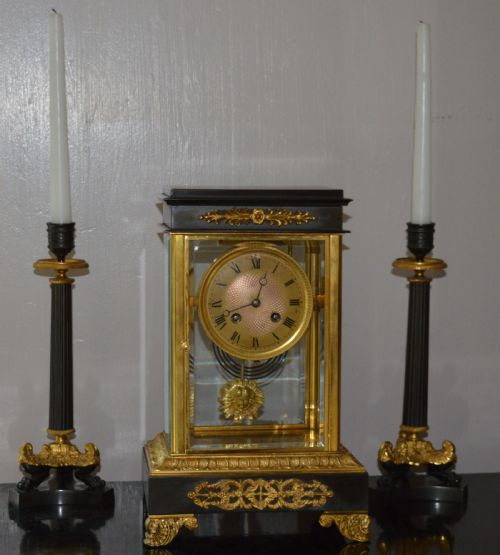
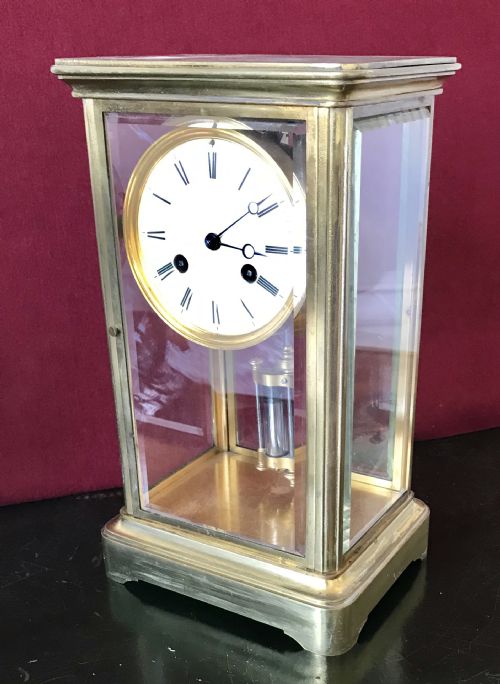
These french crystal glass clock examples combine heavy bevelled panels with brass frameworks to anchor a mantelpiece.
French Crystal Glass Clock
When you search for a french crystal glass clock, you are looking at timepieces that span periods from the nineteenth century into the twentieth, taking the form of mantel clocks and portico clocks. The evidence shows styles ranging through Charles X, Late Victorian, French Belle Epoque, and French Louis XVI Style, alongside the classic four glass and crystal regulator formats.
You are most likely to meet examples housed in brass, ormolu, or gilt brass frames fitted with transparent glass panels that reveal the internal movement. Many of these pieces incorporate decorative elements such as enamel panels and paste stones to embellish the dial or case.
The architectural forms vary from towering portico designs featuring cut crystal columns to upright regulator cases with oval or bow-fronted glass shapes. These variations reflect the changing tastes of French workshops across the decades from the 1870s up to the mid twentieth century.
Assessing quality and execution
The standard of a piece depends on the crispness of the brass or ormolu casting and the thickness and clarity of the bevelled glass panels. Heavier metal mounts and finely ground crystal indicate superior workshop production.
Detailing on the enamel dials and the presence of signed mechanical movements by recognised makers separate standard examples from finer specimens. The precision in the fit of the glass panes into the metal housing also marks the grade of construction.
French Crystal Glass Clock Retail Price Guide 2026
Typical asking prices for french crystal glass clock among the pieces listed under this phrase on Sellingantiques today, from the lower quarter to the upper quarter. They describe what is for sale here now, not the wider market.
Listings feature items spanning the Victorian era through the 1960s, constructed from brass, ormolu, and bevelled glass.
Breguet·Samuel Marti et Cie·L Epee France
The French Crystal Glass Clock Glossary
- Ormolu
- Gilded bronze or brass mounts used extensively in French clock cases. This technique gives the metal a rich, golden appearance.
- Crystal regulator
- A mantel clock featuring glass panels on all four sides allowing a clear view of the movement and swinging pendulum. These clocks often possess mercury-filled compensating pendulums.
- Portico clock
- An architectural clock style supported by columns resembling a classical portico. Charles X examples frequently utilise this balanced structural form.
- Bevelled glass
- Glass panes with angled edges cut and polished to a specific slope. This edge treatment adds refractive depth to the clock case.
French Crystal Glass Clock: Frequently Asked Questions
What is a french crystal glass clock?
These pieces are mantel and portico timepieces encased in transparent glass panels supported by brass or gilt metal frames. They were produced by various French workshops during the nineteenth and twentieth centuries.
The design allows light to pass through the case, showcasing the mechanical movement and pendulum from multiple angles. Styles range from strict architectural porticos to curved crystal regulators.
How do you wind a crystal regulator?
Winding requires opening the front or back glass door to access the arbors on the enamel dial using the correct key. Care must be taken not to overwind the mainspring.
The delicate glass panels mean that access should be gentle to avoid shifting the brass frame or stressing the glazed housing during maintenance.
Where should you place a four glass clock?
These clocks suit prominent mantelpieces, consoles, or tabletops where light can pass through the surrounding glass panes. A stable, level surface is essential for the pendulum to beat evenly.
Positioning them away from direct sunlight and heavy vibrations protects both the exterior metal finishes and the internal gear train.
How are different periods identified?
Periods are identified through stylistic cues such as the heavy neoclassical columns of Charles X portico pieces versus the sleeker brass frames of later crystal regulators. Maker signatures and dial typography also point to specific decades.
Materials provide further clues, as earlier nineteenth-century items often employ distinct ormolu casting styles compared to mid-twentieth-century productions.