

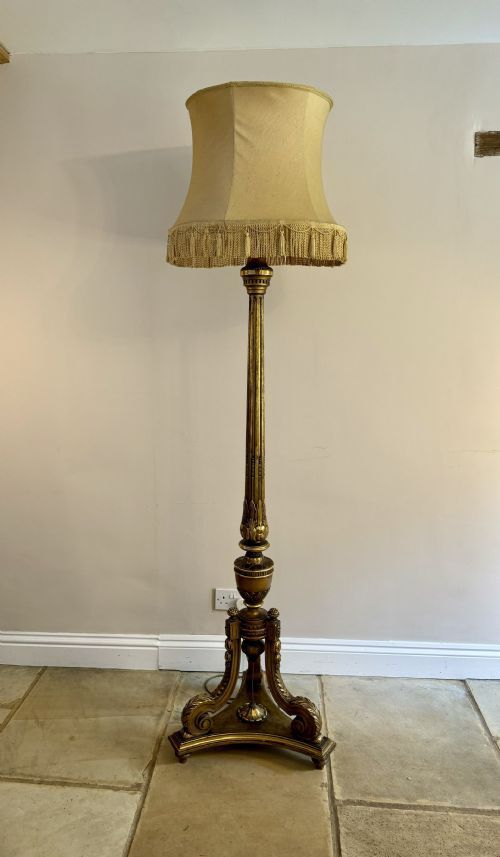


French Carved Standard Lamp
These French carved standard lamps bring genuine warmth and height to a room through centuries of decorative tradition.
French Carved Standard Lamp
A French carved standard lamp provides substantial vertical lighting while acting as a commanding decorative anchor in a reception room or study. These pieces take the form of tall floor-standing columns or boudoir lights designed to illuminate grand interiors with diffused ambient light.
The selections available here range from Victorian interpretations of French taste to Louis XVI revival pieces and Belle Epoque designs. Buyers frequently encounter giltwood and carved wooden shafts carrying fabric shades, alongside occasional onyx and ormolu variants from the nineteenth and early twentieth centuries.
How they were made
Craftsmen shaped these lamp bases from solid timber before applying layers of gesso to create crisp relief ornamentation. Artisans then finished the surfaces with gold leaf or gilding to achieve the characteristic reflective sheen associated with French chateau interiors.
Makers integrated brass and ormolu mounts to secure extending mechanisms or decorative collars on the column shafts. Fabric shades completed the construction, pairing with weighted bases to ensure stability for the tall wooden structures.
French Carved Standard Lamp Retail Price Guide 2026
Typical asking prices for french carved standard lamp among the pieces listed under this phrase on Sellingantiques today, from the lower quarter to the upper quarter. They describe what is for sale here now, not the wider market.
Some tall floor lamps feature extending brass columns, allowing them to adjust their height for maximum illumination.
What varies in quality
Quality rests upon the depth and crispness of the hand-carved detail across the wooden or giltwood shaft. Superior examples display sharp relief work where acanthus leaves, classical fluting and floral motifs remain distinct beneath the gold leaf.
The choice of materials further defines the tier of the piece, moving from standard giltwood timbers to sophisticated combinations involving onyx and cast ormolu. Structural integrity in extending mechanisms and the weight distribution of the base also separate standard production from exceptional studio work.
The French Carved Standard Lamp Glossary
- Giltwood
- Timber that has been coated with gold leaf or a thin layer of gold paint. This finish creates the bright, light-reflecting surface seen on classical revival furniture and lighting.
- Ormolu
- Gilded bronze ornamentation applied to decorative arts. It provides contrasting metallic detail against wood and onyx surfaces.
- Gesso
- A plaster-like mixture applied to wood bases before gilding. It provides a smooth, receptive ground for intricate carved details.
- Louis XVI Revival
- A decorative style drawing on eighteenth-century French royal aesthetics. It favours restrained classical symmetry, straight fluted columns and botanical motifs.
French Carved Standard Lamp: Frequently Asked Questions
Where should I place a standard lamp?
These tall floor lamps work best in corners or beside seating areas where their height can balance large pieces of furniture. They project ambient light upwards and outwards, softening dark corners in principal rooms.
Ensure the lamp stands on a stable floor surface away from heavy foot traffic to protect the tall wooden or giltwood shaft from accidental knocks.
How do I date an antique lamp?
Dating relies on stylistic clues such as revival motifs, the treatment of the carved wood, and the integration of materials like onyx or ormolu. Victorian and Edwardian examples often combine classical restraint with robust joinery.
Examine the construction methods and surface wear to align the piece with periods spanning from the mid-nineteenth century to the early twentieth century.
Are these lamps wired for modern use?
Most antique lighting has been rewired at various points in its long history to meet contemporary safety standards. Buyers should inspect the flex and bulb holder upon acquisition to ensure compatibility with modern electrical systems.
An electrician can easily update internal wiring without altering the exterior giltwood or carved wooden components of the standard lamp.
What styles are common in French lighting?
The dominant styles include Louis XVI revival, classical revival, baroque and neoclassical designs. These aesthetics emphasise symmetry, ornate carved foliage and architectural columns.
Pieces from the Belle Epoque era bring a lighter, more decorative French chateau sensibility to the traditional floor-standing format.