



French Cane Settee
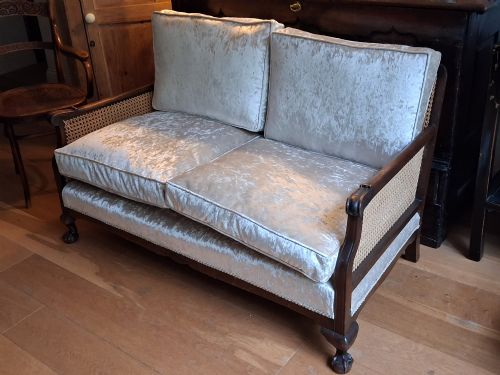
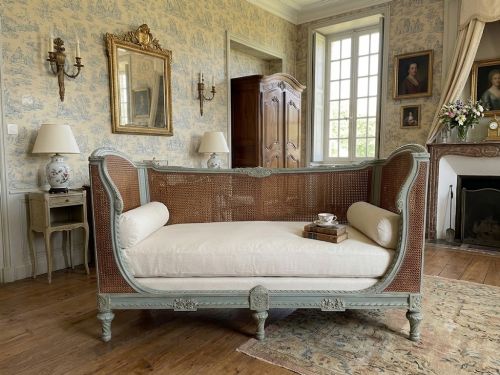
A french cane settee brings lightness and structure to a room, offering woven seating framed in timber across various period styles.
French Cane Settee
When you search for a french cane settee, you are looking at upholstered and woven seating that spans the eighteenth century through to the twentieth century. These seating options appear under descriptions such as canapés, bergères, day beds, and love seats.
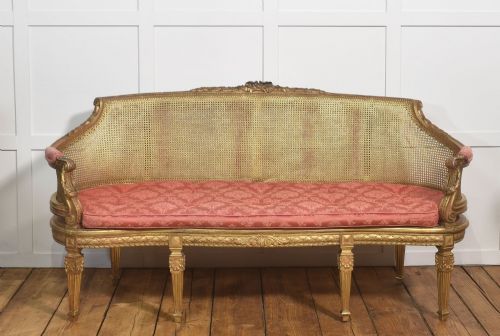
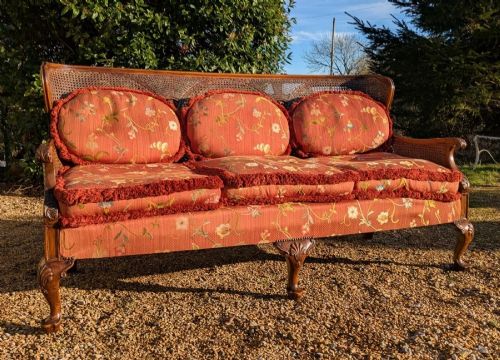
The versions you are most likely to meet on this page belong to the Louis XV and Louis XVI styles, alongside revival pieces from the nineteenth and early twentieth centuries. They range from small painted window seats to larger three-seater sofas with feather cushions.
Makers and craftsmen of these periods built them for salons and withdrawing rooms, employing timber frames to support intricate woven cane panels. Their forms vary from curved corbeille shapes to straight-lined revival frames.
What varies in quality
Quality rests in the precision of the timber carving and the tightness of the cane weaving across the frame. Finer examples display crisp detail in the giltwood or painted surfaces and well-balanced proportions in the arms and backrest.
The integrity of the original canework and the weight of the timber frame distinguish standard production from superior pieces. Stronger joinery and refined shaping separate the more ambitious workshop commissions from simpler domestic furniture.
French Cane Settee Retail Price Guide 2026
Typical asking prices for french cane settee among the pieces listed under this phrase on Sellingantiques today, from the lower quarter to the upper quarter. They describe what is for sale here now, not the wider market.
The selection includes various formats, ranging from two-seater bergère sofas and day beds to window seats and love seats.
The French Cane Settee Glossary
- Canapé
- An upholstered sofa or settee, often featuring exposed wood frames and woven cane panels. These pieces formed part of formal seating sets in period interiors.
- Bergère
- An enclosed upholstered armchair or sofa with solid sides, frequently incorporating cane work and loose seat cushions. They offer deeper seating than standard open chairs.
- Giltwood
- Timber coated with gold leaf or a gold-coloured finish to create a reflective surface. This treatment was common on high-status seating frames.
- Corbeille
- A basket-shaped furniture form with a rounded, curving back that wraps around the sitter. It appears frequently on French day beds and settees.
- Louis XVI Style
- A neoclassical design period characterised by straight lines, symmetry, and classical motifs such as fluting and ribbons. It contrasts with the earlier curved lines of the Louis XV style.
French Cane Settee: Frequently Asked Questions
How do I clean cane work?
Wipe the woven cane gently with a damp cloth to remove dust, avoiding excessive moisture that can weaken the natural fibres. Allow the material to dry completely in a well-ventilated space.
Condition the wood surrounding the cane with appropriate furniture wax, taking care not to let cleaning products soak into the open weave of the seat or back.
Can I reupholster a bergere sofa?
Loose cushions on these sofas can be recovered in new fabric to suit your interior scheme without altering the historic structure of the frame. Feather cushions often benefit from modern inner linings while retaining their original exterior covers if sound.
Consult a specialist upholsterer who understands traditional stitching and stuffing techniques to preserve the integrity of the piece.
How do I tell Louis XV from Louis XVI?
Louis XV pieces feature asymmetrical curves, cabriole legs, and flowing rococo ornamentation that softens the structural lines of the timber. The overall effect emphasises movement and organic shapes.
Louis XVI furniture introduces straight tapered legs, geometric symmetry, and neoclassical details such as fluting and carved rosettes, reflecting a shift towards classical restraint.
Where should I place a settee?
Position these settees in drawing rooms, bedrooms, or large hallways where the detailed carved frame and cane back remain visible from multiple angles. They function well as statement seating rather than heavy lounging furniture.
Keep the timber away from direct sunlight and strong heat sources to prevent the wood from drying out and the cane work from becoming brittle.