
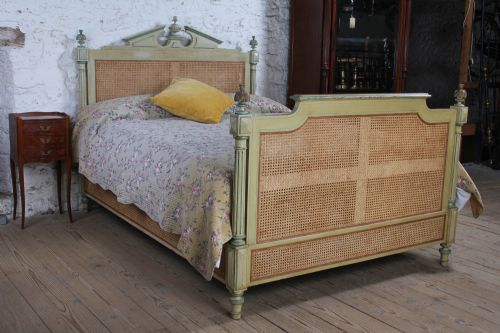
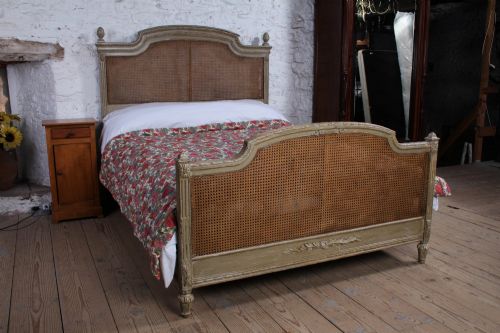


French Cane Bed Frame
A french cane bed frame brings structural lightness and classical proportion into a bedroom through woven panels set within timber.
French Cane Bed Frame
A french cane bed frame combines structural timber with woven panels, appearing in forms such as double, king size, and super king sizes. These pieces arrive from various periods, including the Victorian era, nineteen hundred, nineteen ten, and nineteen twenty.
The aesthetic draws heavily upon Louis XVI style, French chateau, and Art Deco traditions. Alongside standard bed frames, listings include broader bedroom suites featuring matching chairs, bedsides, and drawers.
Most examples rely on carved wood, beech, and painted finishes, sometimes enhanced with gold leaf. Natural cane and rattan form the woven components that define the characteristic texture of these bed frames.
How they were made
Construction relies upon carved wood and beech frameworks shaped into styles like Louis XVI revival and French neoclassical forms. Artisans integrated natural cane and rattan by weaving plant fibres through drilled holes or channels within the wooden rails.
Surfaces frequently received layers of paint or polychrome treatment, occasionally complemented by hand-painted portrait panels. Gilding with gold leaf added metallic highlights to carved mouldings and decorative crests.
Some beds come with hand-painted portrait panels, offering silent company from past centuries while you sleep.
What varies in quality
Differentiation lies in the crispness of the carved wood details and the precision of the woven cane panels. Earlier pieces from nineteen hundred often display deep relief carving compared to later iterations.
The sophistication of the finish shifts from plain painted wood to elaborate polychrome decoration and applied gold leaf. Inclusion of matching suite components like bedside cabinets elevates the coherence of the bedroom grouping.
The French Cane Bed Frame Glossary
- Cane
- A material woven from the outer skin of rattan palms to create a flexible, patterned mesh. It provides breathable panels for headboards and footboards.
- Louis XVI Style
- A classical design movement characterised by straight lines, symmetry, and restrained ornamentation. It draws on ancient Roman and Greek motifs.
- Polychrome
- A method of decorating wooden surfaces with multiple colours. This technique appears on painted bedroom furniture and portrait panels.
- Rattan
- A climbing palm native to tropical regions used to produce sturdy framing poles and pliable weaving material. The inner and outer portions serve different structural purposes.
- Gold Leaf
- Extremely thin sheets of beaten gold applied to wooden mouldings and frames. It creates a luminous, gilded surface finish.
French Cane Bed Frame: Frequently Asked Questions
How do I clean cane panels?
Wipe the woven surface gently using a damp cloth without soaking the natural fibres. Avoid harsh chemical cleaners that can dry out the rattan.
Keep the material conditioned by applying a light coat of boiled linseed oil occasionally. This maintains flexibility and prevents the cane from becoming brittle over time.
Will a standard mattress fit?
Dimensions vary because many pieces originate from different decades and locations. Check the specific width and length measurements provided for each frame.
Some larger configurations require bespoke mattress sizes or modified base supports. Confirm the internal dimensions before sourcing a mattress.
Are these frames sturdy?
Solid timber construction using beech provides a robust structural core for daily use. Joints are traditionally pinned and tenoned for stability.
Care should be taken when moving large headboards to avoid stressing the woven cane inserts. Proper assembly ensures the framework bears weight securely.
How do I date these beds?
Examine the timber species, hand-carved details, and style indicators like Louis XVI revival motifs. Stylistic markers often align with periods such as nineteen ten or nineteen twenty.
Construction methods such as the gauge of the cane and the type of paint finish offer further chronological clues. Archive records and historical design traits help confirm the era.